Atoms
From Thomson's model to Bohr's quantized orbits — understanding atomic structure and spectra
Table of Contents
12.1 Introduction
By the nineteenth century, enough evidence had accumulated in favour of atomic hypothesis of matter. In 1897, the experiments on electric discharge through gases carried out by J.J. Thomson revealed that atoms of different elements contain negatively charged constituents (electrons) that are identical for all atoms. However, atoms on a whole are electrically neutral. Therefore, an atom must also contain some positive charge to neutralise the negative charge of the electrons.
12.2 Thomson's Model
Thomson proposed the "plum pudding" model: electrons are embedded in a uniformly distributed positive charge sphere, like plums in a pudding. This model could not explain the results of Rutherford's later experiments.
12.3 Rutherford's Nuclear Model
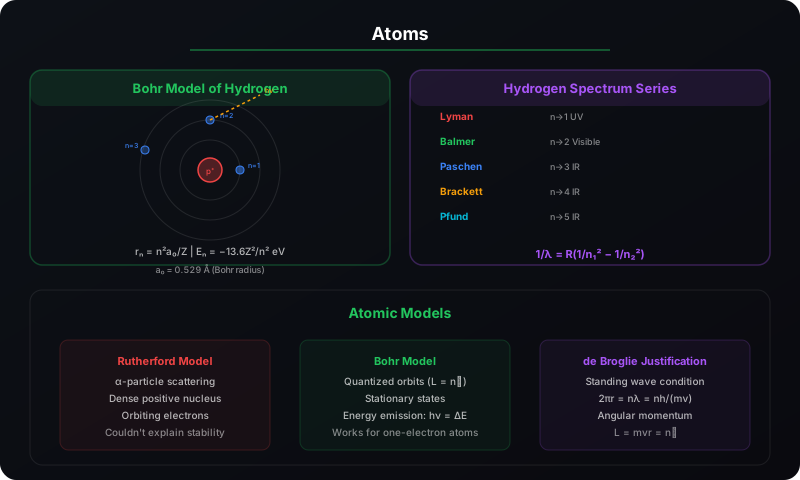
Rutherford's α-particle scattering experiment led to the nuclear model of the atom:
- Most α-particles passed straight through (most of atom is empty space)
- Some were deflected at large angles (positive charge concentrated in small nucleus)
- A few bounced back (mass concentrated in nucleus)
According to classical electrodynamics, an accelerating charge radiates energy. An orbiting electron would lose energy, spiral into the nucleus, and the atom would collapse in ~10⁻¹¹ s. But atoms are stable!
12.4 Bohr's Model of Hydrogen
Niels Bohr (1913) postulated a model that explained atomic stability and spectra:
- Stationary states: Electrons orbit in specific allowed orbits without radiating
- Quantization: Angular momentum L = mvr = nℏ (n = 1, 2, 3, ...)
- Energy emission:
12.5 Hydrogen Spectrum
The spectral lines of hydrogen are explained by transitions between energy levels:
Lyman Series
n₁ = 1. Ultraviolet region. All lines converge to 91.2 nm limit.
Balmer Series
n₁ = 2. Visible region (400-700 nm). First observed series.
Paschen Series
n₁ = 3. Infrared region. Lines beyond visible spectrum.
Brackett & Pfund
n₁ = 4, 5. Far infrared. Used in astronomical observations.
12.6 de Broglie's Explanation
de Broglie explained Bohr's quantization condition using the wave nature of electrons. An electron in a circular orbit must form a standing wave: