Nuclei
Nuclear structure, binding energy, radioactivity, and nuclear reactions
Table of Contents
13.1 Introduction
In every atom, the positive charge and mass are densely concentrated at the centre of the atom forming its nucleus. The overall dimensions of a nucleus are much smaller than those of an atom. Experiments on scattering of α-particles demonstrated that the radius of a nucleus was smaller than the radius of an atom by a factor of about 10⁴. This means the volume of a nucleus is about 10⁻¹² times the volume of the atom.
13.2 Nuclear Structure
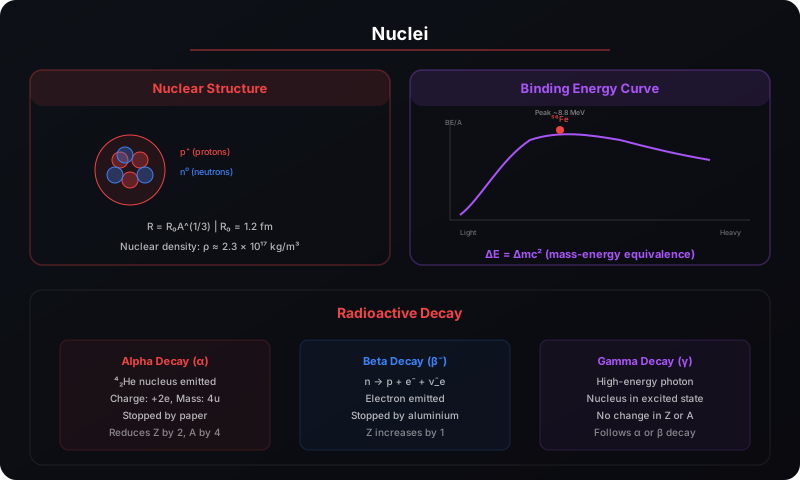
The nucleus consists of protons and neutrons (collectively called nucleons):
13.3 Mass-Energy Equivalence
Einstein's mass-energy equivalence relates mass and energy:
13.4 Nuclear Binding Energy
Binding energy is the energy required to separate a nucleus into its constituent nucleons:
Light nuclei (A < 30) have lower BE/A. BE/A increases, peaks at ⁵⁶Fe, then slowly decreases. This explains why fission of heavy nuclei and fusion of light nuclei both release energy.
13.5 Nuclear Force
The nuclear force is the strong attractive force that holds nucleons together:
- Strongest force in nature (100× stronger than electromagnetic)
- Short range (~2 fm) — acts only between adjacent nucleons
- Charge-independent (p-p, n-n, p-n forces are nearly equal)
- Saturates — each nucleon interacts only with nearest neighbors
13.6 Radioactive Decay
Radioactivity is the spontaneous emission of radiation from unstable nuclei:
13.7 Nuclear Fission and Fusion
Nuclear Fission
Heavy nucleus splits into lighter fragments. ²³⁵U + n → ¹⁴¹Ba + ⁹²Kr + 3n. Chain reaction. Used in nuclear reactors and bombs.
Nuclear Fusion
Light nuclei combine to form heavier nucleus. 4¹H → ⁴He + 2e⁺ + 2ν_e + energy. Powers the Sun. Requires extreme temperature (~10⁷ K).