Dual Nature of Radiation and Matter
From photoelectric effect to de Broglie waves — light and matter show both wave and particle character
Table of Contents
11.1 Introduction
Maxwell's equations of electromagnetism and Hertz's experiments on the generation and detection of electromagnetic waves in 1887 strongly established the wave nature of light. Towards the same period at the end of 19th century, experimental investigations on conduction of electricity through gases at low pressure led to many historic discoveries — including the discovery of X-rays by Roentgen in 1895, and of electron by J.J. Thomson in 1897.
11.2 Electron Emission
Electrons in a metal are bound by the work function energy. They can be emitted from the metal surface by providing sufficient energy:
- Thermionic emission: Heating the metal provides thermal energy
- Field emission: Strong electric field pulls electrons out
- Photoelectric emission: Light of sufficient frequency ejects electrons
- Secondary emission: High-energy electrons strike the surface
11.3 Photoelectric Effect
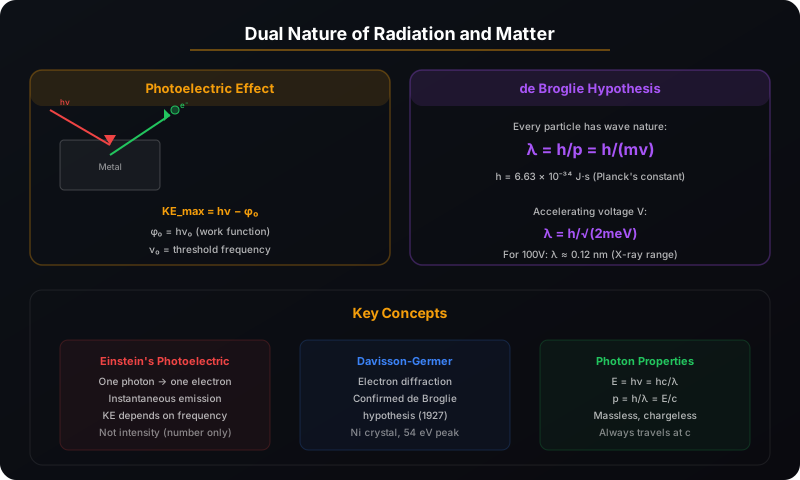
The photoelectric effect is the emission of electrons when light of sufficient frequency shines on a metal surface. Key observations that classical wave theory could not explain:
- There exists a threshold frequency ν₀ below which no emission occurs, regardless of intensity
- KE of emitted electrons depends on frequency, not intensity
- Emission is instantaneous (no time lag), even at low intensity
- Number of electrons is proportional to intensity (at constant frequency)
11.4 Einstein's Photoelectric Equation
Einstein explained the photoelectric effect using Planck's quantum hypothesis. A single photon transfers its entire energy to a single electron:
The minimum negative (retarding) potential V₀ needed to stop the most energetic photoelectrons: eV₀ = KE_max = hν − φ₀. The graph of V₀ vs ν is a straight line with slope h/e.
11.5 Particle Nature of Light: Photons
Light consists of quanta called photons, each carrying energy E = hν and momentum p = h/λ:
11.6 Wave Nature of Matter
de Broglie proposed that just as radiation has particle-like properties, material particles have wave-like properties:
11.7 Davisson-Germer Experiment
The Davisson-Germer experiment (1927) confirmed the wave nature of electrons by observing electron diffraction from a nickel crystal:
- Electrons accelerated through 54 V showed a diffraction peak at 50°
- Experimental wavelength matched de Broglie prediction: λ = 0.165 nm
- This provided direct evidence for the wave nature of matter