Wave Optics
Light as a wave — interference, diffraction, and polarisation phenomena
Table of Contents
10.1 Introduction
In 1637 Descartes gave the corpuscular model of light and derived Snell's law. It explained the laws of reflection and refraction of light at an interface. However, the corpuscular model could not explain phenomena like interference, diffraction, and polarisation — which require the wave nature of light.
10.2 Huygens' Principle
Huygens' principle states that every point on a wavefront acts as a source of secondary wavelets. The new wavefront is the tangential surface (envelope) of all these secondary wavelets.
- Each point on the wavefront becomes a source of secondary wavelets
- Secondary wavelets spread out in all directions with speed of light
- The new wavefront is the forward envelope of secondary wavelets
- Explains rectilinear propagation, reflection, and refraction
10.3 Refraction Using Huygens' Principle
Huygens' principle explains Snell's law of refraction. When a wavefront passes from one medium to another with different speed, the secondary wavelets travel at different speeds, causing the wavefront to bend.
10.4 Young's Double Slit Experiment
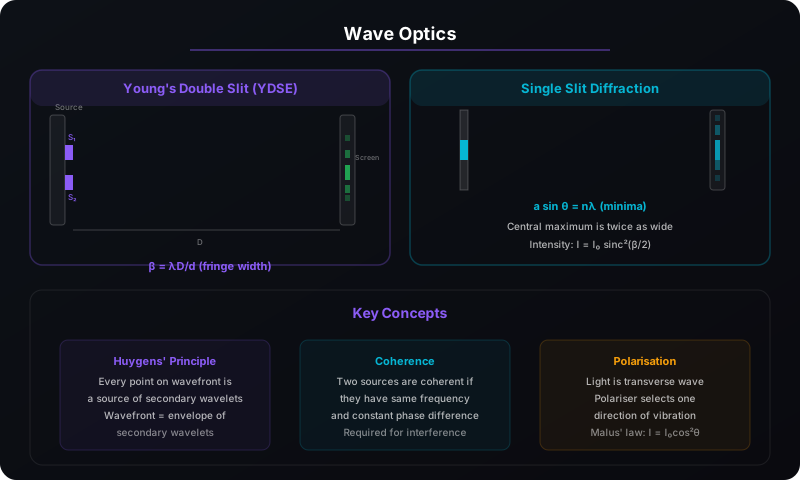
Young's double slit experiment (YDSE) provides definitive evidence of the wave nature of light through interference:
- Bright fringes: Path difference = nλ (constructive interference)
- Dark fringes: Path difference = (n+½)λ (destructive interference)
- Fringes are equally spaced and parallel to the slits
- Fringe width increases with wavelength (violet → red)
10.5 Interference of Light
Interference occurs when two coherent waves superpose. The resultant intensity depends on the phase difference:
10.6 Diffraction of Light
Diffraction is the bending of light around obstacles and through apertures. In single slit diffraction:
Interference: Superposition of waves from two coherent sources. All bright fringes have equal intensity.
Diffraction: Superposition of waves from different parts of the same wavefront. Central maximum is brightest, secondary maxima decrease in intensity.
10.7 Polarisation
Polarisation proves that light is a transverse wave. A polariser selects only one direction of vibration: