Systems of Particles & Rotational Motion
From centre of mass to moment of inertia — the physics of extended bodies
Table of Contents
- Introduction
- Centre of Mass
- Motion of Centre of Mass
- Linear Momentum of a System of Particles
- Vector Product of Two Vectors
- Angular Velocity and its Relation with Linear Velocity
- Torque and Angular Momentum
- Equilibrium of a Rigid Body
- Moment of Inertia
- Kinematics of Rotational Motion about a Fixed Axis
- Dynamics of Rotational Motion about a Fixed Axis
- Angular Momentum in Case of Rotation about a Fixed Axis
6.1 Introduction
In the earlier chapters we primarily considered the motion of a single particle. Any real body which we encounter in daily life has a finite size. In dealing with the motion of extended bodies often the idealised model of a particle is inadequate. An extended body is a system of particles.
A rigid body is a body with a perfectly definite and unchanging shape. The distances between all pairs of particles of such a body do not change. The motion of a rigid body which is not pivoted or fixed in some way is either a pure translation or a combination of translation and rotation.
6.2 Centre of Mass
The centre of mass of a system of particles is the point where the entire mass of the system can be assumed to be concentrated for describing its translational motion.
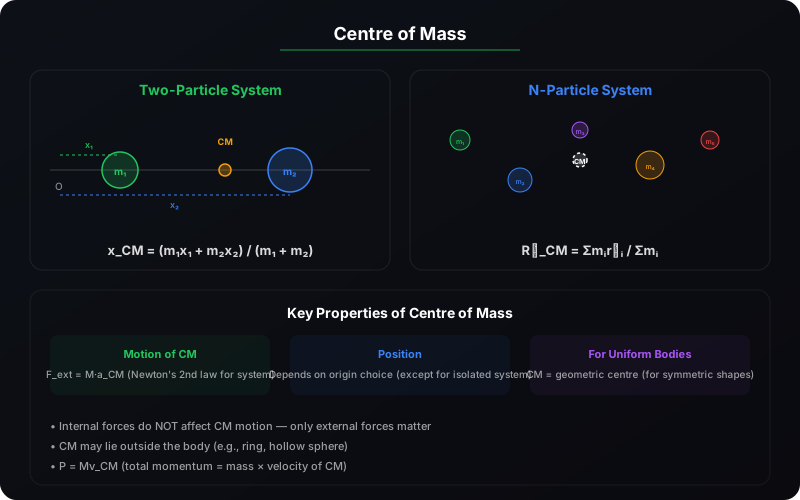
- For two particles: x_CM = (m₁x₁ + m₂x₂)/(m₁ + m₂)
- For continuous bodies: R⃗_CM = (1/M) ∫ r⃗ dm (integration over the body)
- Symmetric bodies: CM at geometric centre (uniform rod, disc, sphere)
- CM may lie outside: e.g., ring, hollow sphere, crescent-shaped bodies
6.3 Motion of Centre of Mass
The motion of the centre of mass of a system of particles is governed by Newton's second law applied to the system as a whole:
Internal forces (between particles of the system) do NOT affect the motion of the centre of mass. Only external forces matter. This is why a firecracker explodes — internal forces change the relative motion but the CM continues on its original parabolic trajectory.
The total linear momentum of the system is: P⃗ = Mv⃗_CM = Σmᵢv⃗ᵢ. This connects the system's total momentum to the CM velocity.
6.4 Linear Momentum of a System of Particles
The total linear momentum of a system of particles equals the total mass times the velocity of the centre of mass:
If no external force acts on the system, P⃗ is constant (conservation of momentum). The CM moves with constant velocity in this case.
6.5 Vector Product of Two Vectors
The vector product (cross product) of two vectors A⃗ and B⃗ produces a new vector C⃗ perpendicular to both:
- Right-hand rule: Curl fingers from A⃗ to B⃗, thumb points in direction of A⃗ × B⃗
- Anticommutative: A⃗ × B⃗ = −B⃗ × A⃗
- Distributive: A⃗ × (B⃗ + C⃗) = A⃗ × B⃗ + A⃗ × C⃗
- Parallel vectors: A⃗ × B⃗ = 0 if A⃗ ∥ B⃗
6.6 Angular Velocity and its Relation with Linear Velocity
For a particle moving in a circle of radius r with speed v, the angular velocity ω is:
All points on a rigid body rotating about a fixed axis have the same angular velocity ω. However, their linear velocities differ: v = rω, where r is the perpendicular distance from the axis.
6.7 Torque and Angular Momentum
Torque is the rotational analogue of force. It measures how effectively a force causes rotation about an axis.

τ⃗ = dL⃗/dt — The net external torque equals the rate of change of angular momentum. When τ_ext = 0, angular momentum L is conserved.
6.8 Equilibrium of a Rigid Body
A rigid body is in mechanical equilibrium when both the net external force and net external torque are zero:
Translational Equilibrium
F⃗_ext = 0 → a_CM = 0. No net force, no acceleration of CM.
Rotational Equilibrium
τ⃗_ext = 0 → α = 0. No net torque, no angular acceleration.
Both conditions must be satisfied simultaneously for complete equilibrium.
6.9 Moment of Inertia
Moment of inertia (I) is the rotational analogue of mass. It measures the resistance of a body to changes in its rotational motion.
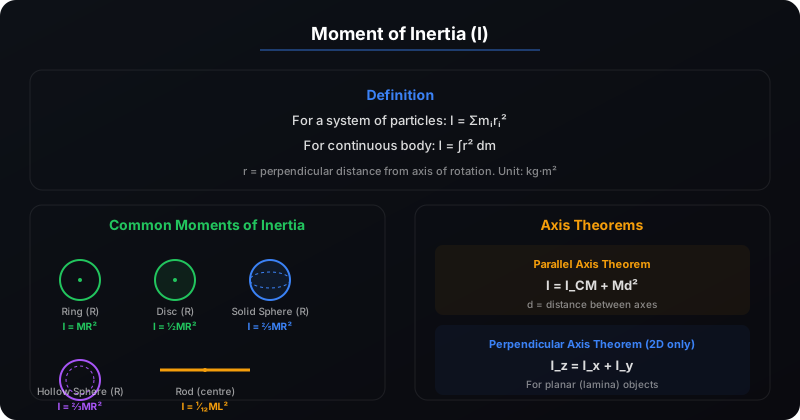
Parallel Axis Theorem
Perpendicular Axis Theorem (2D only)
6.10 Kinematics of Rotational Motion about a Fixed Axis
The kinematic equations for rotational motion about a fixed axis are direct analogues of the translational equations:

| Translational | Rotational | Relation |
|---|---|---|
| Displacement x | Angular displacement θ | x = rθ |
| Velocity v | Angular velocity ω | v = rω |
| Acceleration a | Angular acceleration α | a = rα |
| Mass m | Moment of inertia I | I = Σmr² |
| Force F | Torque τ | τ = rF sin θ |
6.11 Dynamics of Rotational Motion about a Fixed Axis
Newton's second law for rotation relates torque to angular acceleration:
The work done by a torque is: W = ∫ τ dθ. The rotational kinetic energy is: K_rot = ½Iω². For a body rolling without slipping: K_total = ½mv² + ½Iω² = ½(m + I/R²)v².
6.12 Angular Momentum in Case of Rotation about a Fixed Axis
For a rigid body rotating about a fixed axis with angular velocity ω:
If no external torque acts: L = Iω = constant. When I decreases, ω increases (and vice versa). Examples: ice skater pulling arms in, diver tucking during somersault, satellite orbiting Earth.
Ice Skater
Arms extended → I large, ω small. Arms pulled in → I small, ω large. L stays constant.
Neutron Star
When a massive star collapses, its radius decreases dramatically. I decreases, so ω increases — forming a rapidly spinning pulsar.