Gravitation
From falling apples to orbiting planets — the universal force that shapes the cosmos
Table of Contents
7.1 Introduction
Early in our lives, we become aware of the tendency of all material objects to be attracted towards the Earth. Anything thrown up falls down towards the Earth, going uphill is lot more tiring than going downhill, raindrops from the clouds above fall towards the Earth and there are many other such phenomena.
Historically it was the Italian Physicist Galileo (1564-1642) who recognised the fact that all bodies, irrespective of their masses, are accelerated towards the Earth with a constant acceleration.
7.2 Kepler's Laws
Johannes Kepler (1571-1640) formulated three elegant laws from Tycho Brahe's observations of planetary motions:
1. Law of Orbits: All planets move in elliptical orbits with the Sun situated at one of the foci of the ellipse.
2. Law of Areas: The line that joins any planet to the Sun sweeps equal areas in equal intervals of time.
3. Law of Periods: The square of the time period of revolution of a planet is proportional to the cube of the semi-major axis of the ellipse traced out by the planet.
The Law of Areas is a consequence of conservation of angular momentum. Since the gravitational force is a central force (directed along the line joining the Sun and planet), the torque about the Sun is zero, and hence angular momentum is conserved.
7.3 Universal Law of Gravitation
Newton's universal law of gravitation states that every particle of matter in the universe attracts every other particle with a force that is directly proportional to the product of their masses and inversely proportional to the square of the distance between their centres.
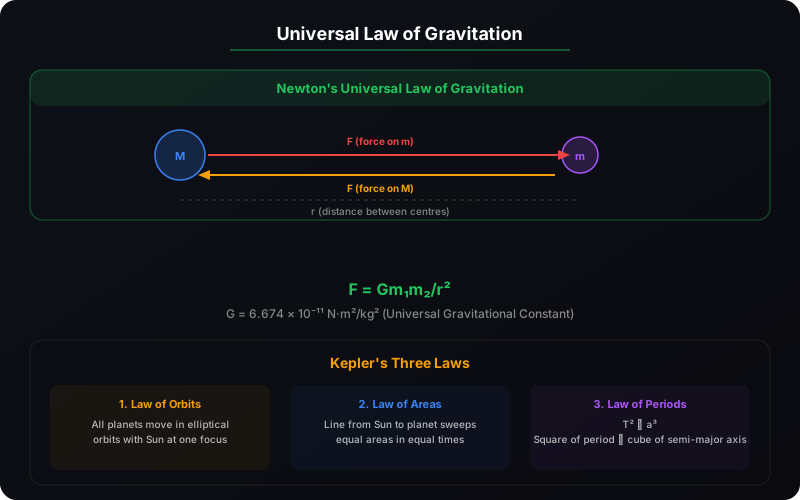
- Mutual force: Both masses experience equal and opposite forces (Newton's Third Law)
- Always attractive: Gravitational force is always attractive, unlike electromagnetic force
- Valid for all: Applies to all masses — atoms, planets, galaxies
- Superposition: Net force on a mass due to multiple masses is the vector sum of individual forces
7.4 The Gravitational Constant
The value of G was measured by Henry Cavendish in 1798 using a sensitive torsion balance. The experiment is known as the Cavendish experiment and is sometimes called "weighing the Earth."
The gravitational force is the weakest of the four fundamental forces. For two 1 kg masses 1 m apart, the gravitational force is only about 6.67 × 10⁻¹¹ N — incredibly tiny! Yet it governs the motion of galaxies because gravity is always attractive and acts over infinite range.
7.5 Acceleration Due to Gravity of the Earth
The acceleration produced in a body due to the gravitational force of the Earth is called acceleration due to gravity, denoted by g.
The value of g varies from place to place on Earth's surface. It is slightly more at the poles and slightly less at the equator due to Earth's rotation and its oblate shape.
7.6 Acceleration Due to Gravity Below and Above the Surface
The value of g changes with height above or depth below the Earth's surface:
Above Surface (h)
g' = GM/(R+h)² = gR²/(R+h)²
Decreases with height. At h = R, g' = g/4.
Below Surface (d)
g' = g(1 − d/R) = g(R−d)/R
Decreases linearly with depth. At centre, g' = 0.
Inside a uniform spherical shell of matter, the net gravitational force on a particle is zero (Shell Theorem). This is why g decreases inside the Earth — only the mass interior to your depth contributes to gravity.
7.7 Gravitational Potential Energy
The gravitational potential energy of a mass m at a distance r from the centre of a mass M is:

Near the Earth's surface (h ≪ R), this simplifies to the familiar U = mgh. The negative sign indicates that the system is bound — work must be done to separate the masses to infinity.
7.8 Escape Speed
The escape speed is the minimum speed with which a body must be projected vertically upward from the surface of a planet so that it escapes the gravitational field of the planet.
Escape speed is independent of the mass of the body, the direction of projection (as long as it doesn't hit the ground), and the location from where it is projected. For Earth: v_e ≈ 11.2 km/s. For Moon: v_e ≈ 2.4 km/s.
7.9 Earth Satellites
A satellite is a body which revolves around a planet in a circular orbit. The orbital speed, time period, and other parameters depend on the orbital radius.
Orbital Speed
v₀ = √(GM/r) = √(gR²/r)
v₀ = v_e/√2 ≈ 7.9 km/s for LEO
Time Period
T = 2π√(r³/GM)
T ≈ 84 min for LEO, 24 h for GEO
Geostationary Satellites
A geostationary satellite orbits the Earth with a time period of 24 hours at an altitude of approximately 36,000 km above the equator. It appears stationary relative to the Earth's surface. Used for communication and weather monitoring.
7.10 Energy of an Orbiting Satellite
The total mechanical energy of a satellite orbiting at radius r:
The binding energy is the energy required to remove a satellite from its orbit to infinity: E_bind = GMm/(2r) = ½mv₀². This equals the kinetic energy of the satellite!
As r increases: kinetic energy decreases (v decreases), potential energy increases (less negative), total energy increases (less negative). A satellite in a higher orbit has more total energy but moves slower.