Work, Energy & Power
The interplay between force, displacement, energy, and the rate at which energy is transferred
Table of Contents
5.1 Introduction
The terms 'work', 'energy' and 'power' are frequently used in everyday language. A farmer ploughing the field, a construction worker carrying bricks, a student studying for a competitive examination, an artist painting a beautiful landscape, all are said to be working. In physics, however, the word 'Work' covers a definite and precise meaning.
Before we proceed to this task, we need to develop a mathematical prerequisite, namely the scalar product of two vectors.
The Scalar Product
The scalar product or dot product of any two vectors A and B, denoted as A·B, is defined as:
- Commutative: A⃗ · B⃗ = B⃗ · A⃗
- Distributive: A⃗ · (B⃗ + C⃗) = A⃗ · B⃗ + A⃗ · C⃗
- Perpendicular vectors: A⃗ · B⃗ = 0 if θ = 90°
- Component form: A⃗ · B⃗ = AxBx + AyBy + AzBz
5.2 Notions of Work and Kinetic Energy: The Work-Energy Theorem
Consider rectilinear motion under constant acceleration a: v² − u² = 2as. Multiplying both sides by m/2:
This provides a motivation for the definitions of work and kinetic energy. The left side is the difference in the quantity 'half the mass times the square of the speed' from its initial value to its final value. We call each of these quantities the kinetic energy, denoted by K. The right side is a product of the displacement and the component of the force along the displacement. This quantity is called work and is denoted by W.
The change in kinetic energy of a particle is equal to the work done on it by the net force.
5.3 Work
The work done by a force is defined to be the product of component of the force in the direction of the displacement and the magnitude of this displacement.

When is Work Zero?
- Displacement is zero: A weightlifter holding a 150 kg mass steadily for 30 s does no work on the load.
- Force is zero: A block moving on a smooth horizontal table is not acted upon by a horizontal force.
- Force ⊥ displacement: For θ = 90°, cos(90°) = 0. The centripetal force in circular motion does no work!
Positive and Negative Work
Positive Work (0 ≤ θ < 90°)
Force has a component along displacement. Energy is transferred TO the object.
Negative Work (90° < θ ≤ 180°)
Force has a component opposite to displacement. Energy is transferred FROM the object.
5.4 Kinetic Energy
If an object of mass m has velocity v, its kinetic energy K is:
Kinetic energy is a scalar quantity. The kinetic energy of an object is a measure of the work an object can do by virtue of its motion. It is always positive and depends on the reference frame (velocity is frame-dependent).
5.5 Work Done by a Variable Force
When the force varies with position, we can calculate the work done by dividing the displacement into small segments where the force is approximately constant, then summing (integrating):
The work done by a variable force F(x) as a particle moves from x₁ to x₂ is the area under the force-position curve between those limits. If F is constant, this reduces to W = F(x₂ − x₁) = Fd.
5.6 The Work-Energy Theorem for a Variable Force
The work-energy theorem holds even for variable forces. We have already seen this for constant forces. For variable forces, we use the integral form:
The work-energy theorem for a variable force is thus valid for any force (conservative or non-conservative). It states that the total work done on a particle equals the change in its kinetic energy, regardless of whether the force is constant or variable.
5.7 The Concept of Potential Energy
A conservative force is one for which the work done is independent of the path and depends only on the initial and final positions. Examples: gravitational force, electrostatic force, spring force.
Gravitational Potential Energy
Non-Conservative Forces
Forces like friction, air resistance, and viscous drag are non-conservative. The work done by these forces depends on the path taken. They dissipate mechanical energy into thermal energy (heat).
When only conservative forces do work, total mechanical energy (K + U) is conserved. When non-conservative forces (like friction) do work, mechanical energy is NOT conserved — it converts to heat, sound, etc.
5.8 The Conservation of Mechanical Energy
When only conservative forces act on a system, the total mechanical energy (kinetic + potential) remains constant:
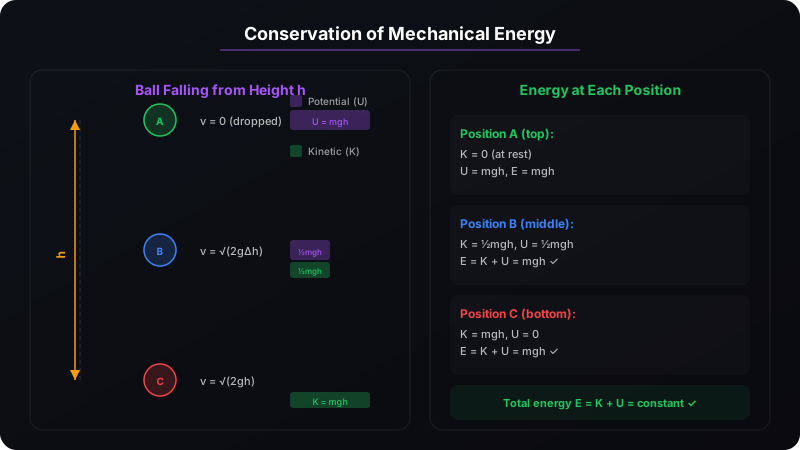
A ball dropped from height h: At top (v=0): E = mgh. At any height y: E = ½mv² + mgy = mgh. At bottom (y=0): E = ½mv² = mgh → v = √(2gh).
5.9 The Potential Energy of a Spring
A spring that obeys Hooke's Law (F = −kx) stores elastic potential energy when compressed or stretched:
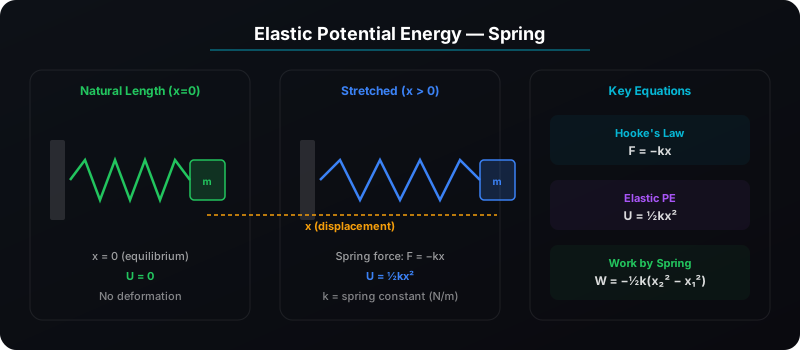
Work Done by Spring
W = −½k(x₂² − x₁²). Negative sign: spring force is opposite to displacement.
Energy Conservation with Spring
½mv₁² + ½kx₁² = ½mv₂² + ½kx₂²
5.10 Power
Power is the rate at which work is done or energy is transferred:
Average vs Instantaneous Power
Average Power
P_avg = W/Δt = ΔE/Δt. Total work divided by total time.
Instantaneous Power
P = dW/dt = F⃗ · v⃗. Power at a specific instant.
1 horsepower (hp) = 746 W. This unit is commonly used for engines and motors. A typical car engine produces 70–200 kW (94–268 hp).
5.11 Collisions
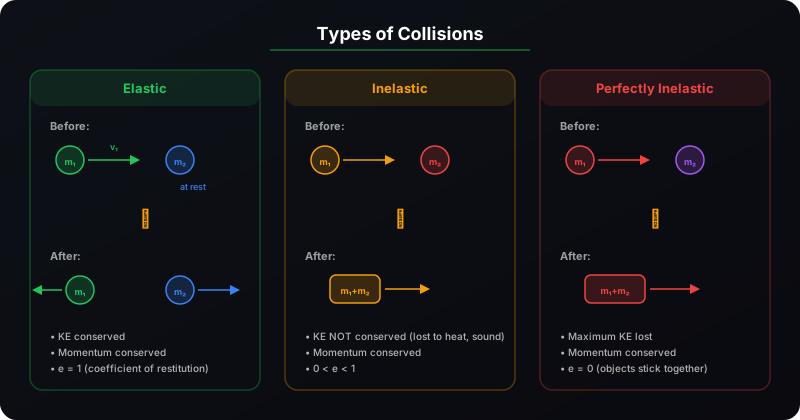
A collision is an interaction between two or more bodies that results in changes in their motion. Collisions can be classified based on how kinetic energy is conserved.
Elastic Collision
Both KE and momentum conserved. e = 1. Ideal — real collisions are approximately elastic (e.g., billiard balls).
Inelastic Collision
Momentum conserved, KE NOT conserved. 0 < e < 1. Most real collisions.
Perfectly Inelastic
Momentum conserved, maximum KE lost. e = 0. Objects stick together after collision.
Coefficient of Restitution
e = −(v₂′ − v₁′)/(v₂ − v₁). Relates relative velocities before and after collision.
Formulas for One-Dimensional Collisions
Special Cases
- Equal masses (m₁ = m₂): Velocities are exchanged in elastic collision. If m₂ at rest, m₁ stops and m₂ moves with v₁.
- Heavy hits light (m₁ ≫ m₂): m₁ barely changes speed, m₂ bounces off with nearly 2v₁.
- Light hits heavy (m₁ ≪ m₂): m₁ bounces back with nearly −v₁, m₂ barely moves.