Laws of Motion
Newton's three laws that form the foundation of classical mechanics
Table of Contents
4.1 Introduction
In the preceding chapter, our concern was to describe the motion of a particle in space quantitatively. We saw that uniform motion needs the concept of velocity alone whereas non-uniform motion requires the concept of acceleration. So far, we have not asked the question as to what governs the motion of bodies. In this chapter, we turn to this basic question.
Some external agency is needed to provide force to move a body from rest. Likewise, an external force is needed also to retard or stop motion. A stone released from the top of a building accelerates downward due to the gravitational pull of the earth. This shows that external agencies can exert force on a body even from a distance.
4.2 Aristotle's Fallacy
The Greek thinker Aristotle (384 B.C–322 B.C.) held the view that if a body is moving, something external is required to keep it moving. According to this view, for example, an arrow shot from a bow keeps flying since the air behind the arrow keeps pushing it.
A moving toy car comes to rest because of the external force of friction. To counter this force, the child has to apply an external force on the car in the direction of motion. If there were no friction, the child would not be required to apply any force to keep the toy car in uniform motion.
What is the flaw in Aristotle's argument? The answer is: a moving toy car comes to rest because the external force of friction on the car by the floor opposes its motion. To counter this force, the child has to apply an external force on the car in the direction of motion. When the car is in uniform motion, there is no net external force acting on it: the force by the child cancels the force (friction) by the floor.
The opposing forces such as friction (solids) and viscous forces (for fluids) are always present in the natural world. This explains why forces by external agencies are necessary to overcome the frictional forces to keep bodies in uniform motion. Now we understand where Aristotle went wrong. He coded this practical experience in the form of a basic argument. To get at the true law of nature for forces and motion, one has to imagine a world in which uniform motion is possible with no frictional forces opposing. This is what Galileo did.
4.3 The Law of Inertia
Galileo studied motion of objects on an inclined plane. Objects (i) moving down an inclined plane accelerate, while those (ii) moving up retard. (iii) Motion on a horizontal plane is an intermediate situation. Galileo concluded that an object moving on a frictionless horizontal plane must neither have acceleration nor retardation, i.e. it should move with constant velocity.
Another experiment by Galileo leading to the same conclusion involves a double inclined plane. A ball released from rest on one of the planes rolls down and climbs up the other. If the planes are smooth, the final height of the ball is nearly the same as the initial height. In the ideal situation, when friction is absent, the final height of the ball is the same as its initial height.
If the slope of the second plane is decreased and the experiment repeated, the ball will still reach the same height, but in doing so, it will travel a longer distance. In the limiting case, when the slope of the second plane is zero (i.e. is horizontal) the ball travels an infinite distance. In other words, its motion never ceases.
The state of rest and the state of uniform linear motion (motion with constant velocity) are equivalent. In both cases, there is no net force acting on the body. It is incorrect to assume that a net force is needed to keep a body in uniform motion.
4.4 Newton's First Law of Motion
Galileo's simple, but revolutionary ideas dethroned Aristotelian mechanics. A new mechanics had to be developed. This task was accomplished almost single-handedly by Isaac Newton, one of the greatest scientists of all times. Newton built on Galileo's ideas and laid the foundation of mechanics in terms of three laws of motion that go by his name.
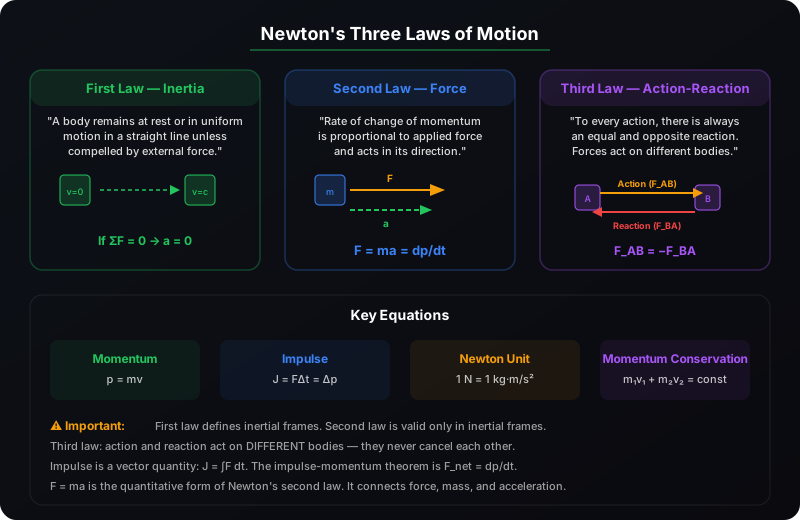
Every body continues to be in its state of rest or of uniform motion in a straight line unless compelled by some external force to act otherwise.
The state of rest or uniform linear motion both imply zero acceleration. The first law of motion can, therefore, be simply expressed as: If the net external force on a body is zero, its acceleration is zero. Acceleration can be non-zero only if there is a net external force on the body.
Applications of First Law
Two kinds of situations are encountered in the application of this law in practice. In some examples, we know that the net external force on the object is zero. In that case we can conclude that the acceleration of the object is zero. For example, a spaceship out in interstellar space, far from all other objects and with all its rockets turned off, has no net external force acting on it. Its acceleration, according to the first law, must be zero. If it is in motion, it must continue to move with a uniform velocity.
More often, however, we do not know all the forces to begin with. In that case, if we know that an object is unaccelerated (i.e. it is either at rest or in uniform linear motion), we can infer from the first law that the net external force on the object must be zero.
Suppose we are standing in a stationary bus and the driver starts the bus suddenly. We get thrown backward with a jerk. Our feet are in touch with the floor. If there were no friction, we would remain where we were, while the floor of the bus would simply slip forward under our feet. However, fortunately, there is some friction between the feet and the floor.
4.5 Newton's Second Law of Motion
The first law refers to the simple case when the net external force on a body is zero. The second law of motion refers to the general situation when there is a net external force acting on the body. It relates the net external force to the acceleration of the body.
Momentum
Momentum of a body is defined to be the product of its mass m and velocity v, and is denoted by p:
These qualitative observations lead to the second law of motion expressed by Newton as follows:
The rate of change of momentum of a body is directly proportional to the applied force and takes place in the direction in which the force acts.
Important Points About Second Law
- F = 0 implies a = 0: The second law is consistent with the first law.
- Vector law: Equivalent to three equations, one for each component: Fx = dpx/dt = max, Fy = dpy/dt = may, Fz = dpz/dt = maz.
- Applicable to systems: F refers to total external force on the system, a refers to acceleration of the system as a whole (or centre of mass).
- Local relation: Acceleration here and now is determined by the force here and now, not by any history of the motion.
Impulse
We sometimes encounter examples where a large force acts for a very short duration producing a finite change in momentum of the body. The product of force and time, which is the change in momentum of the body, remains a measurable quantity. This product is called impulse:

4.6 Newton's Third Law of Motion
The second law relates the external force on a body to its acceleration. What is the origin of the external force on the body? What agency provides the external force? The simple answer in Newtonian mechanics is that the external force on a body always arises due to some other body.
To every action, there is always an equal and opposite reaction.
Thus, according to Newtonian mechanics, force never occurs singly in nature. Force is the mutual interaction between two bodies. Forces always occur in pairs. Further, the mutual forces between two bodies are always equal and opposite.

Action and reaction act on DIFFERENT bodies. They never cancel each other. A horse can pull a cart because the horse exerts a force on the cart, and the cart exerts an equal and opposite force on the horse — but these act on different objects!
4.7 Conservation of Momentum
The second and third laws of motion lead to one of the most important principles in physics — the conservation of momentum. Consider an isolated system of two particles interacting only with each other. By Newton's third law, the force on the first particle due to the second is equal and opposite to the force on the second particle due to the first.
This principle is applicable in all collisions. In an isolated system (no external forces), the total momentum before collision equals the total momentum after collision.
4.8 Equilibrium of a Particle
A particle is in equilibrium if the net external force on it is zero. Equilibrium can be:
Static Equilibrium
Particle is at rest. Velocity = 0, acceleration = 0.
Dynamic Equilibrium
Particle moves with constant velocity. Acceleration = 0, but velocity ≠ 0.
Lami's Theorem
If a particle is in equilibrium under the action of three coplanar forces F₁, F₂, F₃, then:
4.9 Common Forces in Mechanics
In mechanics, we encounter several common types of forces. Understanding these forces is essential for solving problems involving free body diagrams.

Gravitational (W)
F = mg (toward Earth's center). g ≈ 9.8 m/s² on Earth's surface.
Normal Force (N)
Perpendicular to contact surface. Self-adjusting, always ≥ 0.
Friction (f)
Opposes relative motion/tendency. f ≤ μN (static), f = μN (kinetic).
Tension (T)
Force transmitted through string/rope. Always pulls (never pushes).
Friction is not a fundamental force — it arises from electromagnetic interactions between atoms at the contact surfaces. Static friction is a self-adjusting force that can take any value up to a maximum μₛN.
4.10 Circular Motion
An object moving in a circular path with constant speed has an acceleration directed toward the center of the circle (centripetal acceleration). This acceleration requires a net force directed toward the center.
The centripetal force is NOT a new type of force. It is the net force (could be gravity, tension, friction, normal force, or a combination) that causes circular motion. There is no such thing as "centrifugal force" in inertial frames.
4.11 Solving Problems in Mechanics
To solve problems involving Newton's laws, follow these steps:
- Step 1: Identify the object of interest and draw a free body diagram showing all forces acting on it.
- Step 2: Choose a convenient coordinate system. For inclined planes, align one axis along the surface.
- Step 3: Apply Newton's second law (F = ma) separately for each component direction.
- Step 4: If there are multiple objects, apply Newton's third law to relate forces between them.
- Step 5: Solve the resulting equations simultaneously for the unknowns.