Motion in a Plane
From vectors to projectile motion and circular motion — the mathematics of two-dimensional motion
Table of Contents
3.1 Introduction
In the last chapter we developed the concepts of position, displacement, velocity and acceleration for motion along a straight line. But to describe motion in two dimensions (a plane) or three dimensions (space), we need to use vectors. Therefore, it is first necessary to learn the language of vectors.
3.2 Scalars and Vectors
A scalar quantity has magnitude only — specified completely by a single number with proper unit. Examples: distance, mass, temperature, time. Scalars combine using ordinary algebra.
A vector quantity has both magnitude and direction, and obeys the triangle law of addition. Examples: displacement, velocity, acceleration, force. Vectors are represented by bold face (A) or an arrow over a letter (A⃗).
Scalars
Magnitude only. Combine with ordinary algebra: +, −, ×, ÷
Vectors
Magnitude + direction. Combine with triangle/parallelogram laws
3.2.1 Position and Displacement Vectors
The position vector r⃗ points from the origin to the object's location. The displacement vector Δr⃗ = r⃗′ − r⃗ joins the initial and final positions, regardless of the actual path taken.
The magnitude of displacement is always less than or equal to the path length. Displacement depends only on initial and final positions, not on the path taken.
3.2.2 Equality of Vectors
Two vectors are equal if and only if they have the same magnitude and the same direction. Shifting a vector parallel to itself does not change it (free vectors).
3.3 Multiplication of Vectors by Real Numbers
Multiplying a vector A by a positive number λ gives a vector with magnitude λ|A| and the same direction. Multiplying by a negative number reverses the direction.
3.4 Addition and Subtraction of Vectors — Graphical Method
Vectors obey the triangle law or equivalently the parallelogram law of addition.
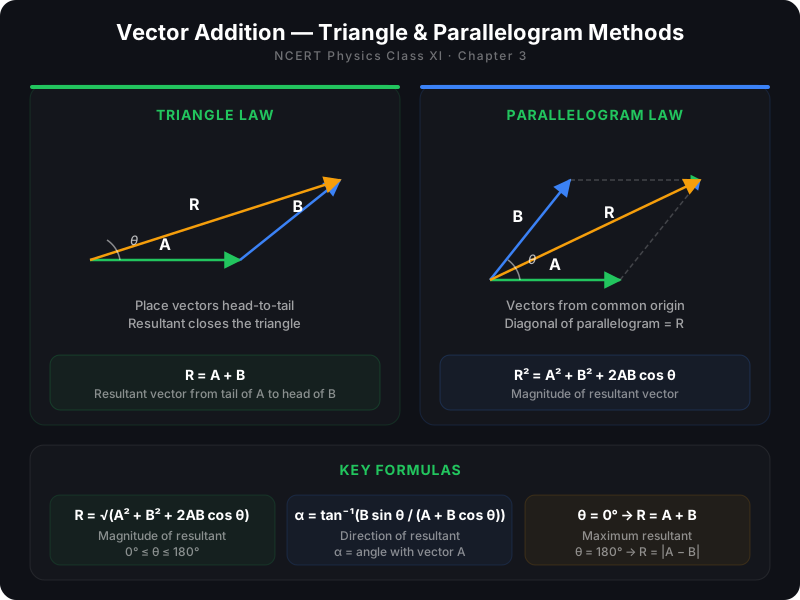
- Commutative: A⃗ + B⃗ = B⃗ + A⃗
- Associative: (A⃗ + B⃗) + C⃗ = A⃗ + (B⃗ + C⃗)
- Null vector: A⃗ + (−A⃗) = 0⃗, where |0⃗| = 0
- Subtraction: A⃗ − B⃗ = A⃗ + (−B⃗)
3.5 Resolution of Vectors
A vector A in the x-y plane can be resolved into components along the x- and y-axes using unit vectors î and ĵ.
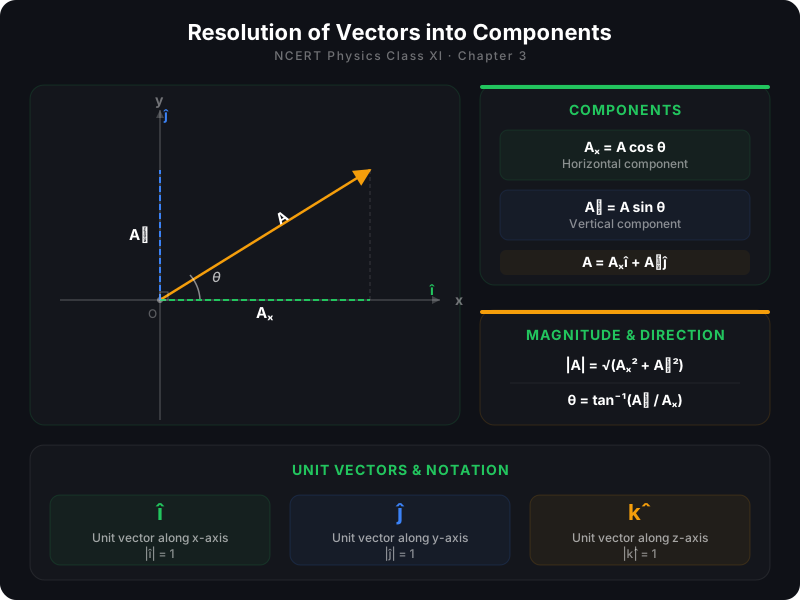
From A, θ → Components
Ax = A cos θ
Ay = A sin θ
From Components → A, θ
A = √(Ax² + Ay²)
θ = tan⁻¹(Ay/Ax)
3.6 Vector Addition — Analytical Method
For two vectors A⃗ and B⃗ with components (Ax, Ay) and (Bx, By):
3.7 Motion in a Plane
For motion in x-y plane, position vector r⃗ = xî + yĵ. The velocity and acceleration can be expressed in component form:
Position
r⃗ = xî + yĵ
Δr⃗ = Δx î + Δy ĵ
Velocity
v⃗ = vx î + vy ĵ
v = √(vx² + vy²)
Acceleration
a⃗ = ax î + ay ĵ
a = √(ax² + ay²)
Key Point
Motions in x and y can be treated independently — perpendicular directions don't affect each other
3.8 Motion in a Plane with Constant Acceleration
For constant acceleration a⃗, the kinematic equations extend naturally to two dimensions:
These are vector equations — they work component by component. Treat x and y motions independently with their own initial velocities and accelerations.
3.9 Projectile Motion
An object in flight after being projected is called a projectile. Its motion can be decomposed into horizontal (constant velocity) and vertical (constant acceleration g) components.
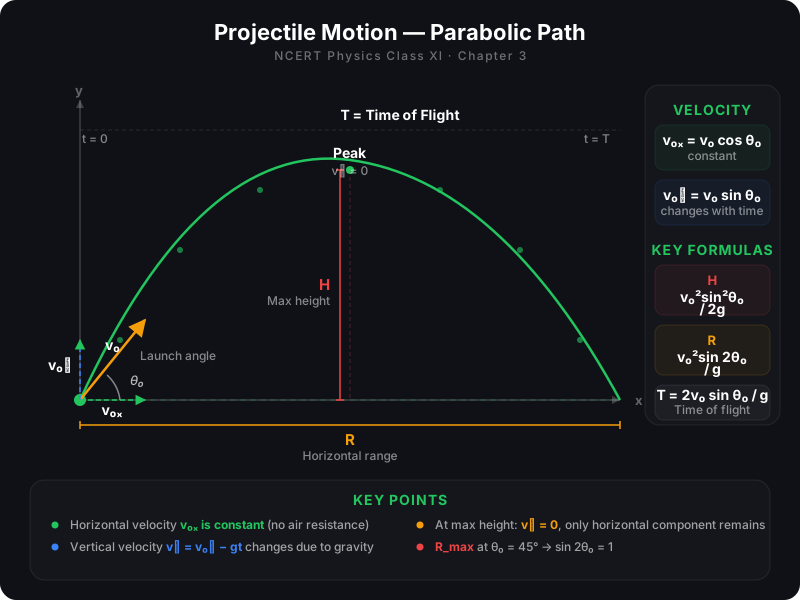
- x-component: vx = v₀ cos θ₀ (constant), x = (v₀ cos θ₀)t
- y-component: vy = v₀ sin θ₀ − gt, y = (v₀ sin θ₀)t − ½gt²
- Path equation: y = x tan θ₀ − gx²/(2v₀²cos²θ₀) — a parabola
Key Parameters
Time of Flight
T = 2v₀ sin θ₀ / g
Maximum Height
H = v₀² sin²θ₀ / (2g)
Horizontal Range
R = v₀² sin 2θ₀ / g
Maximum Range
R_max = v₀² / g at θ₀ = 45°
For elevations that exceed or fall short of 45° by equal amounts α, the ranges are equal. That is, angles (45° + α) and (45° − α) give the same range.
3.10 Uniform Circular Motion
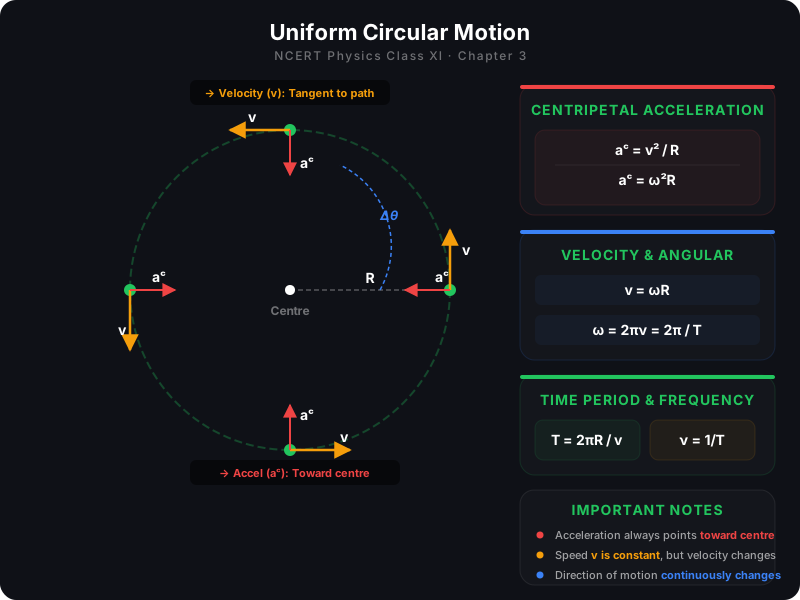
When an object follows a circular path at constant speed, the motion is called uniform circular motion. Although the speed is constant, the velocity direction changes continuously, so there is always an acceleration directed toward the center of the circle.
Angular Speed
ω = Δθ/Δt = v/R
Unit: rad/s
Linear Speed
v = ωR = 2πR/T = 2πRν
T = time period
Centripetal Acceleration
a_c = v²/R = ω²R = 4π²ν²R
Always toward center
Important Note
Acceleration is NOT constant — its magnitude is constant but direction changes continuously. It's not a constant vector!