Motion in a Straight Line
Describing how objects move — from instantaneous velocity to the kinematic equations that govern uniformly accelerated motion
Table of Contents
2.1 Introduction
Motion is common to everything in the universe. We walk, run and ride a bicycle. Even when we are sleeping, air moves into and out of our lungs and blood flows in arteries and veins. The earth rotates once every twenty-four hours and revolves round the sun once in a year.
Motion is change in position of an object with time. In this chapter, we learn how to describe motion by developing the concepts of velocity and acceleration. We confine ourselves to the study of motion of objects along a straight line, also known as rectilinear motion.
In Kinematics, we study ways to describe motion without going into the causes of motion. The study of causes of motion forms the subject matter of Chapter 4 (Laws of Motion).
2.2 Instantaneous Velocity and Speed
The average velocity tells us how fast an object has been moving over a given time interval but does not tell us how fast it moves at different instants. For this, we define instantaneous velocity or simply velocity v at an instant t.
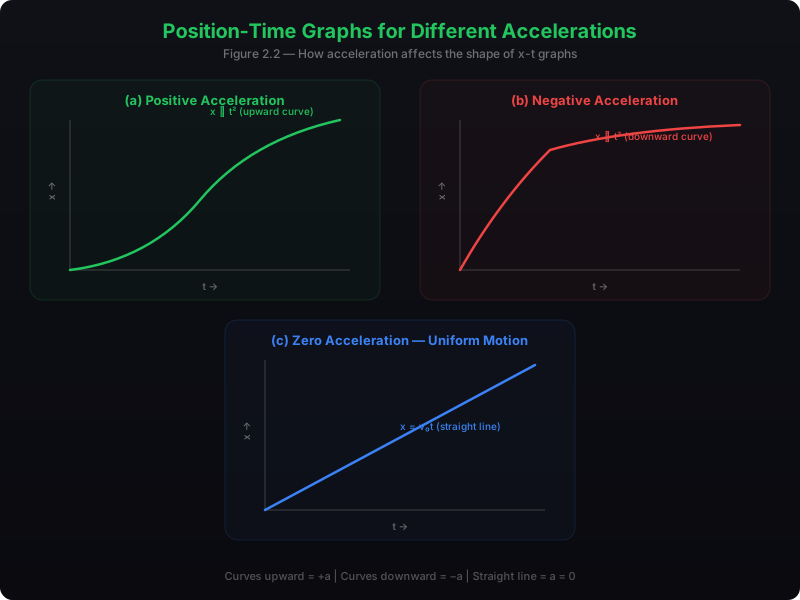
The velocity at an instant is the slope of the tangent to the position-time graph at that instant. In the language of calculus, it is the differential coefficient of x with respect to t.
Instantaneous speed is the magnitude of instantaneous velocity. A velocity of +24.0 m/s and −24.0 m/s both have an associated speed of 24.0 m/s. The instantaneous speed at any instant equals the magnitude of the instantaneous velocity at that instant.
2.3 Acceleration
The velocity of an object changes during its course of motion. The rate of change of velocity with time is acceleration. Through his studies of freely falling objects, Galileo concluded that the rate of change of velocity with time is a constant for all objects in free fall.
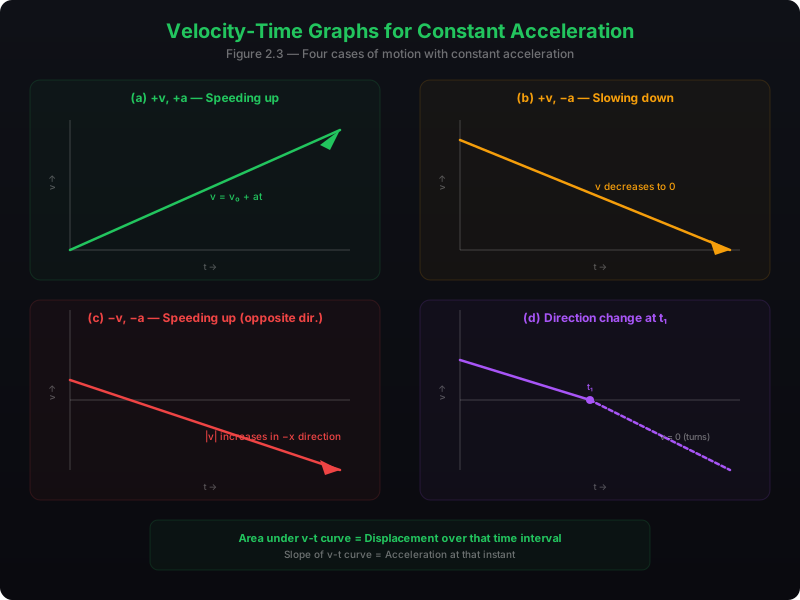
The area under the velocity-time curve between times t₁ and t₂ is equal to the displacement of the object during that interval. For constant velocity u, the v-t graph is a horizontal line and area = uT (displacement).
2.4 Kinematic Equations for Uniformly Accelerated Motion
For uniformly accelerated motion, we can derive simple equations that relate displacement (x), time taken (t), initial velocity (v₀), final velocity (v) and acceleration (a).

v = v₀ + at
When displacement x is unknown. Relates velocity to time.
x = v₀t + ½at²
When final velocity v is unknown. Relates position to time.
v² = v₀² + 2ax
When time t is unknown. Relates velocity to position.
x = (v₀ + v)t/2
Average velocity formula — useful when acceleration isn't constant.
2.4.1 Free Fall
An object released near the surface of the Earth accelerates downward under gravity. If air resistance is neglected, the object is in free fall. The acceleration due to gravity g ≈ 9.8 m/s² is constant for small heights.
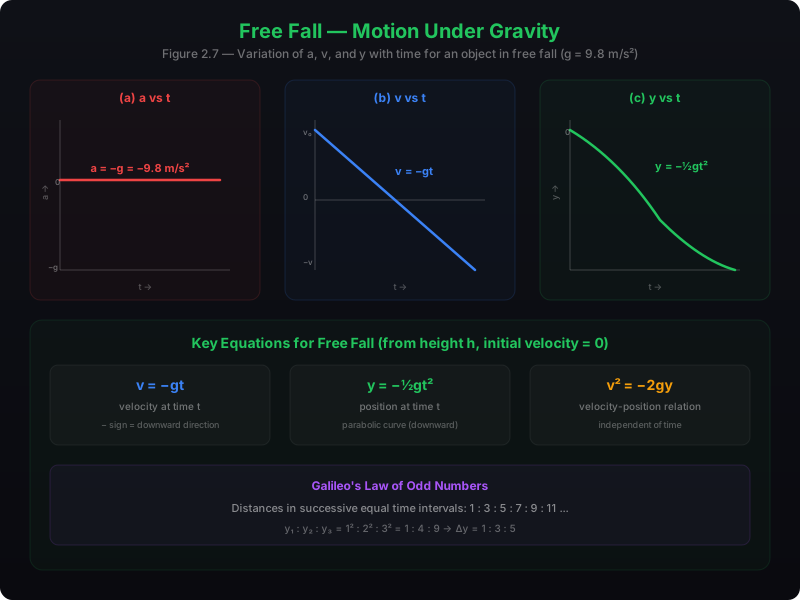
The distances traversed during equal intervals of time, by a body falling from rest, stand in the ratio 1 : 3 : 5 : 7 : 9 : 11 ... — the odd numbers beginning with unity. This was established by Galileo Galilei (1564–1642), the first to make quantitative studies of free fall.
2.4.2 Stopping Distance
2.5 Relative Velocity
The relative velocity of object A with respect to object B is defined as the velocity of A as observed from B. For two objects moving along the same straight line:
If two objects are moving in opposite directions, the relative speed is the sum of their individual speeds. If moving in the same direction, the relative speed is the difference.
A police van moving at 30 km/h fires a bullet at a thief's car moving at 192 km/h in the same direction. If the muzzle speed is 150 m/s, the bullet's speed relative to the ground is 30 km/h + 150 m/s = 158.3 m/s. The bullet hits the thief's car at 158.3 − 53.3 = 105 m/s relative to the thief's car.