Units and Measurement
The foundation of all physical science — understanding how we quantify the universe through units, significant figures, and dimensional analysis
Table of Contents
1.1 Introduction
Measurement of any physical quantity involves comparison with a certain basic, arbitrarily chosen, internationally accepted reference standard called unit. The result of a measurement of a physical quantity is expressed by a number (numerical measure) accompanied by a unit.
Although the number of physical quantities appears to be very large, we need only a limited number of units for expressing all the physical quantities, since they are inter-related with one another. The units for the fundamental or base quantities are called fundamental or base units. The units of all other physical quantities can be expressed as combinations of the base units. Such units obtained for the derived quantities are called derived units. A complete set of these units, both the base units and derived units, is known as the system of units.
A complete system of units must include both fundamental (base) units and derived units. The derived units are obtained by combining base units through multiplication and division only.
1.2 The International System of Units
In earlier times, scientists of different countries used different systems of units. Three such systems were in extensive use:
CGS System
Centimetre, Gram, Second — used in many scientific fields
FPS System
Foot, Pound, Second — British system
MKS System
Metre, Kilogram, Second — precursor to SI
SI System
International System — currently accepted worldwide
The Système International d' Unités (SI), with standard scheme of symbols, units and abbreviations, developed by the Bureau International des poids et mesures (BIPM) in 1971, was recently revised by the General Conference on Weights and Measures in November 2018.

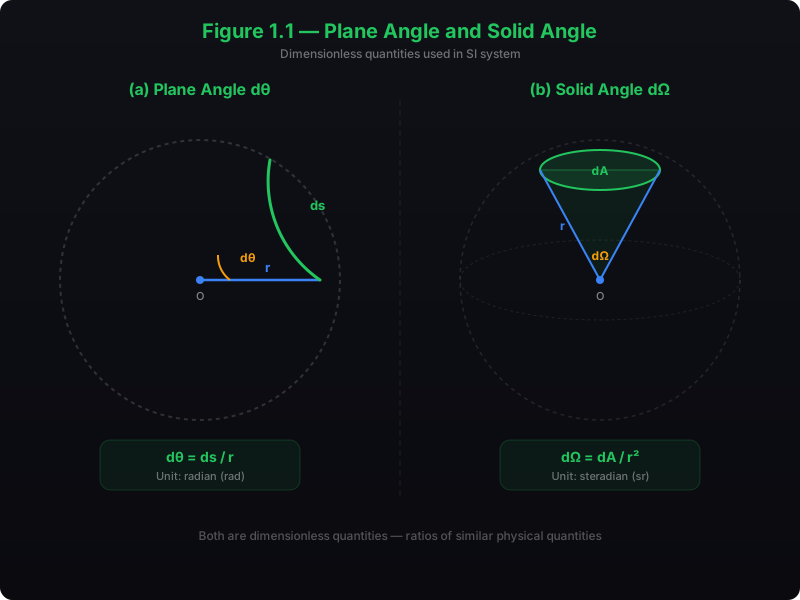
In SI, there are seven base units as given in Table 1.1. Besides the seven base units, there are two more units defined for (a) plane angle dθ as the ratio of length of arc ds to the radius r and (b) solid angle dΩ as the ratio of the intercepted area dA of the spherical surface to the square of its radius r.
| Supplementary Unit | Symbol | Definition | Dimension |
|---|---|---|---|
| Radian | rad | Plane angle = arc length / radius | Dimensionless |
| Steradian | sr | Solid angle = area / radius² | Dimensionless |
- Metre (m) — defined by the speed of light in vacuum: c = 299,792,458 m/s
- Kilogram (kg) — defined by Planck constant: h = 6.62607015 × 10⁻³⁴ J·s
- Second (s) — defined by caesium-133 atom frequency: ΔνCs = 9,192,631,770 Hz
- Ampere (A) — defined by elementary charge: e = 1.602176634 × 10⁻¹⁹ C
- Kelvin (K) — defined by Boltzmann constant: k = 1.380649 × 10⁻²³ J/K
- Mole (mol) — defined by Avogadro number: NA = 6.02214076 × 10²³
- Candela (cd) — defined by luminous efficacy: Kcd = 683 lm/W
1.3 Significant Figures
Every measurement involves errors. The result of measurement should be reported in a way that indicates the precision of measurement. The reliable digits plus the first uncertain digit are known as significant digits or significant figures.
If we say the period of oscillation of a simple pendulum is 1.62 s, the digits 1 and 6 are reliable and certain, while the digit 2 is uncertain. Thus, the measured value has three significant figures.
- All non-zero digits are significant
- All zeros between two non-zero digits are significant
- Zeros to the left of the first non-zero digit are NOT significant
- Trailing zeros in a number without a decimal are NOT significant
- Trailing zeros in a number WITH a decimal ARE significant
- Use scientific notation to remove ambiguity about trailing zeros
1.3.1 Rules for Arithmetic Operations
The final result should not have more significant figures than the original data from which it was obtained.
1.3.2 Rounding Off
The convention is that the preceding digit is raised by 1 if the insignificant digit to be dropped is more than 5, and is left unchanged if less than 5. For the digit exactly 5: if the preceding digit is even, drop the 5; if odd, raise the preceding digit by 1.
In multi-step calculations, retain one extra digit in intermediate steps and round off to proper significant figures at the end. This prevents accumulation of rounding errors.
1.4 Dimensions of Physical Quantities
The nature of a physical quantity is described by its dimensions. All physical quantities represented by derived units can be expressed in terms of some combination of seven fundamental or base quantities. We call these base quantities as the seven dimensions of the physical world.
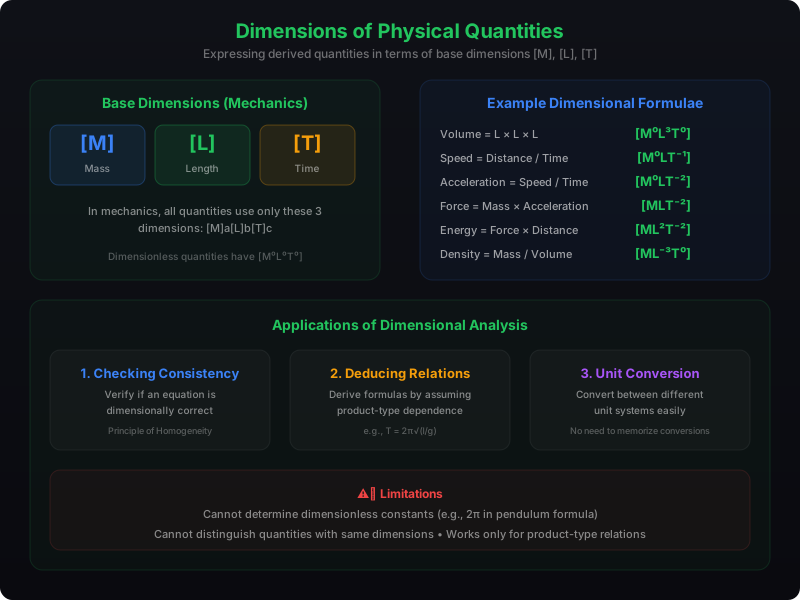
In mechanics, all physical quantities can be written in terms of the dimensions [L], [M] and [T]. For example:
| Physical Quantity | Formula | Dimensions | SI Unit |
|---|---|---|---|
| Volume | length × breadth × height | [L³] | m³ |
| Speed | distance / time | [LT⁻¹] | m/s |
| Acceleration | speed / time | [LT⁻²] | m/s² |
| Force | mass × acceleration | [MLT⁻²] | N |
| Energy | force × distance | [ML²T⁻²] | J |
| Pressure | force / area | [ML⁻¹T⁻²] | Pa |
Using square brackets [ ] around a quantity means we are dealing with 'the dimensions of' the quantity. Note that in dimensional representation, magnitudes are not considered — it is the quality of the type of physical quantity that enters.
1.5 Dimensional Formulae and Equations
The expression which shows how and which of the base quantities represent the dimensions of a physical quantity is called the dimensional formula of the given physical quantity.
An equation obtained by equating a physical quantity with its dimensional formula is called the dimensional equation of the physical quantity.
1.6 Dimensional Analysis and Applications
The recognition of concepts of dimensions, which guide the description of physical behaviour, is of basic importance. Only those physical quantities can be added or subtracted which have the same dimensions.
1.6.1 Checking Dimensional Consistency
The principle of homogeneity of dimensions states: if the dimensions of all the terms in an equation are not the same, the equation is wrong.
A dimensionally correct equation need not be actually an exact (correct) equation, but a dimensionally wrong or inconsistent equation must be wrong. Dimensional consistency does not guarantee correctness.
1.6.2 Deducing Relations Among Physical Quantities
The method of dimensions can sometimes be used to deduce relations among physical quantities. Consider a simple pendulum whose period T depends on length l, mass of bob m, and acceleration due to gravity g:
- Dimensionless constants (like 2π) cannot be determined by this method
- Cannot distinguish between physical quantities having same dimensions
- Works only for product-type relations among quantities