Three Dimensional Geometry
Lines, planes, and distances in three-dimensional space — the geometry of our world
In this chapter
11.1 Introduction
In Class XI, we studied the 3D coordinate geometry. Now we extend this to study the geometry of lines and planes in three-dimensional space. In everyday life, we live in a three-dimensional space — every object has length, breadth and height. This chapter develops the tools to describe lines and planes in this space using algebra.
We already know that a line in space can be determined if it passes through a given point and has a given direction. Similarly, a plane can be determined if it passes through a given point and has a given direction (normal). The aim of this chapter is to find the equations of lines and planes in space under different given conditions.
11.2 Direction Cosines and Direction Ratios of a Line
Recall that if a directed line L makes angles α, β, γ with the positive directions of the x, y and z axes respectively, measured in the anticlockwise direction, then these angles are called the direction angles of the line L. If the direction angles are α, β, γ, then their cosines cos α, cos β, cos γ are called the direction cosines of the line L.
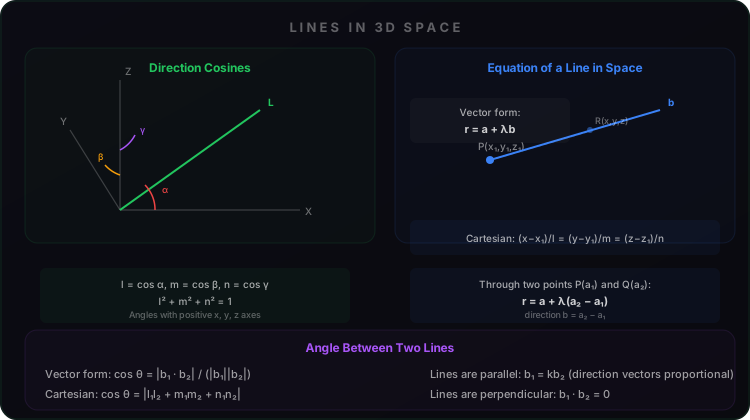
If l, m, n are the direction cosines of a line, then l² + m² + n² = 1.
Direction Cosines of a Line Joining Two Points
If P(x₁, y₁, z₁) and Q(x₂, y₂, z₂) are two points on a line, then the direction cosines of the line segment PQ are:
where PQ = √((x₂−x₁)² + (y₂−y₁)² + (z₂−z₁)²)
Direction Ratios
If l, m, n are the direction cosines and a, b, c are the direction ratios of a line, then: l = a/√(a²+b²+c²), m = b/√(a²+b²+c²), n = c/√(a²+b²+c²).
11.3 Equation of a Line in Space
Vector Form
The equation of a line that passes through a given point whose position vector is a and is parallel to a given vector b is:
Cartesian Form
Equation of a line through a point (x₁, y₁, z₁) and having direction cosines l, m, n is:
Equation Through Two Points
The vector equation of a line passing through two points whose position vectors are a and b is:
The parameter λ represents the "t" value — when λ = 0, we are at point P; when λ = 1, we reach point Q. Any value of λ gives a point on the line.
11.4 Angle between Two Lines
If θ is the acute angle between two lines L₁: r = a₁ + λb₁ and L₂: r = a₂ + μb₂, then:
If a₁, b₁, c₁ and a₂, b₂, c₂ are the direction ratios of two lines and θ is the acute angle between the two lines, then:
Parallel Lines
Two lines are parallel if their direction vectors are proportional: b₁ = kb₂ for some scalar k.
Perpendicular Lines
Two lines are perpendicular if b₁ · b₂ = 0, i.e., a₁a₂ + b₁b₂ + c₁c₂ = 0.
11.5 Shortest Distance between Two Lines
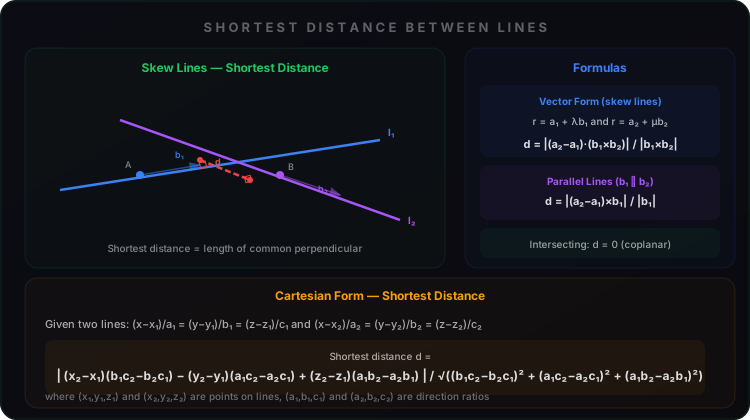
If two lines in space intersect at a point, then the shortest distance between them is zero. Also, if two lines in space are parallel, then the shortest distance between them will be the perpendicular distance, i.e. the length of the perpendicular drawn from a point on one line onto the other line.
Further, in space, there are lines which are neither intersecting nor parallel. In fact, such pair of lines are non-coplanar and are called skew lines.
Shortest Distance Between Skew Lines
The shortest distance between two skew lines is the length of the line segment perpendicular to both the lines. This is the unique line segment that is perpendicular to both lines and connects them.
For two skew lines r = a₁ + λb₁ and r = a₂ + μb₂, the shortest distance is:
The common perpendicular direction is b₁ × b₂, and the numerator is the scalar triple product of (a₂ − a₁), b₁ and b₂.
Shortest Distance Between Parallel Lines
If two lines are parallel (b₁ ∥ b₂), the formula simplifies. The direction b₁ × b₂ would be zero (since parallel vectors have zero cross product), so we use a different approach:
Cartesian Form
For lines (x−x₁)/a₁ = (y−y₁)/b₁ = (z−z₁)/c₁ and (x−x₂)/a₂ = (y−y₂)/b₂ = (z−z₂)/c₂:
/ √((b₁c₂−b₂c₁)² + (a₁c₂−a₂c₁)² + (a₁b₂−a₂b₁)²)
If the lines intersect, the shortest distance is d = 0 (the lines are coplanar). The condition for intersection is that the determinant |a₂−a₁, b₁, b₂| = 0.
∑ Summary
- Direction cosines of a line are the cosines of the angles made by the line with the positive directions of the coordinate axes.
- If l, m, n are the direction cosines of a line, then l² + m² + n² = 1.
- Direction cosines of a line joining two points P(x₁, y₁, z₁) and Q(x₂, y₂, z₂) are (x₂−x₁)/PQ, (y₂−y₁)/PQ, (z₂−z₁)/PQ where PQ = √((x₂−x₁)² + (y₂−y₁)² + (z₂−z₁)²).
- Direction ratios of a line are the numbers which are proportional to the direction cosines of a line.
- If l, m, n are the direction cosines and a, b, c are the direction ratios, then l = a/√(a²+b²+c²), m = b/√(a²+b²+c²), n = c/√(a²+b²+c²).
- Skew lines are lines in space which are neither parallel nor intersecting. They lie in different planes.
- Angle between skew lines is the angle between two intersecting lines drawn from any point parallel to each of the skew lines.
- If l₁, m₁, n₁ and l₂, m₂, n₂ are the direction cosines of two lines and θ is the acute angle, then cos θ = |l₁l₂ + m₁m₂ + n₁n₂|.
- If a₁, b₁, c₁ and a₂, b₂, c₂ are the direction ratios, then cos θ = |a₁a₂ + b₁b₂ + c₁c₂| / √((a₁²+b₁²+c₁²)(a₂²+b₂²+c₂²)).
- Vector equation of a line through point a parallel to b: r = a + λb.
- Cartesian equation: (x−x₁)/l = (y−y₁)/m = (z−z₁)/n.
- Vector equation through two points a and b: r = a + λ(b − a).
- If θ is the acute angle between r = a₁ + λb₁ and r = a₂ + μb₂, then cos θ = |b₁ · b₂|/(|b₁||b₂|).
- Shortest distance between two skew lines r = a₁ + λb₁ and r = a₂ + μb₂ is d = |(a₂−a₁)·(b₁×b₂)| / |b₁×b₂|.
- Shortest distance between parallel lines r = a₁ + λb and r = a₂ + μb is d = |(a₂−a₁)×b| / |b|.
- If lines intersect, the shortest distance d = 0.