Vector Algebra
Quantities with magnitude and direction — the language of force, motion, and space
In this chapter
10.1 Introduction
"In most sciences one generation tears down what another has built and what one has established another undoes. In Mathematics alone each generation builds a new story to the old structure." — Herman Hankel
In our day-to-day life we come across many queries such as — What is your height? How should a football player hit the ball to give a pass to another player of his team?
A possible answer to the first query is 1.6 metres — a quantity that involves only one value (magnitude), which is a real number. Such quantities are called scalars. However, an answer to the second query is a quantity (called force) which involves muscular strength (magnitude) and direction. Such quantities are called vectors.
In mathematics, physics and engineering we frequently come across both types of quantities — scalar quantities such as length, mass, time, distance, speed, area, volume, temperature, work, money, voltage, density, resistance, etc. and vector quantities like displacement, velocity, acceleration, force, weight, momentum, electric field intensity, etc.
10.2 Some Basic Concepts
Let l be any straight line in plane or three dimensional space. This line can be given two directions by means of arrowheads. A line with one of these directions prescribed is called a directed line. If we restrict the line l to the line segment AB, then a magnitude is prescribed on the line l with one of the two directions, so that we obtain a directed line segment. Thus, a directed line segment has magnitude as well as direction.
A quantity that has magnitude as well as direction is called a vector. A directed line segment is a vector, denoted as AB or simply as a, and read as "vector AB" or "vector a".
Position Vector
From Class XI, recall the three dimensional right-handed rectangular coordinate system. Consider a point P in space, having coordinates (x, y, z) with respect to the origin O(0, 0, 0). The vector OP having O and P as its initial and terminal points, respectively, is called the position vector of the point P with respect to O.
Direction Cosines and Direction Ratios
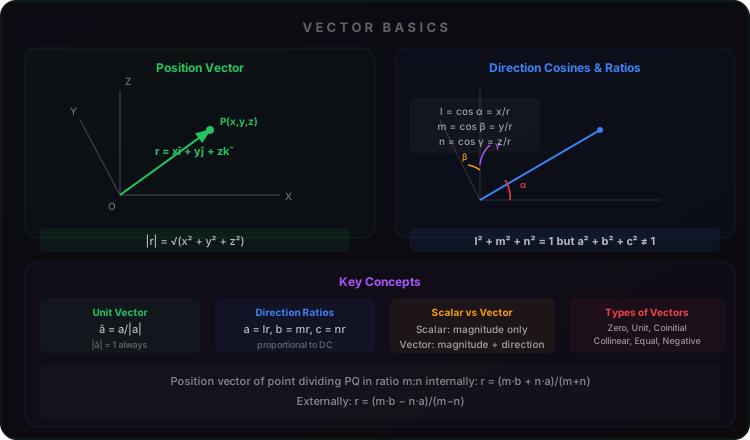
Consider the position vector r of a point P(x, y, z). The angles α, β, γ made by the vector with the positive directions of x, y and z-axes respectively, are called its direction angles. The cosine values of these angles, i.e., cos α, cos β and cos γ are called direction cosines of the vector, and usually denoted by l, m and n, respectively.
a = lr, b = mr, c = nr (direction ratios)
l² + m² + n² = 1 but a² + b² + c² ≠ 1 in general, since direction ratios are proportional to direction cosines.
10.3 Types of Vectors
Zero Vector
A vector whose initial and terminal points coincide, having zero magnitude. It cannot be assigned a definite direction (or may be regarded as having any direction).
Unit Vector
A vector whose magnitude is unity (1 unit). The unit vector in the direction of a given vector a is denoted by â.
Coinitial Vectors
Two or more vectors having the same initial point are called coinitial vectors.
Collinear Vectors
Two or more vectors are collinear if they are parallel to the same line, irrespective of their magnitudes and directions.
Equal Vectors
Two vectors are equal if they have the same magnitude and direction regardless of the positions of their initial points.
Negative of a Vector
A vector whose magnitude is the same as that of a given vector but direction is opposite to that of it.
10.4 Addition of Vectors
Triangle Law of Addition
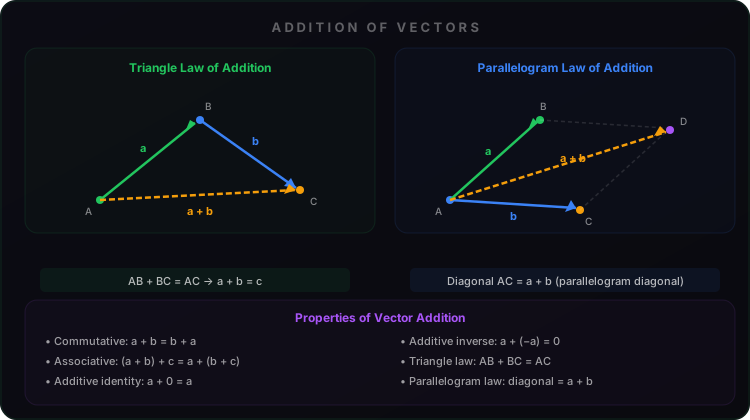
If we have two vectors a and b, represented by the directed line segments AB and BC respectively, then their sum a + b is represented by the directed line segment AC. This is the triangle law of vector addition.
Parallelogram Law of Addition
If two vectors a and b are represented by the two adjacent sides of a parallelogram starting from a common point, then their sum a + b is represented by the diagonal of the parallelogram starting from that same point.
Properties of Vector Addition
- Commutative: a + b = b + a
- Associative: (a + b) + c = a + (b + c)
- Additive identity: a + 0 = a
- Additive inverse: a + (−a) = 0
- The vector sum of the three sides of a triangle taken in order is 0
The position vector of a point R dividing a line segment joining points P and Q (position vectors a and b) in the ratio m:n:
Internally: r = (m·b + n·a)/(m+n)
Externally: r = (m·b − n·a)/(m−n)
10.5 Multiplication of a Vector by a Scalar
Let a be a given vector and λ be a scalar. Then the product of the vector a by the scalar λ, denoted by λa, is a vector whose magnitude is |λ| times that of a. The direction of λa is the same as that of a if λ is positive, and opposite to that of a if λ is negative.
â = a/|a| (unit vector in the direction of a)
λ(μa) = (λμ)a | (λ + μ)a = λa + μa | λ(a + b) = λa + λb
10.6 Product of Two Vectors
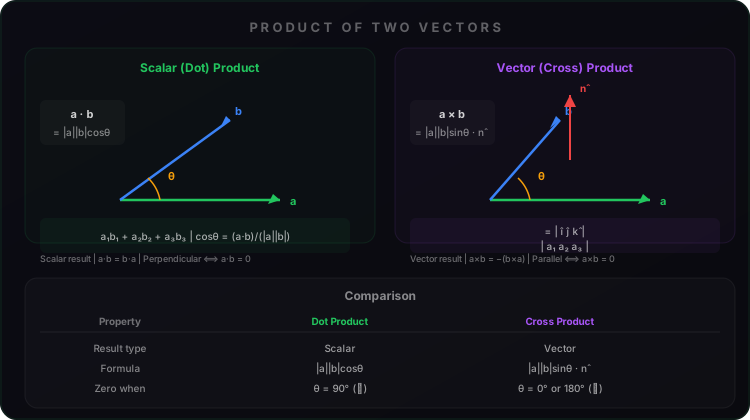
There are two types of products of vectors: the scalar (dot) product and the vector (cross) product. The dot product yields a scalar, while the cross product yields a vector.
Scalar (Dot) Product
The scalar product of two non-zero vectors a and b, denoted by a · b, is defined as:
Component form: a₁b₁ + a₂b₂ + a₃b₃
a · b = 0 if and only if a and b are perpendicular (orthogonal). Also, |a · b| = |a| × (projection of b on a).
Vector (Cross) Product
The vector product of two non-zero vectors a and b, denoted by a × b, is defined as:
Component form: a × b = | î ĵ k̂ |
| a₁ a₂ a₃ |
| b₁ b₂ b₃ |
Dot product gives a scalar; cross product gives a vector. The cross product is anticommutative: a × b = −(b × a). The dot product is commutative: a · b = b · a.
Geometric Applications
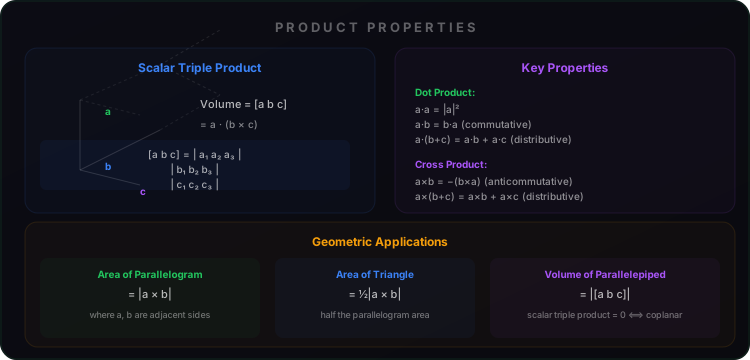
- Area of parallelogram with adjacent sides a and b = |a × b|
- Area of triangle with adjacent sides a and b = ½|a × b|
- Volume of parallelepiped with edges a, b, c = |[a b c]| = |a · (b × c)|
- Three vectors are coplanar if and only if [a b c] = 0
Scalar Triple Product
The scalar triple product of three vectors a, b, c is defined as [a b c] = a · (b × c). It represents the signed volume of the parallelepiped whose edges are a, b and c.
| b₁ b₂ b₃ |
| c₁ c₂ c₃ |
∑ Summary
- Position vector of a point P(x, y, z) is r = xî + yĵ + zk̂, and its magnitude is |r| = √(x² + y² + z²).
- The scalar components of a vector are its direction ratios, and represent its projections along the respective axes.
- The magnitude (r), direction ratios (a, b, c) and direction cosines (l, m, n) of any vector are related as: l = a/r, m = b/r, n = c/r.
- The vector sum of the three sides of a triangle taken in order is 0.
- The vector sum of two coinitial vectors is given by the diagonal of the parallelogram whose adjacent sides are the given vectors.
- Multiplication of a given vector a by a scalar λ changes the magnitude by |λ| and keeps the direction same (or opposite) according as λ is positive (or negative).
- For a given vector a, the vector â = a/|a| gives the unit vector in the direction of a.
- The position vector of a point R dividing PQ (position vectors a, b) in ratio m:n internally is r = (mb + na)/(m+n); externally is r = (mb − na)/(m−n).
- Scalar product: a · b = |a||b| cos θ. Also, cos θ = (a · b)/(|a||b|).
- If θ is the angle between two vectors a and b, their cross product is a × b = |a||b| sin θ · n̂, where n̂ is a unit vector perpendicular to the plane of a and b such that a, b, n̂ form a right-handed system.
- For vectors a = a₁î + a₂ĵ + a₃k̂ and b = b₁î + b₂ĵ + b₃k̂:
a + b = (a₁+b₁)î + (a₂+b₂)ĵ + (a₃+b₃)k̂
a − b = (a₁−b₁)î + (a₂−b₂)ĵ + (a₃−b₃)k̂
λa = λa₁î + λa₂ĵ + λa₃k̂ - Area of parallelogram = |a × b|; Area of triangle = ½|a × b|.
- Volume of parallelepiped = |[a b c]|. Vectors a, b, c are coplanar if [a b c] = 0.
📜 Historical Note
Though we must mention that in practice, the idea of vector concept and their addition was known much earlier, ever since the time of Aristotle (384–322 B.C.), a Greek philosopher and pupil of Plato (427–348 B.C.). At that time it was supposed to be known that the combined action of two or more forces could be seen by adding them according to the parallelogram law.
The correct law for the composition of forces — that forces add vectorially — had been discovered in the case of perpendicular forces by Stevin-Simon (1548–1620). In 1586 A.D., he analysed the principle of geometric addition of forces in his treatise DeBeghinselen der Weeghconst ("Principles of the Art of Weighing"), which caused a major breakthrough in the development of mechanics. But it took another 200 years for the general concept of vectors to form.
In the 1880s, Josaih Willard Gibbs (1839–1903), an American physicist and mathematician, and Oliver Heaviside (1850–1925), an English engineer, created what we now know as vector analysis, essentially by separating the real (scalar) part of quaternion from its imaginary (vector) part. In 1881 and 1884, Gibbs printed a treatise entitled Elements of Vector Analysis. This book gave a systematic and concise account of vectors. However, much of the credit for demonstrating the applications of vectors is due to Heaviside and P.G. Tait (1831–1901) who contributed significantly to this subject.