Differential Equations
Equations that describe how things change — the language of nature itself
In this chapter
9.1 Introduction
"He who seeks for methods without having a definite problem in mind seeks for the most part in vain." — D. Hilbert
A differential equation is an equation involving derivatives of the dependent variable with respect to the independent variable. These equations arise everywhere in physics, chemistry, biology, economics — anywhere rates of change are involved.
9.2 Basic Concepts
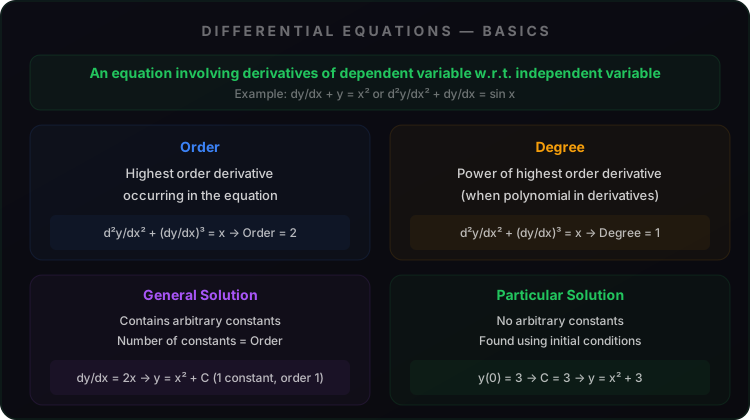
Order
Highest order derivative in the equation. E.g., d²y/dx² + dy/dx = 0 has order 2.
Degree
Power of the highest order derivative (when polynomial in derivatives). E.g., (d²y/dx²)³ has degree 3.
General Solution
Contains arbitrary constants (as many as the order). Represents all possible solutions.
Particular Solution
No arbitrary constants. Found by applying initial/boundary conditions to the general solution.
9.3 Formation of Differential Equations
To form a differential equation from a given family of curves:
Step 1: Write the equation with arbitrary constants
Step 2: Differentiate as many times as the number of constants
Step 3: Eliminate the arbitrary constants from the equations
Step 4: The resulting equation is the differential equation
9.4 Methods of Solving
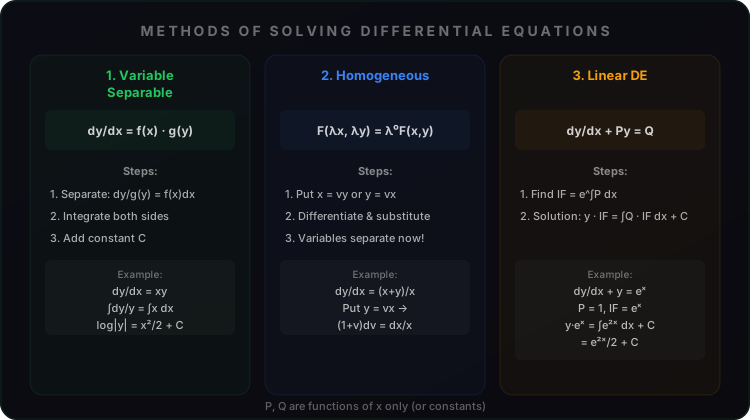
Method 1: Variable Separable
Separate all y-terms with dy on one side, all x-terms with dx on the other, then integrate both sides.
Method 2: Homogeneous Differential Equations
Substitute x = vy (or y = vx) to convert to variable separable form.
Method 3: Linear Differential Equations
Integrating Factor: IF = e^∫P dx
Solution: y · IF = ∫Q · IF dx + C
Always check in this order:
1. Is it variable separable?
2. Is it homogeneous?
3. Is it linear?
If none work, other methods (Bernoulli, exact) may be needed at higher levels.
9.5 Summary
• Differential equation: involves derivatives of dependent variable
• Order: highest derivative · Degree: power of highest derivative
• General solution: has arbitrary constants (= order) · Particular: no constants
• Variable separable: separate x and y, then integrate
• Homogeneous: F(λx,λy) = λ⁰F(x,y) → substitute y = vx
• Linear DE: dy/dx + Py = Q → IF = e^∫Pdx → y·IF = ∫Q·IF dx + C