Application of Integrals
Finding areas bounded by curves — where integration becomes geometry
In this chapter
8.1 Introduction
"One should study Mathematics because it is only through Mathematics that nature can be conceived in harmonious form." — Birkhoff
Elementary geometry gives us formulae for areas of triangles, rectangles, and circles. But what about the area under a parabola, or between two curves? Integral calculus provides the tools to calculate these areas precisely.
8.2 Area under Simple Curves
The area under a curve can be thought of as the sum of infinitely many thin vertical (or horizontal) strips.
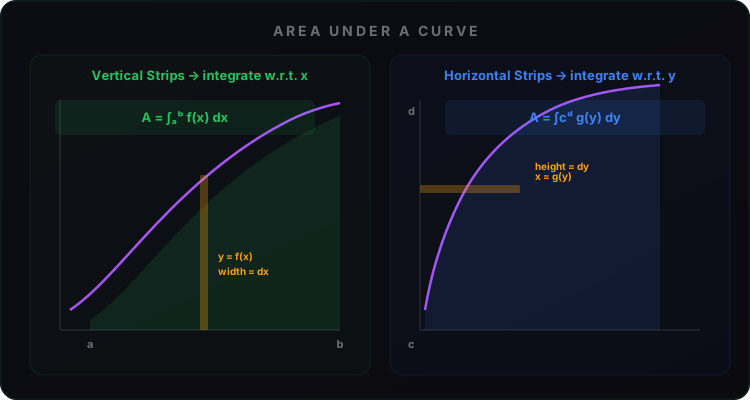
Vertical strips (w.r.t. x):
Area = ∫ₐᵇ y dx = ∫ₐᵇ f(x) dx
Horizontal strips (w.r.t. y):
Area = ∫cᵈ x dy = ∫cᵈ g(y) dy
Area Between Two Curves
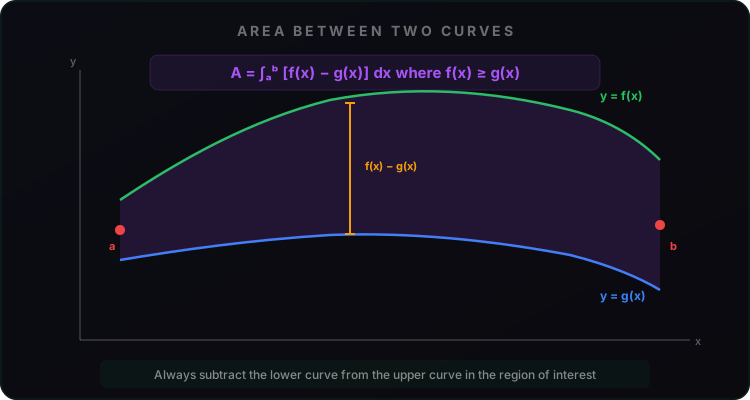
(i) If the curve is below the x-axis, take absolute value: |∫ₐᵇ f(x) dx|
(ii) When curves cross, split the integral at intersection points
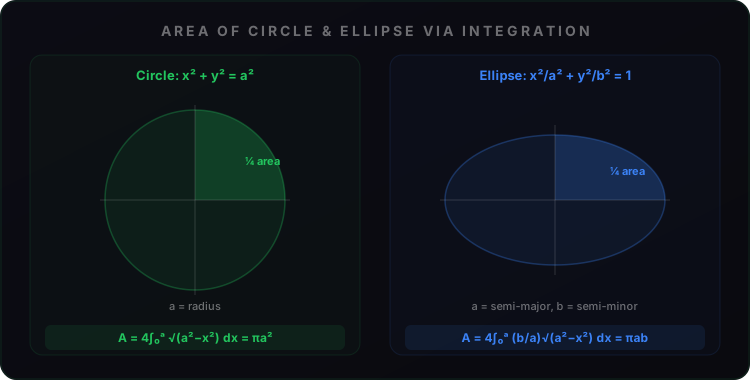
(iii) Use symmetry: area of circle = 4 × (area in first quadrant)
Area of Circle and Ellipse
8.3 Summary
• Vertical strips: Area = ∫ₐᵇ f(x) dx — integrate w.r.t. x
• Horizontal strips: Area = ∫cᵈ g(y) dy — integrate w.r.t. y
• Between curves: A = ∫ₐᵇ [f(x) − g(x)] dx (upper − lower)
• Signed area: area below x-axis → take absolute value
• Circle: A = πa² · Ellipse: A = πab
• Use symmetry to simplify calculations when possible