Determinants
The scalar companion of square matrices — solving equations, finding areas, and testing invertibility
In this chapter
4.1 What is a Determinant?
"All Mathematical truths are relative and conditional." — C.P. Steinmetz
A determinant is a scalar value associated with every square matrix. It encodes important properties of the matrix — whether it's invertible, how it transforms area/volume, and whether a system of linear equations has a unique solution.
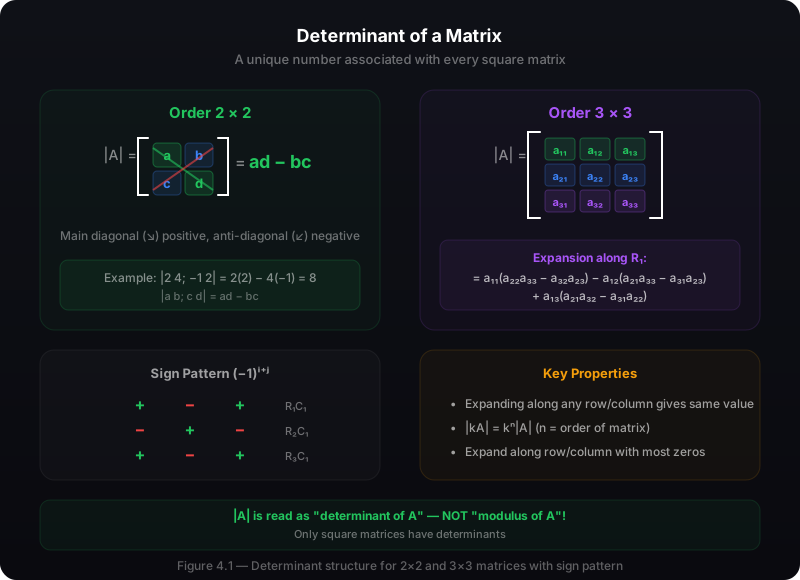
For a square matrix A = [aᵢⱼ] of order n, the determinant is denoted by |A| or det(A) or ∆.
Order 1: |[a]| = a
Order 2: |a b; c d| = ad − bc
Order 3: Expand along any row or column
Determinant of Order 3 × 3
A 3×3 determinant can be expanded along any row or column (6 ways total), and all give the same result. Expanding along the first row:
Always expand along the row or column with the most zeros — it saves time! The sign pattern for positions alternates: +, −, +; −, +, −; +, −, +
If A = kB where A and B are square matrices of order n, then |A| = kⁿ|B|, not k|B|.
Example: If A = 2B (2×2), then |A| = 4|B|, not 2|B|.
4.2 Area of a Triangle
Determinants provide an elegant way to compute the area of a triangle when the vertex coordinates are known.
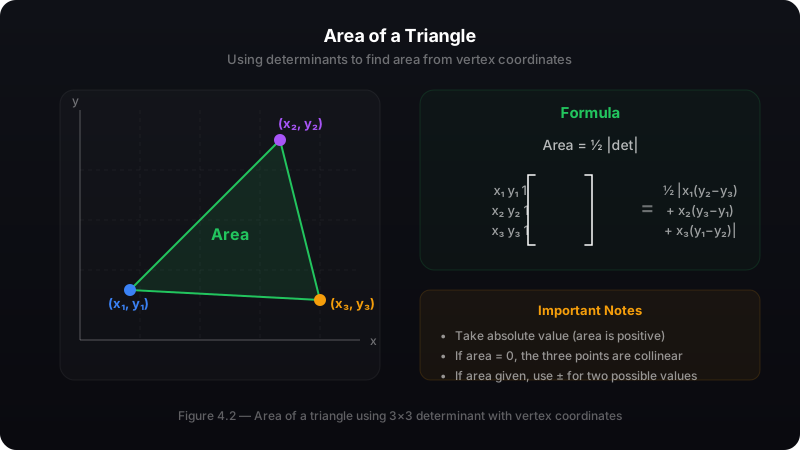
x₁ y₁ 1
x₂ y₂ 1
x₃ y₃ 1
(i) Area is always positive — take the absolute value of the determinant
(ii) If the area is given, use both ± values for the determinant
(iii) If three points are collinear, the area = 0
4.3 Minors and Cofactors
Minors and cofactors provide a systematic way to expand determinants and are essential for finding adjoints and inverses.
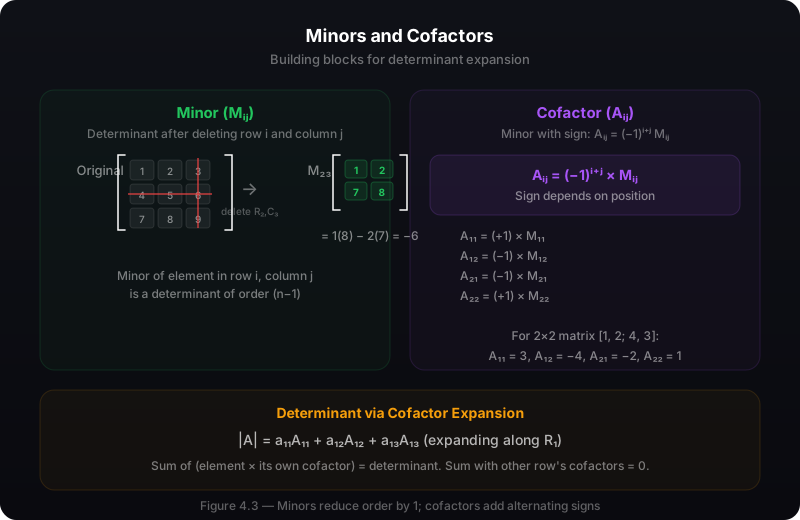
Minor (Mᵢⱼ)
The determinant obtained by deleting the ith row and jth column. For a 3×3 matrix, each minor is a 2×2 determinant.
Cofactor (Aᵢⱼ)
Aᵢⱼ = (−1)ⁱ⁺ʲ × Mᵢⱼ. The cofactor is the minor with a sign depending on position.
Determinant via Cofactor Expansion
= a₁₁A₁₁ + a₂₁A₂₁ + a₃₁A₃₁ (expanding along C₁)
The sum of products of elements of any row (or column) with their own cofactors = determinant.
But if elements of one row are multiplied with cofactors of a different row, the sum = 0.
4.4 Adjoint and Inverse
The adjoint of a matrix is the transpose of its cofactor matrix. It is the key to finding the inverse.

Adjoint of a Matrix
The adjoint of a square matrix A is the transpose of the matrix of cofactors:
adj A = [Aⱼᵢ] (transpose of cofactor matrix [Aᵢⱼ])
Shortcut for 2×2: adj [a, b; c, d] = [d, −b; −c, a] — swap diagonal, negate off-diagonal
Key Theorem
Inverse of a Matrix
Non-singular (|A| ≠ 0)
A⁻¹ exists and is unique. A⁻¹ = (1/|A|) adj A
Singular (|A| = 0)
A⁻¹ does NOT exist. The matrix cannot be inverted.
Properties
| Property | Statement |
|---|---|
| Inverse Formula | A⁻¹ = (1/|A|) adj A |
| |adj A| | |adj A| = |A|ⁿ⁻¹ (n = order) |
| Reversal Law | (AB)⁻¹ = B⁻¹A⁻¹ |
| Double Inverse | (A⁻¹)⁻¹ = A |
| Product Rule | |AB| = |A| × |B| |
4.5 Applications
Determinants and matrix inverses are powerful tools for solving systems of linear equations and checking their consistency.
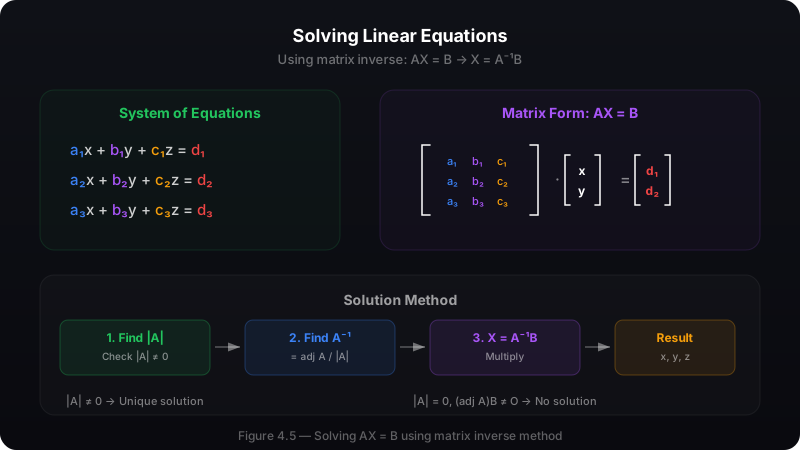
Solving AX = B
For the system a₁x + b₁y + c₁z = d₁, etc., write AX = B:
Case 1: |A| ≠ 0 → Unique solution: X = A⁻¹B
Case 2: |A| = 0 and (adj A)B ≠ O → No solution (inconsistent)
Case 3: |A| = 0 and (adj A)B = O → Either no solution or infinitely many
Consistency
Consistent
The system has at least one solution (unique or infinite).
Inconsistent
The system has no solution at all.
4.6 Summary
• Determinant is a scalar associated with square matrices — |A| or det(A)
• 2×2: |a b; c d| = ad − bc · 3×3: expand along any row/column
• |kA| = kⁿ|A| (n = order), not k|A|
• Area of triangle = ½|determinant with vertex coordinates|
• Minor Mᵢⱼ: delete row i, column j · Cofactor Aᵢⱼ = (−1)ⁱ⁺ʲ Mᵢⱼ
• adj A = transpose of cofactor matrix · A(adj A) = |A|I
• Singular: |A| = 0 (no inverse) · Non-singular: |A| ≠ 0 (inverse exists)
• A⁻¹ = (1/|A|) adj A when |A| ≠ 0
• |adj A| = |A|ⁿ⁻¹ · |AB| = |A||B| · (AB)⁻¹ = B⁻¹A⁻¹
• Solve AX = B → X = A⁻¹B when |A| ≠ 0