Matrices
The rectangular powerhouse of linear algebra — organizing data, solving systems, and transforming space
In this chapter
3.1 What is a Matrix?
"The essence of Mathematics lies in its freedom." — Georg Cantor
A matrix is an ordered rectangular array of numbers or functions, arranged in rows and columns and enclosed within square brackets [ ]. It is one of the most powerful tools in mathematics — used to solve systems of linear equations, represent transformations, manage data in spreadsheets, and much more.
A matrix having m rows and n columns is called a matrix of order m × n. It is denoted as A = [aᵢⱼ]ₘₓₙ, where aᵢⱼ is the element in the ith row and jth column.
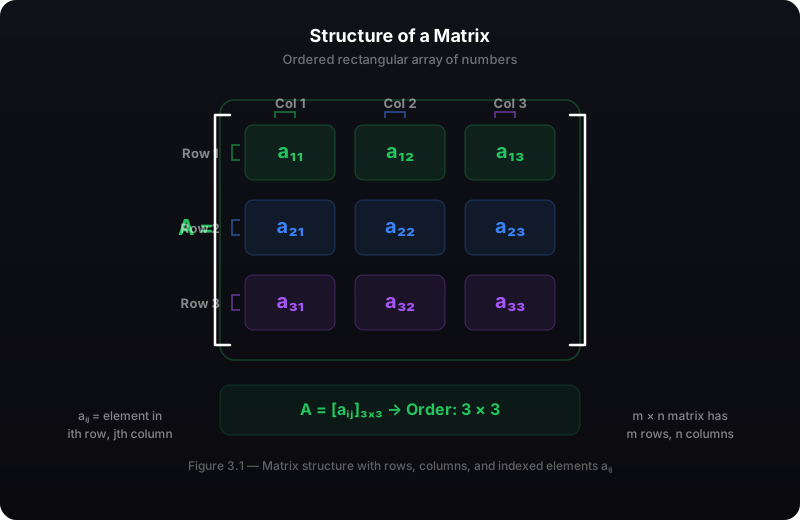
A = [aᵢⱼ]ₘₓₙ means A is an m × n matrix
aᵢⱼ is the (i, j)th element — ith row, jth column
m × n is the "order" or "size" of the matrix
Total elements = m × n
Matrices can represent data systematically. For example, the number of notebooks and pens possessed by three people can be displayed as a 3 × 2 matrix where each row represents a person and each column represents an item type.
• We consider only matrices whose elements are real numbers or functions taking real values
• A point (x, y) in a plane can be represented as a column matrix [x; y] or row matrix [x, y]
• The vertices of a closed rectilinear figure can be expressed as a matrix
3.2 Types of Matrices
Matrices are classified based on their structure and element values. Understanding these types is essential for working with matrix operations.
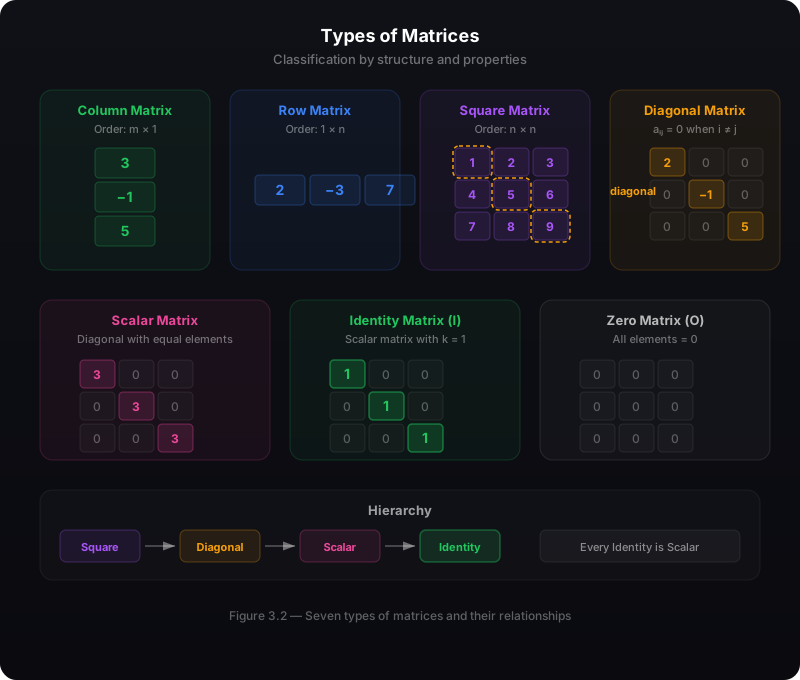
| Type | Definition | Example |
|---|---|---|
| Column Matrix | Only one column (order m × 1) | [3; −1; 5] |
| Row Matrix | Only one row (order 1 × n) | [2, −3, 7] |
| Square Matrix | Number of rows = number of columns (m = n) | 2×2, 3×3, n×n |
| Diagonal Matrix | Square matrix with aᵢⱼ = 0 when i ≠ j | [2, 0; 0, −1] |
| Scalar Matrix | Diagonal matrix with all diagonal elements equal | [3, 0; 0, 3] |
| Identity Matrix (I) | Scalar matrix with all diagonal elements = 1 | [1, 0; 0, 1] |
| Zero Matrix (O) | All elements are zero | [0, 0; 0, 0] |
Every identity matrix is a scalar matrix (with k = 1), but not every scalar matrix is an identity matrix.
Every scalar matrix is a diagonal matrix, but not every diagonal matrix is a scalar matrix.
Every diagonal matrix is a square matrix, but not every square matrix is diagonal.
Equality of Matrices
Two matrices A = [aᵢⱼ] and B = [bᵢⱼ] are equal if and only if:
(i) They are of the same order
(ii) Each element of A equals the corresponding element of B, i.e., aᵢⱼ = bᵢⱼ for all i, j
3.3 Matrix Operations
Addition of Matrices
Two matrices can be added only if they have the same order. The sum is obtained by adding corresponding elements.
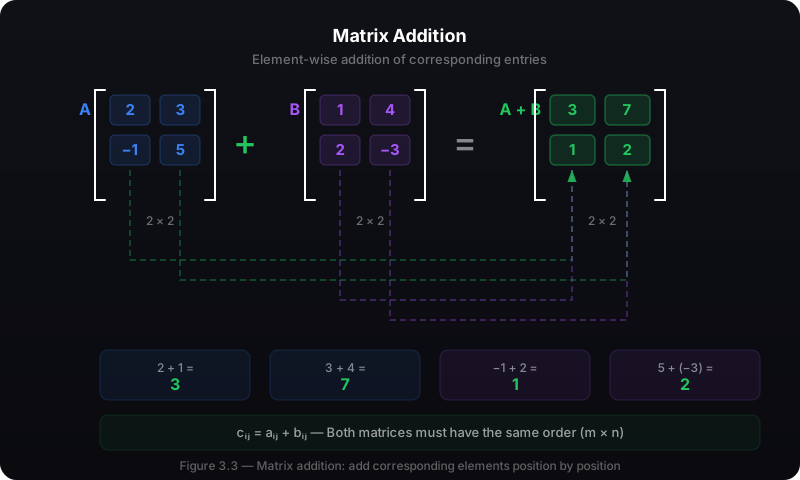
A + B = [aᵢⱼ + bᵢⱼ] = C, where cᵢⱼ = aᵢⱼ + bᵢⱼ
Scalar Multiplication
Multiplying a matrix by a scalar k means multiplying every element of the matrix by k.
If A = [aᵢⱼ]ₘₓₙ and k is a scalar, then:
kA = [k · aᵢⱼ]ₘₓₙ
Example: If A = [3, 1; −5, 7], then 2A = [6, 2; −10, 14]
The negative of a matrix is defined as −A = (−1)A, and the difference is A − B = A + (−1)B.
Properties of Matrix Addition
Commutative Law
A + B = B + A
Associative Law
(A + B) + C = A + (B + C)
Additive Identity
A + O = A (zero matrix)
Additive Inverse
A + (−A) = O
Properties of Scalar Multiplication
For matrices A, B of same order and scalars k, l:
(i) k(A + B) = kA + kB
(ii) (k + l)A = kA + lA
3.4 Matrix Multiplication
Matrix multiplication is fundamentally different from addition. It is not element-wise — instead, it uses a row-by-column dot product.
The product AB is defined only when the number of columns in A equals the number of rows in B.
If A is m × n and B is n × p, then AB is m × p.
Matrix multiplication is NOT commutative: AB ≠ BA in general!
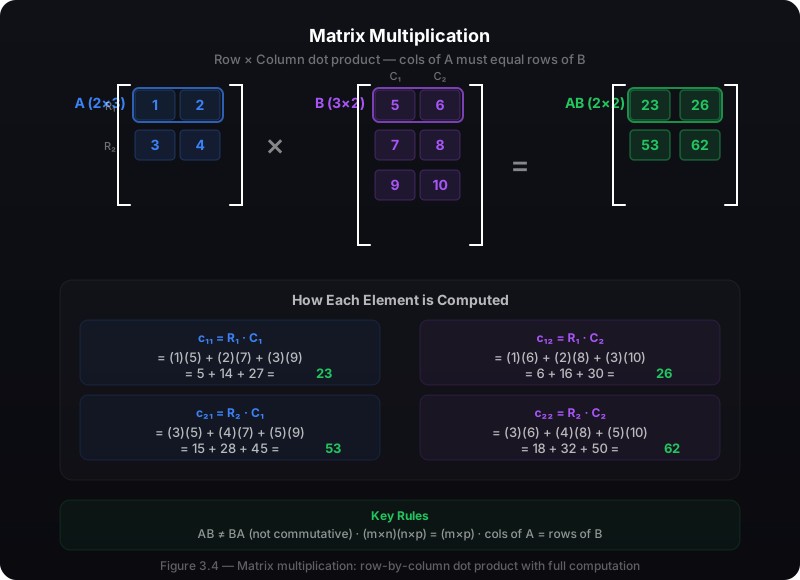
where cᵢₖ = aᵢ₁b₁ₖ + aᵢ₂b₂ₖ + ... + aᵢₙbₙₖ = Σⱼ₌₁ⁿ aᵢⱼbⱼₖ
Why AB ≠ BA
Even when both AB and BA are defined, they are generally not equal. Moreover, AB and BA may have different orders!
Example: If A is 2×3 and B is 3×2, then AB is 2×2 while BA is 3×3.
Exception: Diagonal matrices of the same order commute: AB = BA.
Properties of Matrix Multiplication
Associative Law
(AB)C = A(BC)
Distributive Laws
A(B+C) = AB + AC
(A+B)C = AC + BC
Multiplicative Identity
IA = AI = A
Zero Product
AB = O does NOT imply A = O or B = O
For real numbers, if ab = 0 then either a = 0 or b = 0. This is NOT true for matrices! Two non-zero matrices can multiply to give a zero matrix.
3.5 Transpose of a Matrix
The transpose of a matrix is obtained by interchanging its rows and columns. If A is an m × n matrix, its transpose A' (or Aᵀ) is an n × m matrix.
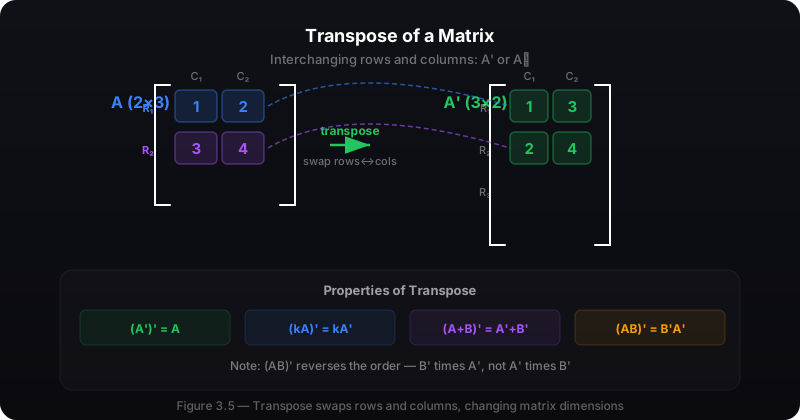
The (i, j)th element of A' = the (j, i)th element of A
Properties of Transpose
| Property | Statement | Meaning |
|---|---|---|
| Double Transpose | (A')' = A | Transposing twice returns original |
| Scalar Multiple | (kA)' = kA' | Scalar factors come out |
| Addition | (A + B)' = A' + B' | Transpose distributes over addition |
| Multiplication | (AB)' = B'A' | Order reverses! |
(AB)' = B'A', not A'B'! The order of multiplication reverses when taking the transpose of a product.
3.6 Symmetric & Skew-Symmetric Matrices
These special types of square matrices have a beautiful relationship with the transpose operation.

Symmetric Matrix
A' = A, meaning aᵢⱼ = aⱼᵢ for all i, j. The matrix mirrors about its main diagonal.
Skew-Symmetric Matrix
A' = −A, meaning aᵢⱼ = −aⱼᵢ. All diagonal elements must be 0.
Theorems
For any square matrix A with real entries:
A + A' is always a symmetric matrix
A − A' is always a skew-symmetric matrix
Any square matrix can be expressed as the sum of a symmetric and a skew-symmetric matrix:
A = ½(A + A') + ½(A − A')
where ½(A + A') is symmetric and ½(A − A') is skew-symmetric.
3.7 Elementary Operations
There are six elementary operations (transformations) on a matrix — three for rows and three for columns. These are fundamental for finding inverses and solving systems.
| Operation | Row Version | Column Version | Description |
|---|---|---|---|
| Type 1 | Rᵢ ↔ Rⱼ | Cᵢ ↔ Cⱼ | Interchange two rows (or columns) |
| Type 2 | Rᵢ → kRᵢ (k ≠ 0) | Cᵢ → kCᵢ (k ≠ 0) | Multiply a row (or column) by a non-zero scalar |
| Type 3 | Rᵢ → Rᵢ + kRⱼ | Cᵢ → Cᵢ + kCⱼ | Add a multiple of one row (or column) to another |
Starting with A = [1, 2; 2, 1]:
Row 2 becomes: [2, 1] − 2×[1, 2] = [2−2, 1−4] = [0, −3]
Result: [1, 2; 0, −3] — This is the first step in converting to row echelon form!
3.8 Invertible Matrices
A square matrix A is invertible if there exists another square matrix B of the same order such that AB = BA = I (the identity matrix). We write B = A⁻¹.
A square matrix A of order m is invertible if there exists B such that:
AB = BA = Iₘ
Then B is the inverse of A, denoted A⁻¹, and A is the inverse of B.
Key Theorems
Uniqueness
Inverse of a square matrix, if it exists, is unique.
Reversal Law
(AB)⁻¹ = B⁻¹A⁻¹ — order reverses!
Finding Inverse Using Elementary Operations
To find A⁻¹ using row operations:
Step 1: Write A = IA
Step 2: Apply row operations on both sides until LHS becomes I
Step 3: When LHS = I, RHS = A⁻¹
If any row becomes all zeros during the process, A⁻¹ does not exist.
• A rectangular matrix does not have an inverse
• If B is the inverse of A, then A is also the inverse of B
• Inverse is unique — there cannot be two different inverses for the same matrix
3.9 Summary
• A matrix is an ordered rectangular array of numbers of order m × n
• Seven types: column, row, square, diagonal, scalar, identity, zero
• Addition: same order, element-wise — commutative and associative
• Scalar multiplication: multiply every element by the scalar
• Multiplication: row × column dot product — NOT commutative (AB ≠ BA)
• Transpose: interchange rows and columns — (AB)' = B'A'
• Symmetric: A' = A · Skew-symmetric: A' = −A (diagonal = 0)
• Any square matrix = symmetric + skew-symmetric
• 6 elementary operations: interchange, scale, add multiple
• Inverse: AB = BA = I → B = A⁻¹ (unique if exists)