Inverse Trigonometric Functions
Undoing trigonometry — finding angles from ratios with restricted domains
In this chapter
2.1 Why Restrictions?
"Mathematics, in general, is fundamentally the science of self-evident things." — Felix Klein
Regular trig functions like sin x, cos x, and tan x are not one-one over their natural domains — they repeat values. This means they don't have inverses unless we restrict their domains.
sin(30°) = 0.5 AND sin(150°) = 0.5
If we ask "what angle gives 0.5?", there are infinitely many answers! For an inverse to exist, we need exactly ONE answer.
We restrict the domain to an interval where the function is one-one, then define the inverse on that restricted domain.
For sin x: restrict to [-π/2, π/2] where it's one-one
For cos x: restrict to [0, π] where it's one-one
For tan x: restrict to (-π/2, π/2) where it's one-one
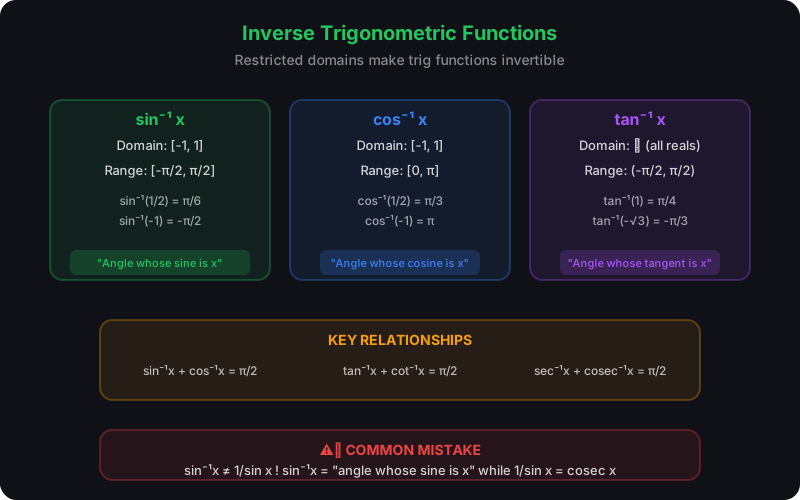
2.2 Principal Value Branches
The principal value branch is the "default" range we choose for each inverse trig function — the one that's most natural and commonly used.
| Function | Domain | Principal Value Range |
|---|---|---|
| sin⁻¹ x | [-1, 1] | [-π/2, π/2] |
| cos⁻¹ x | [-1, 1] | [0, π] |
| tan⁻¹ x | ℝ (all reals) | (-π/2, π/2) |
| cosec⁻¹ x | ℝ - (-1, 1) | [-π/2, π/2] - {0} |
| sec⁻¹ x | ℝ - (-1, 1) | [0, π] - {π/2} |
| cot⁻¹ x | ℝ (all reals) | (0, π) |
sin⁻¹ and cosec⁻¹: Range is [-π/2, π/2] (the "right half" of the unit circle)
cos⁻¹ and sec⁻¹: Range is [0, π] (the "upper half" of the unit circle)
tan⁻¹ and cot⁻¹: Range is (-π/2, π/2) or (0, π) (similar to sin/cos but for angles)
sin⁻¹x ≠ 1/sin x
sin⁻¹x means "the angle whose sine is x"
1/sin x means "one divided by sin x" = cosec x
These are completely different!
2.3 Properties of Inverse Trig Functions
These properties are essential for solving problems and simplifying expressions.
Reciprocal Relationships
sin⁻¹(1/x) = cosec⁻¹x for |x| ≥ 1
cos⁻¹(1/x) = sec⁻¹x for |x| ≥ 1
tan⁻¹(1/x) = cot⁻¹x for x > 0
Negative Arguments
sin⁻¹(-x) = -sin⁻¹x (odd function)
tan⁻¹(-x) = -tan⁻¹x (odd function)
cosec⁻¹(-x) = -cosec⁻¹x (odd function)
cos⁻¹(-x) = π - cos⁻¹x (NOT negative!)
sec⁻¹(-x) = π - sec⁻¹x
cot⁻¹(-x) = π - cot⁻¹x
Complementary Relationships
sin⁻¹x + cos⁻¹x = π/2
tan⁻¹x + cot⁻¹x = π/2
cosec⁻¹x + sec⁻¹x = π/2
The inverse functions are "complementary" — they add up to 90°!

2.4 Key Formulas
Double Angle Formulas
2tan⁻¹x = sin⁻¹(2x/(1+x²)) for |x| ≤ 1
2tan⁻¹x = cos⁻¹((1-x²)/(1+x²)) for x ≥ 0
2tan⁻¹x = tan⁻¹(2x/(1-x²)) for -1 < x < 1
Addition Formulas
tan⁻¹x + tan⁻¹y = tan⁻¹((x+y)/(1-xy)) when xy < 1
tan⁻¹x + tan⁻¹y = π + tan⁻¹((x+y)/(1-xy)) when xy > 1 and x, y > 0
tan⁻¹x - tan⁻¹y = tan⁻¹((x-y)/(1+xy)) when xy > -1
These formulas let you combine multiple inverse trig functions into one, simplify complex expressions, and solve equations involving inverse trig functions.
2.5 Applications
Finding Principal Values
Question: What angle in [-π/2, π/2] has sine = 1/2?
Answer: π/6 (30°)
Because sin(π/6) = 1/2 and π/6 is in the principal value range.
Solving Equations
Using addition formula:
tan⁻¹((2x+3x)/(1-2x·3x)) = π/4
(5x)/(1-6x²) = tan(π/4) = 1
5x = 1 - 6x²
6x² + 5x - 1 = 0
(6x-1)(x+1) = 0
x = 1/6 or x = -1
Check: x = -1 doesn't work (gives negative), so x = 1/6
Proving Identities
Let sin⁻¹(3/5) = α and sin⁻¹(8/17) = β
Then sin α = 3/5, cos α = 4/5
sin β = 8/17, cos β = 15/17
sin(α+β) = sin α cos β + cos α sin β
= (3/5)(15/17) + (4/5)(8/17) = 77/85
Wait, that's not 36/85. Let me recheck...
Actually, we need cos(α+β) = cos α cos β - sin α sin β
= (4/5)(15/17) - (3/5)(8/17) = 36/85 ✓
2.6 Summary
• Inverse trig functions require restricted domains to be one-one
• Principal value branches: sin⁻¹[-π/2,π/2], cos⁻¹[0,π], tan⁻¹(-π/2,π/2)
• sin⁻¹x ≠ 1/sin x — it means "angle whose sine is x"
• Negative arguments: sin⁻¹(-x) = -sin⁻¹x, but cos⁻¹(-x) = π - cos⁻¹x
• Complementary pairs: sin⁻¹x + cos⁻¹x = π/2
• Addition formula: tan⁻¹x + tan⁻¹y = tan⁻¹((x+y)/(1-xy))
• Double angle: 2tan⁻¹x = sin⁻¹(2x/(1+x²)) = cos⁻¹((1-x²)/(1+x²))