Limits and Derivatives
The foundation of calculus — understanding change through limits and rates of change
In this chapter
12.1 Intuitive Idea of Derivatives
"With the Calculus as a key, Mathematics can be successfully applied to the explanation of the course of Nature." — Whitehead
Calculus is the mathematics of change. It helps us understand how things change — velocity, growth, rates, slopes. The derivative is the heart of calculus: it tells us the instantaneous rate of change of a function.
The Velocity Problem
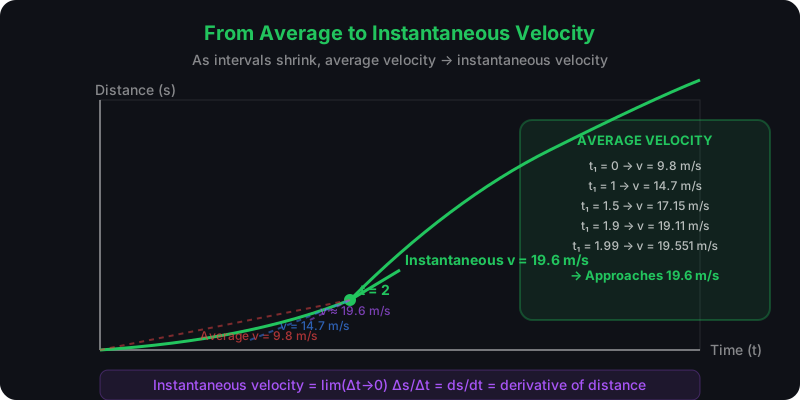
Imagine a ball dropped from a cliff. Its distance is s = 4.9t² meters after t seconds. How fast is it moving at t = 2 seconds?
Average velocity = distance ÷ time (over an interval)
Instantaneous velocity = velocity at an exact moment
As we make the time interval smaller and smaller, the average velocity approaches the instantaneous velocity. This is the limiting process!
At t = 2 seconds, the velocity is approximately 19.6 m/s.
We find this by computing average velocities over smaller and smaller intervals around t = 2, and seeing what value they approach.
12.2 Limits
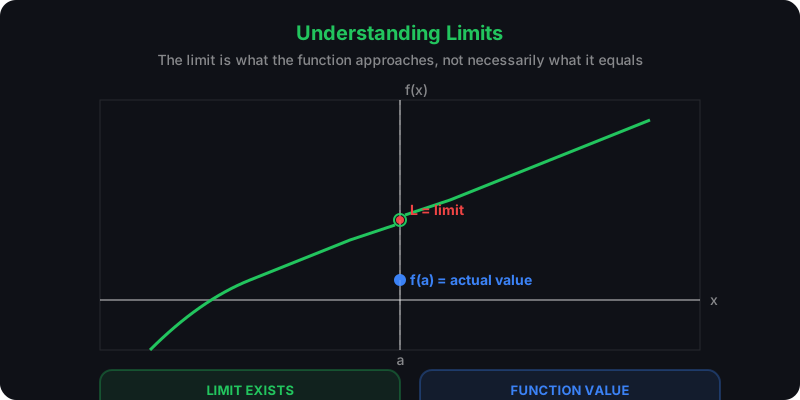
A limit is the value a function approaches as the input approaches a certain point. It's the foundation of calculus.
If f(x) gets closer and closer to L as x approaches a, we write:
lim(x→a) f(x) = L
"The limit of f(x) as x approaches a equals L"
Left-Hand and Right-Hand Limits
Left-Hand Limit
lim(x→a⁻) f(x) — what f(x) approaches as x comes from the LEFT side
Right-Hand Limit
lim(x→a⁺) f(x) — what f(x) approaches as x comes from the RIGHT side
The limit exists only if the left-hand limit equals the right-hand limit:
lim(x→a⁻) f(x) = lim(x→a⁺) f(x) = L
If they're different, the limit does NOT exist!
Important: Limit ≠ Function Value
The limit lim(x→a) f(x) describes what f(x) approaches, not what f(a) actually equals.
They can be different! Example: f(x) = (x²-4)/(x-2) is undefined at x=2, but lim(x→2) f(x) = 4.
12.3 Algebra of Limits
Limits follow algebraic rules that make calculations much easier:
If lim f(x) = L and lim g(x) = M exist, then:
Sum: lim[f(x) + g(x)] = L + M
Difference: lim[f(x) - g(x)] = L - M
Product: lim[f(x) · g(x)] = L · M
Quotient: lim[f(x)/g(x)] = L/M (if M ≠ 0)
Constant: lim[k · f(x)] = k · L
Standard Limits
Polynomial: lim(x→a) xⁿ = aⁿ
Rational: lim(x→a) [f(x)/g(x)] = f(a)/g(a) if g(a) ≠ 0
Special limit:
lim(x→a) (xⁿ - aⁿ)/(x - a) = n·aⁿ⁻¹
Example: Rational Function
Direct substitution gives 0/0 (indeterminate).
Factor: (x²-4) = (x-2)(x+2)
Cancel: (x-2)(x+2)/(x-2) = x+2
Now: lim(x→2) (x+2) = 4 ✓
12.4 Limits of Trigonometric Functions
Two crucial limits for trigonometric functions:
lim(x→0) sin(x)/x = 1
lim(x→0) (1 - cos x)/x = 0
These are fundamental! Many trig limits are solved by reducing to these forms.
The Sandwich Theorem
If f(x) ≤ g(x) ≤ h(x) near a, and lim f(x) = lim h(x) = L, then:
lim g(x) = L
If g(x) is "squeezed" between f(x) and h(x), and both approach L, then g(x) must also approach L.
Example: Finding Trig Limits
Rewrite: [sin(4x)/4x] × [2x/sin(2x)] × (4x/2x)
= 1 × 1 × 2 = 2
Using lim(u→0) sin(u)/u = 1
12.5 Derivatives
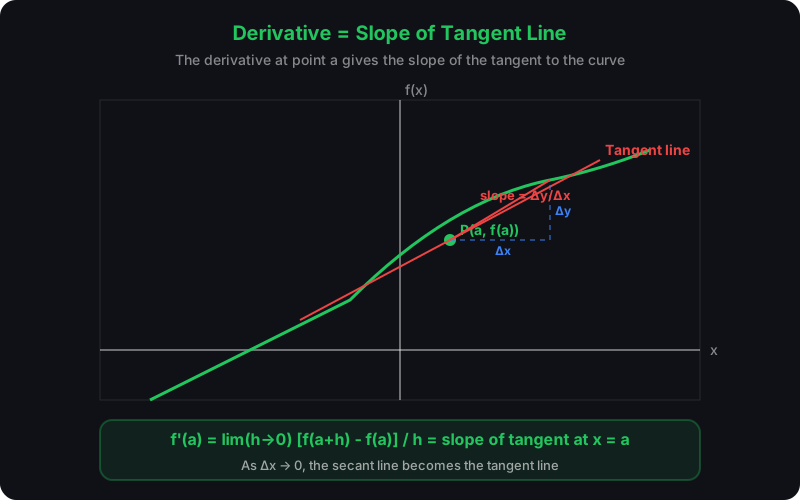
The derivative measures the instantaneous rate of change of a function. Geometrically, it's the slope of the tangent line at a point.
f'(x) = lim(h→0) [f(x+h) - f(x)] / h
This is the first principle of derivatives — the fundamental definition from which all rules are derived.
f'(a) = lim(h→0) [f(a+h) - f(a)] / h
This gives the slope of the tangent line to y = f(x) at x = a.
Geometric Interpretation
The derivative f'(a) equals the slope of the line tangent to the curve at point (a, f(a)).
• Positive derivative → function increasing
• Negative derivative → function decreasing
• Zero derivative → horizontal tangent (potential max/min)
12.6 Algebra of Derivatives
Instead of using the limit definition every time, we have rules that make differentiation easy:
Basic Rules
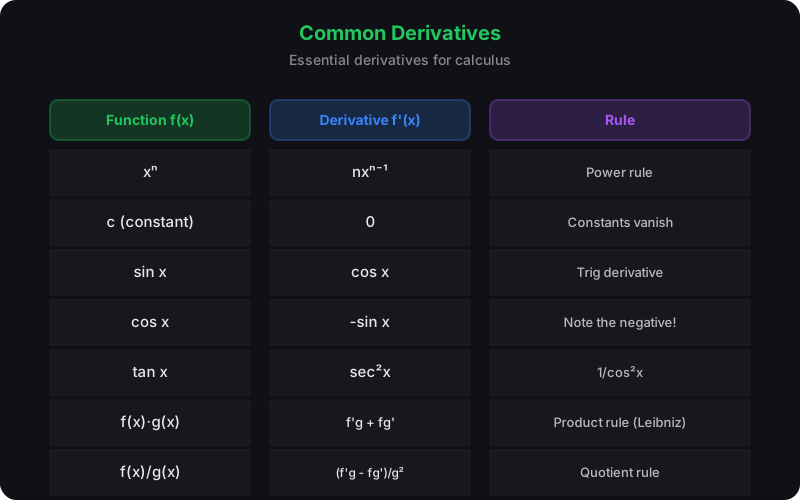
Constant: d/dx [c] = 0
Power: d/dx [xⁿ] = nxⁿ⁻¹
Constant multiple: d/dx [cf(x)] = c·f'(x)
Sum/Difference: d/dx [f(x) ± g(x)] = f'(x) ± g'(x)
Product and Quotient Rules
d/dx [f(x)·g(x)] = f'(x)·g(x) + f(x)·g'(x)
Memory: "derivative of first × second + first × derivative of second"
d/dx [f(x)/g(x)] = [f'(x)·g(x) - f(x)·g'(x)] / [g(x)]²
Memory: "low d-high minus high d-low, over low squared"
Derivatives of Trig Functions
| Function | Derivative |
|---|---|
| sin x | cos x |
| cos x | -sin x |
| tan x | sec²x |
| cot x | -cosec²x |
| sec x | sec x · tan x |
| cosec x | -cosec x · cot x |
Examples
d/dx(x²) = 2x²⁻¹ = 2x ✓
f'(x) = lim(h→0) [sin(x+h) - sin x] / h
= lim(h→0) [2cos(x+h/2)sin(h/2)] / h
= cos x · lim(h→0) sin(h/2)/(h/2)
= cos x · 1 = cos x ✓
12.7 Summary
• Limit: lim(x→a) f(x) = L means f(x) approaches L as x approaches a.
• Left/Right Limits: Must be equal for the limit to exist.
• Limit Laws: Sum, difference, product, quotient rules for limits.
• Key Trig Limits: lim sin(x)/x = 1, lim (1-cos x)/x = 0
• Derivative: f'(x) = lim(h→0) [f(x+h) - f(x)] / h
• Geometric meaning: Derivative = slope of tangent line
• Power rule: d/dx[xⁿ] = nxⁿ⁻¹
• Product rule: (fg)' = f'g + fg'
• Quotient rule: (f/g)' = (f'g - fg') / g²
• Trig derivatives: d/dx(sin x) = cos x, d/dx(cos x) = -sin x