Introduction to Three Dimensional Geometry
From 2D to 3D — extending coordinate geometry into space with x, y, and z axes
In this chapter
11.1 Coordinate Axes and Planes
"Mathematics is both the queen and the hand-maiden of all sciences." — E.T. Bell
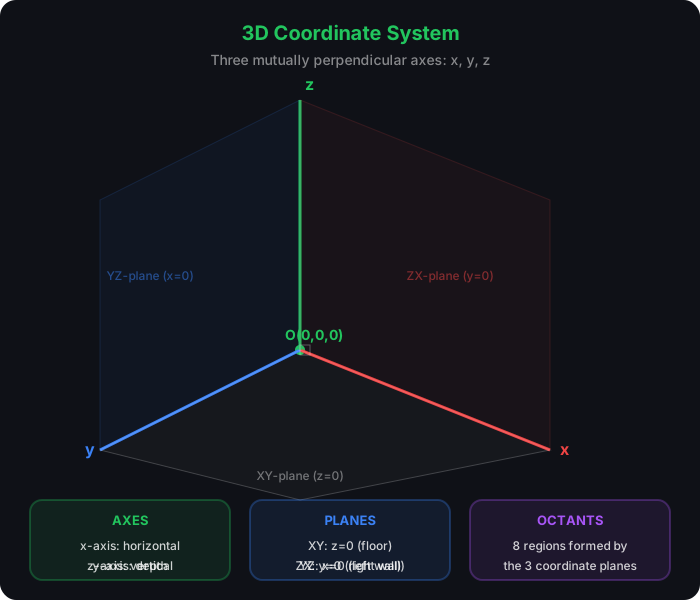
In 2D geometry, we locate points using two perpendicular axes (x and y). In 3D geometry, we add a third axis — the z-axis — that's perpendicular to both x and y axes. This lets us describe positions in space, not just on a flat surface.
The Three Axes
x-axis
Horizontal axis. Points on it have coordinates (x, 0, 0).
y-axis
Vertical axis. Points on it have coordinates (0, y, 0).
z-axis
Perpendicular to both x and y. Points on it have coordinates (0, 0, z).
Origin
Where all three axes meet. Coordinates: (0, 0, 0).
Coordinate Planes
Each pair of axes defines a plane:
XY-plane: z = 0 (the "floor")
YZ-plane: x = 0 (left wall)
ZX-plane: y = 0 (right wall)
These three planes divide space into 8 regions called octants.
11.2 Coordinates in 3D Space
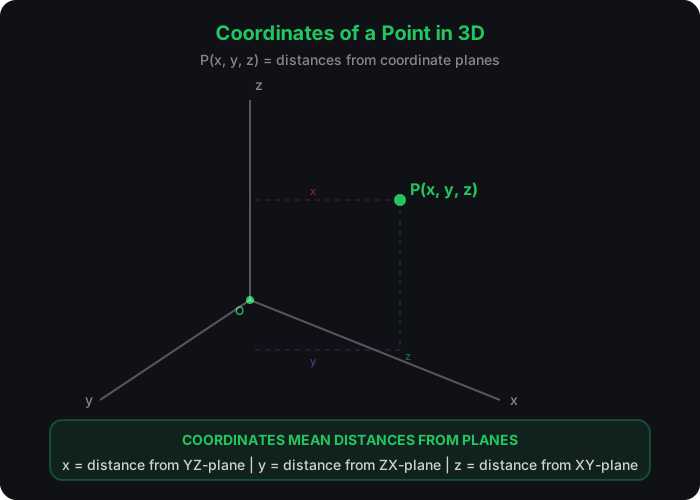
A point in 3D space is represented by an ordered triplet (x, y, z) where:
x = distance from YZ-plane (right/left)
y = distance from ZX-plane (forward/back)
z = distance from XY-plane (up/down)
Example: Point (2, 4, 5) is 2 units from YZ-plane, 4 units from ZX-plane, and 5 units above XY-plane.
Coordinates can be positive or negative:
• Positive x: in front of YZ-plane
• Negative x: behind YZ-plane
• Positive y: right of ZX-plane
• Negative y: left of ZX-plane
• Positive z: above XY-plane
• Negative z: below XY-plane
11.3 Octants
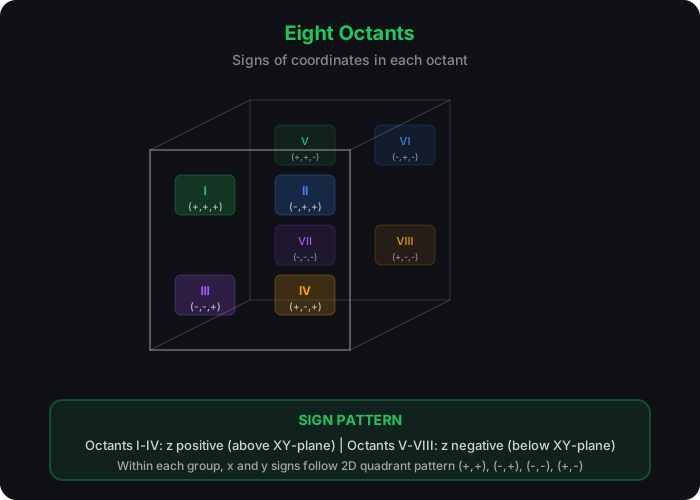
The three coordinate planes divide space into 8 octants (like 4 quadrants in 2D, but doubled).
Octant I: (+, +, +) — all positive
Octant II: (-, +, +)
Octant III: (-, -, +)
Octant IV: (+, -, +)
Octant V: (+, +, -)
Octant VI: (-, +, -)
Octant VII: (-, -, -) — all negative
Octant VIII: (+, -, -)
First 4 octants (I-IV) have positive z (above XY-plane).
Last 4 octants (V-VIII) have negative z (below XY-plane).
Within each group, the signs follow the 2D quadrant pattern!
11.4 Distance Formula in 3D
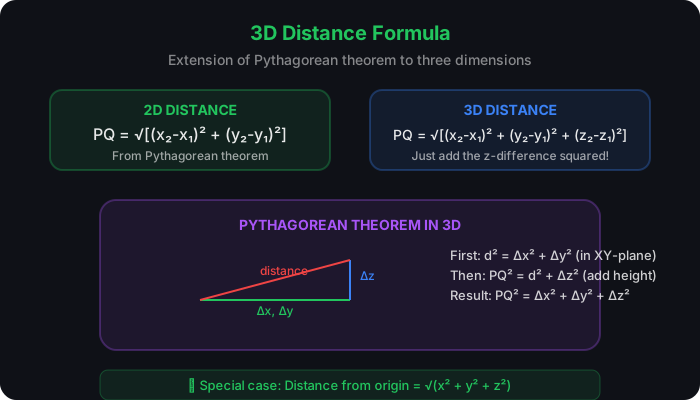
The distance formula extends naturally from 2D to 3D — just add the z-difference squared!
Distance from origin O(0,0,0) to point P(x,y,z):
OP = √(x² + y² + z²)
Example: Distance from origin to (2, 3, 6) = √(4 + 9 + 36) = √49 = 7
Applications
Three points are collinear if they lie on the same line:
Check if PQ + QR = PR
Example: P(-2,3,5), Q(1,2,3), R(7,0,-1)
PQ = √14, QR = √56 = 2√14, PR = √126 = 3√14
√14 + 2√14 = 3√14 ✓ → Points are collinear!
Check if a² + b² = c² (Pythagorean theorem in 3D)
Calculate all three side lengths squared. If the sum of two equals the third, it's a right triangle.
11.5 Applications
Finding Coordinates
Given three vertices of parallelogram ABCD: A(3,-1,2), B(1,2,-4), C(-1,1,2). Find D.
In a parallelogram, diagonals bisect each other. So midpoint of AC = midpoint of BD.
Midpoint of AC = ((3-1)/2, (-1+1)/2, (2+2)/2) = (1, 0, 2)
Let D = (x, y, z). Midpoint of BD = ((1+x)/2, (2+y)/2, (-4+z)/2)
Setting equal: x = 1, y = -2, z = 8 → D(1, -2, 8)
Centroid G of triangle with vertices A(x₁,y₁,z₁), B(x₂,y₂,z₂), C(x₃,y₃,z₃):
G = ((x₁+x₂+x₃)/3, (y₁+y₂+y₃)/3, (z₁+z₂+z₃)/3)
The centroid is the average of all three vertices.
11.6 Summary
• 3D Coordinate System: Three mutually perpendicular axes (x, y, z) meeting at origin.
• Coordinate Planes: XY-plane (z=0), YZ-plane (x=0), ZX-plane (y=0).
• Point Representation: P(x, y, z) where x, y, z are distances from coordinate planes.
• Octants: 8 regions formed by coordinate planes. Signs follow pattern (+,+,+) in Octant I.
• Distance Formula: PQ = √[(x₂-x₁)² + (y₂-y₁)² + (z₂-z₁)²]
• Special Points: On x-axis: (x,0,0). On y-axis: (0,y,0). On z-axis: (0,0,z).
• Collinearity: Points are collinear if PQ + QR = PR.
• Centroid: Average of all three vertices.