Conic Sections
Curves created by slicing a cone — circles, parabolas, ellipses, and hyperbolas are everywhere in nature and engineering
10.1 Sections of a Cone
"Let the relation of knowledge to real life be very visible to your pupils and let them understand how by knowledge the world could be transformed." — Bertrand Russell
Conic sections are curves obtained by intersecting a double-napped cone with a plane. The word "parabola" and "hyperbola" were given by Apollonius. These curves have amazing applications — from planetary orbits to satellite dishes to car headlights!
How to Create Each Conic
Imagine a double-napped cone (like two ice cream cones stuck together). Slice it with a plane at different angles:
Circle: Plane perpendicular to axis (β = 90°)
Ellipse: Plane tilted but cuts one nappe (α < β < 90°)
Parabola: Plane parallel to side (β = α)
Hyperbola: Plane cuts both nappes (β < α)

10.2 Circle
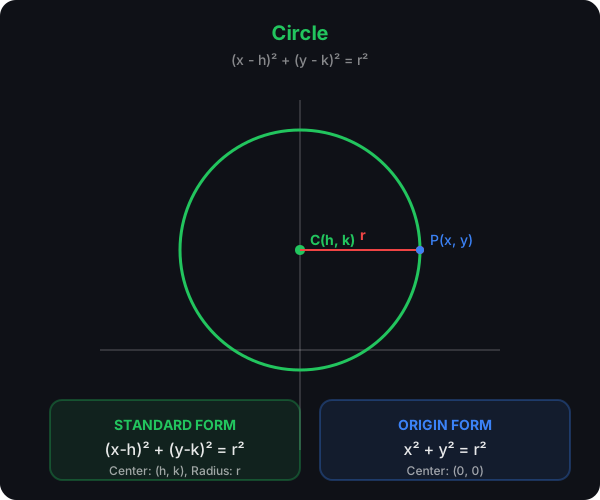
A circle is the set of all points equidistant from a fixed point (the center).
Center (h, k), radius r:
(x - h)² + (y - k)² = r²
Special case: Center at origin → x² + y² = r²
Finding Center and Radius
Given: x² + y² + 8x + 10y - 8 = 0
Step 1: Group x and y terms: (x² + 8x) + (y² + 10y) = 8
Step 2: Complete the square: (x + 4)² + (y + 5)² = 49
Step 3: Read off center and radius: Center (-4, -5), r = 7
10.3 Parabola
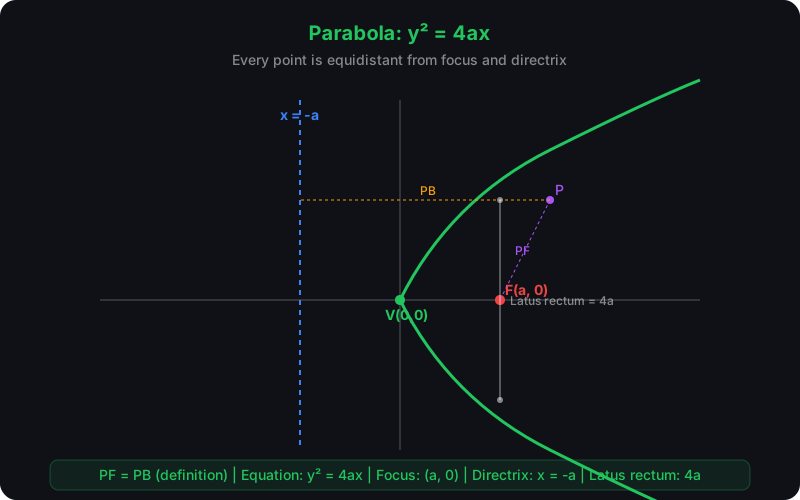
A parabola is the set of all points equidistant from a fixed point (focus) and a fixed line (directrix). The name means "throwing" in Greek — the path of a thrown ball!
y² = 4ax — Opens right, focus (a, 0)
y² = -4ax — Opens left, focus (-a, 0)
x² = 4ay — Opens up, focus (0, a)
x² = -4ay — Opens down, focus (0, -a)
Key Elements
Focus
Fixed point inside the parabola. For y² = 4ax, focus is at (a, 0).
Directrix
Fixed line outside the parabola. For y² = 4ax, directrix is x = -a.
Latus Rectum
Line through focus, perpendicular to axis. Length = 4a.
Axis of Symmetry
Line through focus and vertex. Parabola is symmetric about this line.
10.4 Ellipse
An ellipse is the set of all points where the sum of distances from two fixed points (foci) is constant. Think of it as a "stretched circle."
Foci on x-axis: x²/a² + y²/b² = 1 (a > b)
Foci on y-axis: x²/b² + y²/a² = 1 (a > b)
Where: a = semi-major axis, b = semi-minor axis, c = distance from center to focus
Relationship: c² = a² - b²
Eccentricity
e = c/a where 0 < e < 1
• e close to 0: nearly circular
• e close to 1: very elongated
• Earth's orbit: e ≈ 0.017 (nearly circular)
Latus Rectum
Length = 2b²/a
It's the chord through a focus, perpendicular to the major axis.

10.5 Hyperbola
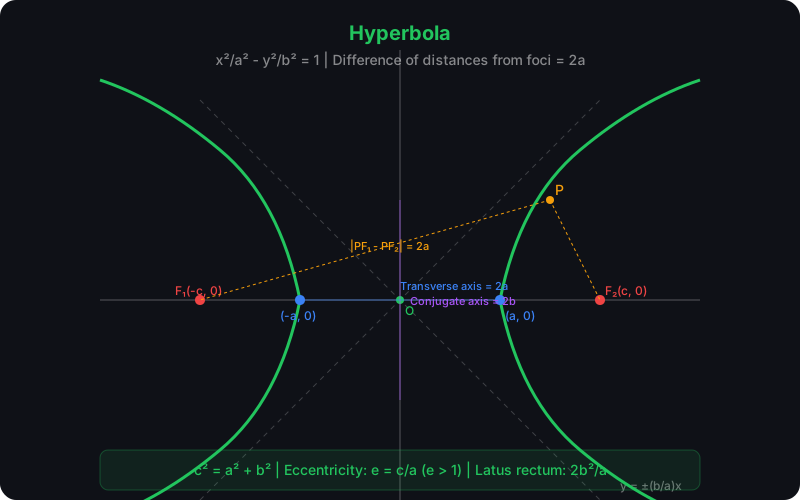
A hyperbola is the set of all points where the difference of distances from two fixed points (foci) is constant. It has two separate branches.
Foci on x-axis: x²/a² - y²/b² = 1
Foci on y-axis: y²/a² - x²/b² = 1
Where: a = semi-transverse axis, b = semi-conjugate axis
Relationship: c² = a² + b² (note: plus, not minus!)
Eccentricity
e = c/a where e > 1
• e close to 1: branches close together
• e large: branches far apart
• Comet orbits often have high eccentricity
Asymptotes
Hyperbola approaches but never touches these lines:
For x²/a² - y²/b² = 1: y = ±(b/a)x
Asymptotes are the diagonals of the "fundamental rectangle" with dimensions 2a × 2b.
10.6 Summary
• Circle: (x-h)² + (y-k)² = r². All points equidistant from center.
• Parabola: y² = 4ax. Equidistant from focus and directrix. Latus rectum = 4a.
• Ellipse: x²/a² + y²/b² = 1. Sum of distances from foci = 2a. c² = a² - b². Latus rectum = 2b²/a.
• Hyperbola: x²/a² - y²/b² = 1. Difference of distances = 2a. c² = a² + b². Latus rectum = 2b²/a.
• Eccentricity: Circle: e=0, Ellipse: 0