Straight Lines
Describing lines algebraically — from slope and intercepts to distance formulas
In this chapter
9.1 Slope of a Line
"Geometry, as a logical system, is a means to make children feel the strength of the human spirit." — H. Freudenthal
Coordinate geometry combines algebra and geometry, pioneered by René Descartes in 1637. The most important concept for straight lines is slope — how steep a line is.
What is Slope?
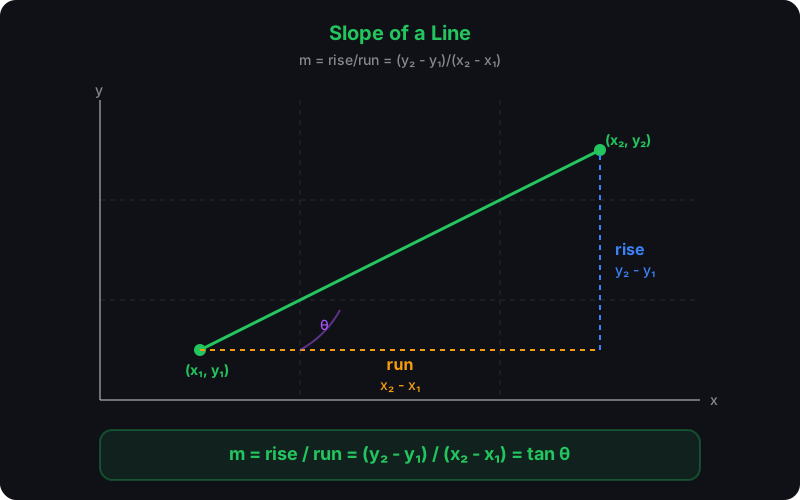
The inclination of a line is the angle θ it makes with the positive x-axis (measured counterclockwise). The slope is:
Horizontal Line
θ = 0°, slope m = 0. The line is flat.
Vertical Line
θ = 90°, slope is undefined. The line is straight up.
Finding Slope from Two Points
For points (x₁, y₁) and (x₂, y₂):
m = (y₂ - y₁) / (x₂ - x₁)
Example: Points (3, -2) and (-1, 4)
m = (4 - (-2)) / (-1 - 3) = 6 / -4 = -3/2
9.2 Parallel and Perpendicular Lines
Parallel Lines
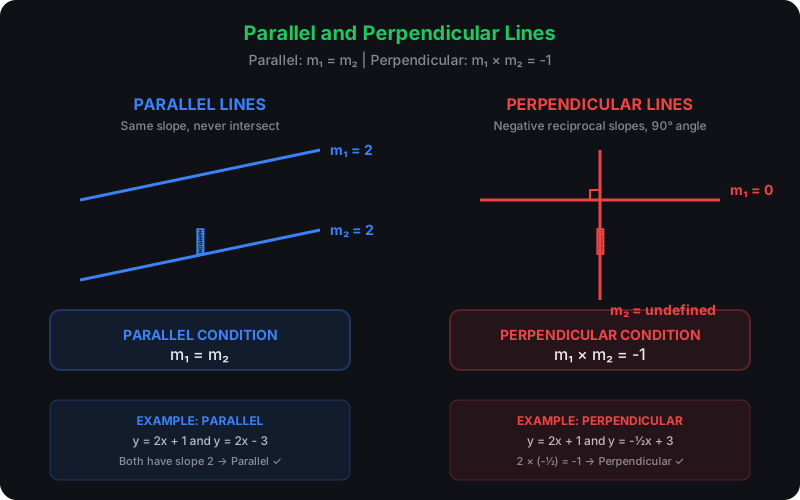
Two lines are parallel if and only if their slopes are equal.
m₁ = m₂
Example: Lines with slopes 3 and 3 are parallel.
Perpendicular Lines
Two lines are perpendicular if and only if the product of their slopes is -1.
m₁ × m₂ = -1 or m₂ = -1/m₁
Example: If one line has slope 2, the perpendicular line has slope -1/2.
Parallel lines have the same slope (they go in the same direction).
Perpendicular lines have negative reciprocal slopes (one goes up, other goes down at right angle).
9.3 Angle Between Lines
The acute angle θ between two lines with slopes m₁ and m₂:
Angle between lines with slopes 1/2 and 3:
tan θ = |(3 - 1/2) / (1 + 3×1/2)| = |(5/2) / (5/2)| = 1
θ = 45°
• If m₁ = m₂: lines are parallel, angle = 0°
• If m₁ × m₂ = -1: lines are perpendicular, angle = 90°
• If 1 + m₁m₂ = 0: denominator is zero, lines are perpendicular
9.4 Equations of Lines
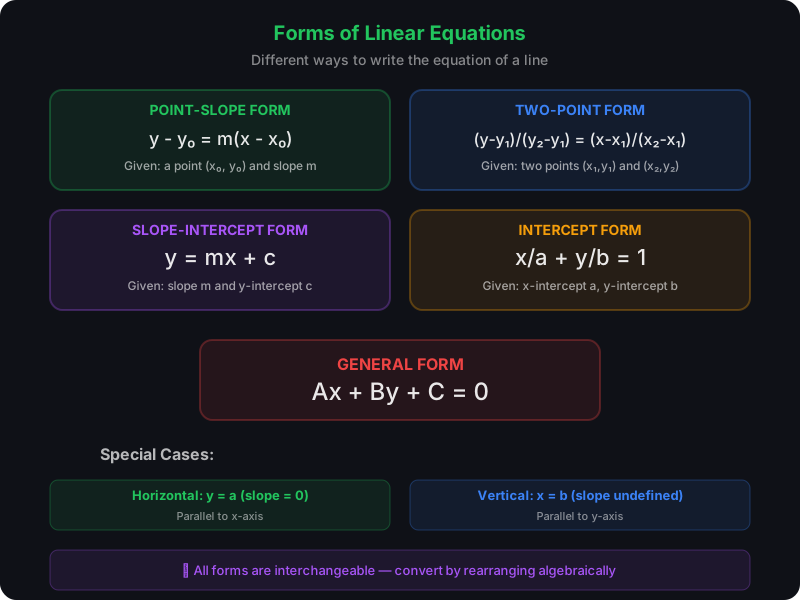
There are several ways to write the equation of a line, depending on what information you have.
Point-Slope Form
y - y₀ = m(x - x₀)
Example: Line through (-2, 3) with slope -4:
y - 3 = -4(x + 2) → 4x + y + 5 = 0
Two-Point Form
(y - y₁)/(y₂ - y₁) = (x - x₁)/(x₂ - x₁)
Example: Line through (1, -1) and (3, 5):
(y + 1)/(5 + 1) = (x - 1)/(3 - 1) → 3x - y - 4 = 0
Slope-Intercept Form
y = mx + c
The line crosses the y-axis at (0, c). This is the most common form!
Intercept Form
x/a + y/b = 1
Example: Line with x-intercept 3 and y-intercept 2:
x/3 + y/2 = 1 → 2x + 3y = 6
General Form
Ax + By + C = 0
Any line can be written in this form. A and B cannot both be zero.
9.5 Distance Formulas
Distance of a Point from a Line
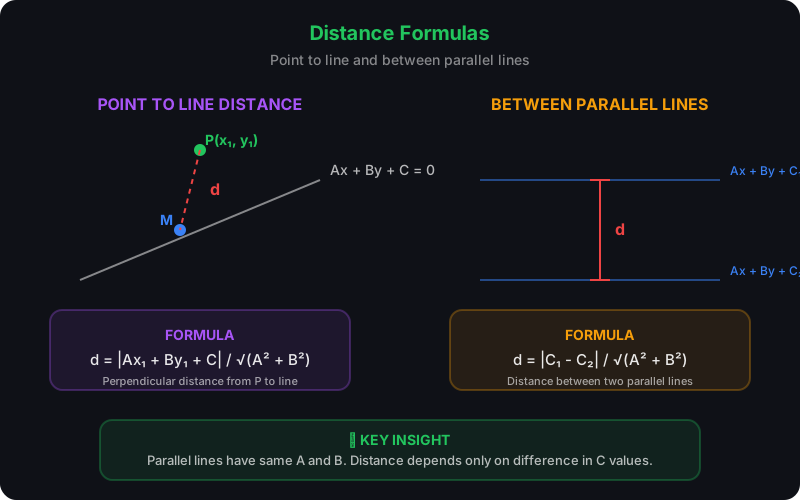
Distance from point (x₁, y₁) to line Ax + By + C = 0:
d = |Ax₁ + By₁ + C| / √(A² + B²)
Example: Distance from (3, -5) to 3x - 4y - 26 = 0:
d = |3(3) - 4(-5) - 26| / √(9 + 16) = |9 + 20 - 26| / 5 = 3/5
Distance Between Parallel Lines
For parallel lines Ax + By + C₁ = 0 and Ax + By + C₂ = 0:
d = |C₁ - C₂| / √(A² + B²)
Example: Lines 3x - 4y + 7 = 0 and 3x - 4y + 5 = 0:
d = |7 - 5| / √(9 + 16) = 2/5
Parallel lines have the same A and B coefficients. The distance formula only uses the difference in C values — the constant terms.
9.6 Summary
• Slope: m = tan θ = (y₂-y₁)/(x₂-x₁). Horizontal: m=0. Vertical: undefined.
• Parallel: m₁ = m₂
• Perpendicular: m₁ × m₂ = -1
• Angle between lines: tan θ = |(m₂-m₁)/(1+m₁m₂)|
• Point-slope: y - y₀ = m(x - x₀)
• Slope-intercept: y = mx + c
• Intercept form: x/a + y/b = 1
• General form: Ax + By + C = 0
• Distance from point: d = |Ax₁+By₁+C| / √(A²+B²)
• Distance between parallel lines: d = |C₁-C₂| / √(A²+B²)