Complex Numbers and Quadratic Equations
Extending the real number system to solve the impossible — where i² = -1 opens new mathematical worlds
In this chapter
4.1 What are Complex Numbers?
"Mathematics is the Queen of Sciences and Arithmetic is the Queen of Mathematics." — Gauss
In earlier classes, you learned that the equation x² + 1 = 0 has no real solution because x² = -1, and the square of every real number is non-negative. But what if we invented a number that solves this equation?
That's exactly what mathematicians did. They defined i (the imaginary unit) as:
Complex Numbers
A complex number is a number of the form a + ib, where a and b are real numbers.
Real Part
The number a is called the real part, written as Re(z). It's the "normal" part.
Imaginary Part
The number b is called the imaginary part, written as Im(z). It's multiplied by i.
• 2 + i3 → Re = 2, Im = 3
• -1 + i√3 → Re = -1, Im = √3
• 4 (which is 4 + i0) → Re = 4, Im = 0 (purely real)
• i5 (which is 0 + i5) → Re = 0, Im = 5 (purely imaginary)
Equality of Complex Numbers
z₁ = z₂ if and only if Re(z₁) = Re(z₂) AND Im(z₁) = Im(z₂)
Example: If 4x + i(3x - y) = 3 + i(-6), then:
• 4x = 3 → x = 3/4
• 3x - y = -6 → y = 33/4
4.2 Algebra of Complex Numbers
Complex numbers follow the same algebraic rules as real numbers, with one special rule: i² = -1.
Addition
(a + ib) + (c + id) = (a + c) + i(b + d)
Example: (2 + i3) + (-6 + i5) = -4 + i8
Properties: Commutative, Associative, Identity (0 + i0), Inverse (-a - ib)
Subtraction
(a + ib) - (c + id) = (a - c) + i(b - d)
Example: (6 + 3i) - (2 - i) = 4 + 4i
Multiplication
(a + ib)(c + id) = (ac - bd) + i(ad + bc)
Example: (3 + i5)(2 + i6) = (6 - 30) + i(18 + 10) = -24 + i28
Remember: i² = -1, so the "ac - bd" part comes from i² = -1.
Division
To divide, multiply numerator and denominator by the conjugate of the denominator:
(a + ib) / (c + id) = [(a + ib)(c - id)] / [(c + id)(c - id)]
This removes i from the denominator because (c + id)(c - id) = c² + d² (a real number).
Properties of Complex Number Algebra
| Property | Addition | Multiplication |
|---|---|---|
| Closure | z₁ + z₂ is complex | z₁ × z₂ is complex |
| Commutative | z₁ + z₂ = z₂ + z₁ | z₁z₂ = z₂z₁ |
| Associative | (z₁+z₂)+z₃ = z₁+(z₂+z₃) | (z₁z₂)z₃ = z₁(z₂z₃) |
| Identity | z + 0 = z | z × 1 = z |
| Inverse | z + (-z) = 0 | z × (1/z) = 1, z ≠ 0 |
| Distributive | z₁(z₂ + z₃) = z₁z₂ + z₁z₃ | |
Multiplicative Inverse
For z = a + ib (where a ≠ 0 or b ≠ 0):
z⁻¹ = (a - ib) / (a² + b²)
Example: Inverse of 2 - 3i = (2 + 3i) / (4 + 9) = (2 + 3i) / 13
4.3 Power of i
The powers of i follow a cyclic pattern that repeats every 4 powers:
After i⁴ = 1, the pattern repeats:
• i⁵ = i⁴ × i = 1 × i = i
• i⁶ = i⁴ × i² = 1 × (-1) = -1
• i⁷ = i⁴ × i³ = 1 × (-i) = -i
• i⁸ = i⁴ × i⁴ = 1 × 1 = 1
General rule: For any integer k:
• i⁴ᵏ = 1
• i⁴ᵏ⁺¹ = i
• i⁴ᵏ⁺² = -1
• i⁴ᵏ⁺³ = -i
Negative Powers of i
i⁻¹ = 1/i = -i (multiply top and bottom by i)
i⁻² = 1/i² = -1
i⁻³ = 1/i³ = i
Example: i⁻³⁵ = i⁻³⁶ × i = (i⁴)⁻⁹ × i = 1 × i = i

Identities
These identities work for complex numbers just like they do for real numbers:
(z₁ + z₂)² = z₁² + 2z₁z₂ + z₂²
(z₁ - z₂)² = z₁² - 2z₁z₂ + z₂²
(z₁ + z₂)³ = z₁³ + 3z₁²z₂ + 3z₁z₂² + z₂³
z₁² - z₂² = (z₁ + z₂)(z₁ - z₂)
4.4 Modulus and Conjugate
These are two important properties of complex numbers that have geometric meaning.
Modulus (Absolute Value)
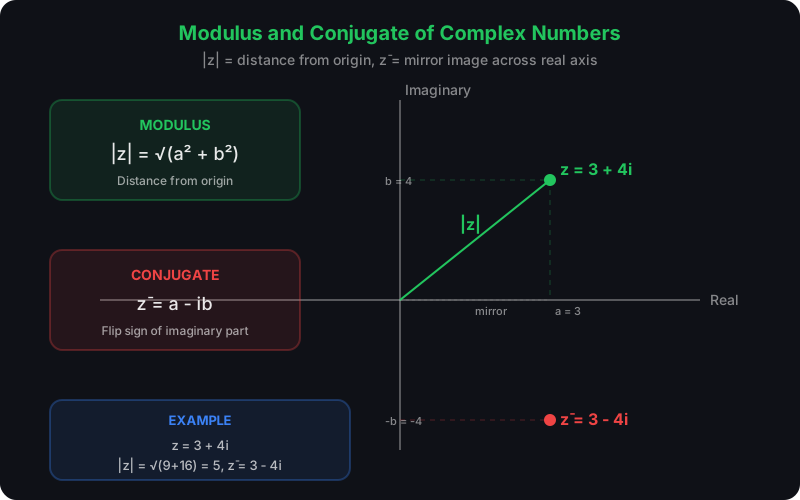
For z = a + ib, the modulus |z| is the distance from the origin to the point (a, b):
|z| = √(a² + b²)
Examples:
• |3 + i4| = √(9 + 16) = √25 = 5
• |2 - i5| = √(4 + 25) = √29
Conjugate
For z = a + ib, the conjugate z̄ is:
z̄ = a - ib (just flip the sign of the imaginary part)
Examples:
• Conjugate of 3 + i4 = 3 - i4
• Conjugate of -2 + i5 = -2 - i5
• Conjugate of i3 = -i3
Properties of Conjugate
(i) z̄₁z̄₂ = (z₁z₂)̄ — conjugate of product = product of conjugates
(ii) z̄₁/z̄₂ = (z₁/z₂)̄ — conjugate of quotient = quotient of conjugates
(iii) z̄₁±z̄₂ = (z₁±z₂)̄ — conjugate of sum/difference
(iv) z̄ = z — conjugate of conjugate = original
(v) z̄z = |z|² — product with conjugate = modulus squared
Finding Multiplicative Inverse Using Conjugate
This is the easiest way to find the inverse:
Example: z = 2 - 3i
• z̄ = 2 + 3i
• |z|² = 4 + 9 = 13
• z⁻¹ = (2 + 3i) / 13
4.5 Argand Plane
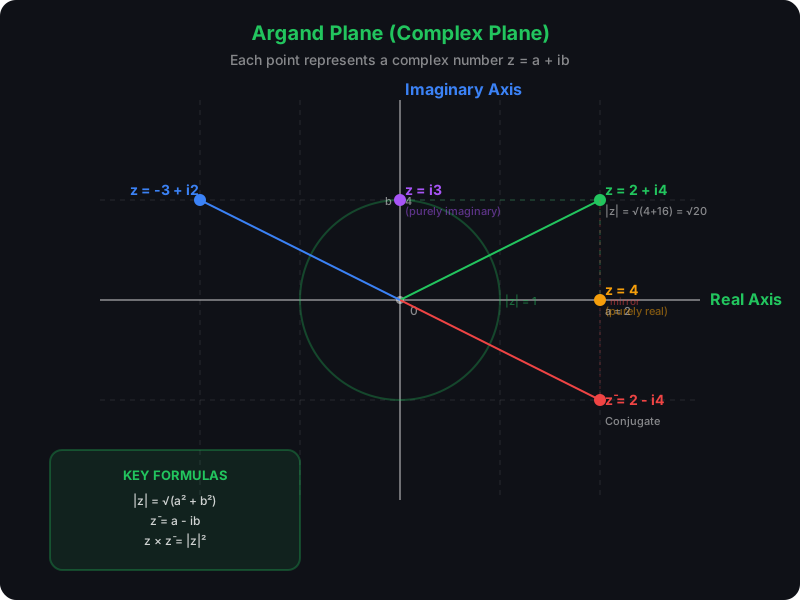
Complex numbers can be represented geometrically! The Argand plane (or complex plane) is like a regular coordinate plane, but:
Horizontal Axis
The x-axis represents the real part (Re). Called the real axis.
Vertical Axis
The y-axis represents the imaginary part (Im). Called the imaginary axis.
To plot z = a + ib:
• Go a units along the real axis (horizontal)
• Go b units along the imaginary axis (vertical)
• Mark the point (a, b)
Examples:
• 2 + i4 → point (2, 4)
• -3 + i2 → point (-3, 2)
• 4 + i0 → point (4, 0) — on the real axis
• 0 + i3 → point (0, 3) — on the imaginary axis
Geometric Interpretation
|z| = √(a² + b²) is the distance from the origin (0,0) to the point (a, b).
• Points with |z| = 1 lie on a unit circle
• Points with |z| < 1 are inside the unit circle
• Points with |z| > 1 are outside the unit circle
The conjugate z̄ = a - ib is the mirror image of z = a + ib across the real axis.
• If z is at (a, b), then z̄ is at (a, -b)
• They're symmetric about the real axis
4.6 Summary
• Complex number: z = a + ib, where a = Re(z), b = Im(z), i² = -1
• Addition: (a + ib) + (c + id) = (a+c) + i(b+d)
• Multiplication: (a + ib)(c + id) = (ac - bd) + i(ad + bc)
• Powers of i: i¹ = i, i² = -1, i³ = -i, i⁴ = 1 (repeats every 4)
• Modulus: |z| = √(a² + b²) — distance from origin
• Conjugate: z̄ = a - ib — mirror image across real axis
• Multiplicative inverse: z⁻¹ = z̄ / |z|²
• Argand plane: Horizontal = real axis, Vertical = imaginary axis