Trigonometric Functions
From measuring triangles to modeling waves — trigonometry is everywhere in mathematics and science
In this chapter
3.1 Angles
"A mathematician knows how to solve a problem, he can not solve it." — Milne
Trigonometry comes from Greek words meaning "measuring the sides of a triangle." It was originally developed to solve geometric problems involving triangles — used by sea captains for navigation, surveyors for mapping, and engineers for building. Today, it's used in seismology, electric circuits, describing atomic states, predicting ocean tides, and analyzing musical tones.
What is an Angle?
An angle is a measure of rotation of a ray about its starting point. The original ray is the initial side, the final position is the terminal side, and the point of rotation is the vertex.
Positive Angle
Rotation in the anticlockwise direction. This is the standard direction.
Negative Angle
Rotation in the clockwise direction.
Degree Measure
If a rotation is 1/360th of a full revolution, the angle is 1 degree (1°). A degree is divided into 60 minutes (1° = 60'), and a minute into 60 seconds (1' = 60").
Radian Measure
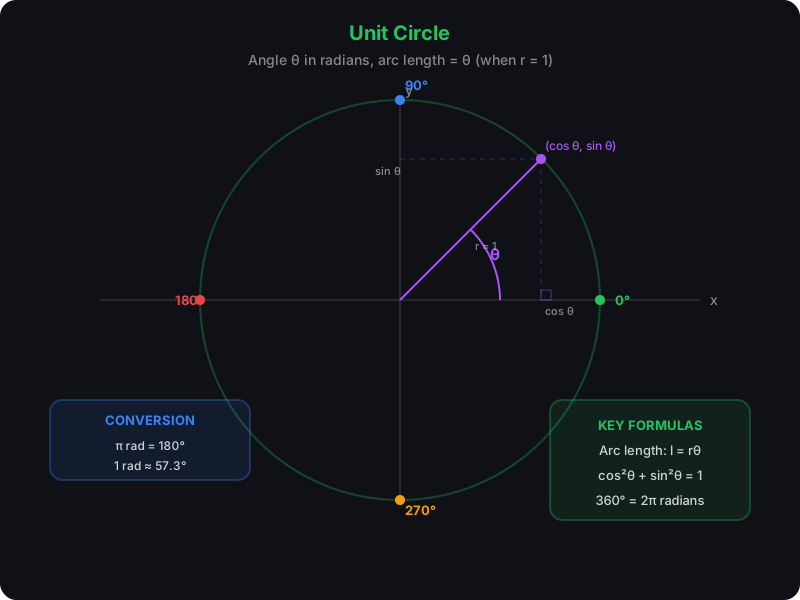
The radian is a more natural unit for measuring angles. One radian is the angle subtended at the center by an arc of length equal to the radius.
In a unit circle (radius = 1), the arc length equals the angle in radians. This makes radians much more natural for calculus and formulas. One full revolution = 2π radians.
Converting Between Degrees and Radians
π radians = 180°
Radian measure = (π/180) × Degree measure
Degree measure = (180/π) × Radian measure
Example: 45° = (π/180) × 45 = π/4 radians
Common Angles
| Degrees | Radians | Common Name |
|---|---|---|
| 30° | π/6 | Special angle |
| 45° | π/4 | Special angle |
| 60° | π/3 | Special angle |
| 90° | π/2 | Right angle |
| 180° | π | Straight angle |
| 270° | 3π/2 | Three-quarter turn |
| 360° | 2π | Full revolution |
Arc Length Formula
Where l = arc length, r = radius, θ = angle in radians. This formula only works when θ is in radians!
3.2 Trigonometric Functions
In earlier classes, you learned trigonometric ratios as ratios of sides in a right triangle. Now we extend these to trigonometric functions defined for any angle using the unit circle.
Unit Circle Definition
Consider a unit circle centered at the origin. Let P(a, b) be any point on the circle where the angle AOP = x radians. Then:
Since P is on the unit circle, a² + b² = 1, which gives us the most important trigonometric identity:
sin²x + cos²x = 1
This is always true for any angle x. From this, we can derive:
• 1 + tan²x = sec²x
• 1 + cot²x = cosec²x
Other Trigonometric Functions
Tangent
tan x = sin x / cos x, where cos x ≠ 0
Cotangent
cot x = cos x / sin x, where sin x ≠ 0
Secant
sec x = 1 / cos x, where cos x ≠ 0
Cosecant
cosec x = 1 / sin x, where sin x ≠ 0
Values at Quadrantal Angles
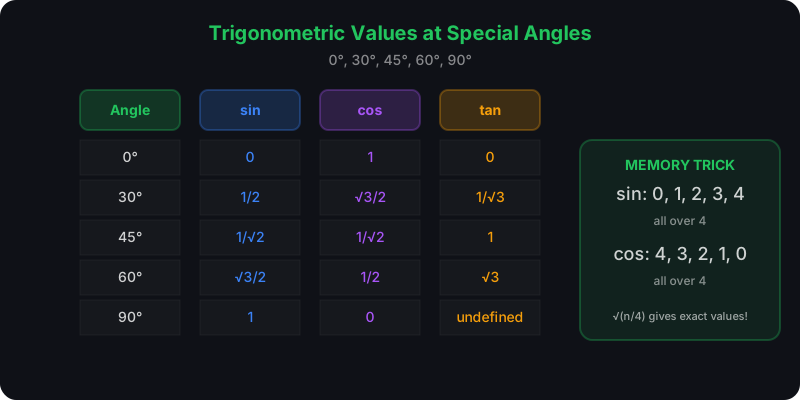
| Angle | 0 | π/2 | π | 3π/2 | 2π |
|---|---|---|---|---|---|
| sin | 0 | 1 | 0 | -1 | 0 |
| cos | 1 | 0 | -1 | 0 | 1 |
| tan | 0 | undefined | 0 | undefined | 0 |
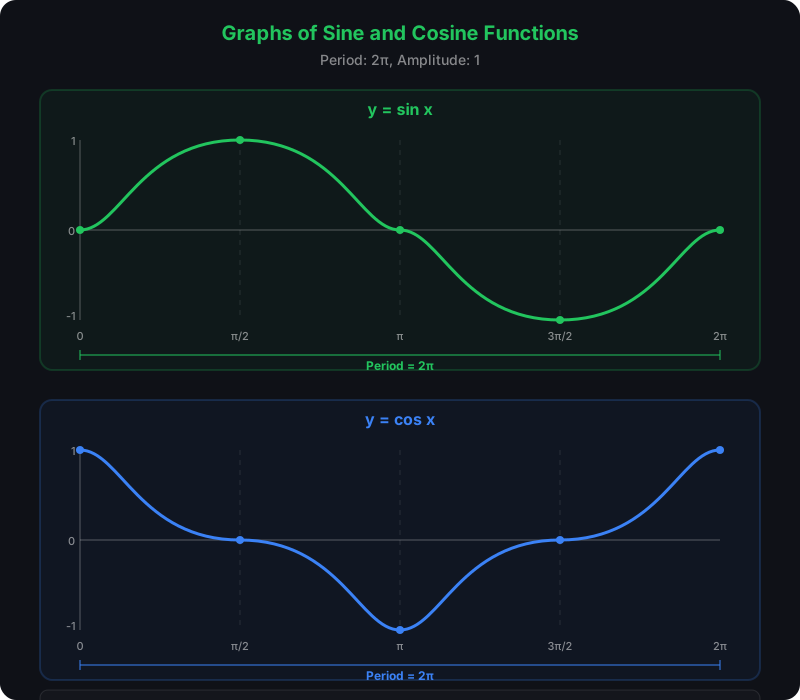
Trigonometric functions are periodic — they repeat their values:
• sin and cos repeat every 2π: sin(2nπ + x) = sin x
• tan and cot repeat every π: tan(π + x) = tan x
3.3 Signs in Quadrants
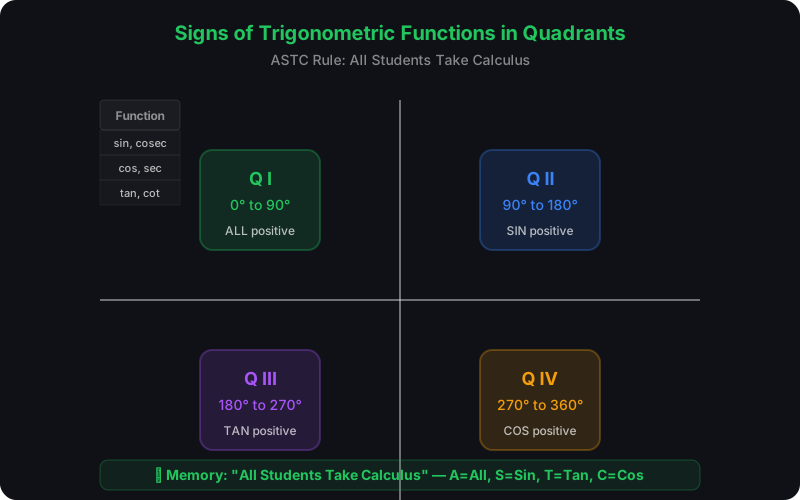
The sign of trigonometric functions depends on which quadrant the angle is in. Remember: in the unit circle, x = cos θ and y = sin θ.
ASTC Rule — "All Students Take Calculus"
All functions positive in Quadrant I
Sine (and cosec) positive in Quadrant II
Tangent (and cot) positive in Quadrant III
Cosine (and sec) positive in Quadrant IV
| Function | Q I (0 to π/2) | Q II (π/2 to π) | Q III (π to 3π/2) | Q IV (3π/2 to 2π) |
|---|---|---|---|---|
| sin x | + | + | - | - |
| cos x | + | - | - | + |
| tan x | + | - | + | - |
Negative Angle Formulas
cos(-x) = cos x (cosine is an even function)
sin(-x) = -sin x (sine is an odd function)
From these, you can derive:
• tan(-x) = -tan x
• cot(-x) = -cot x
• sec(-x) = sec x
• cosec(-x) = -cosec x
3.4 Domain and Range
Understanding the domain (valid inputs) and range (possible outputs) of trigonometric functions is crucial.
| Function | Domain | Range |
|---|---|---|
| sin x | R (all real numbers) | [-1, 1] |
| cos x | R | [-1, 1] |
| tan x | R - {(2n+1)π/2} | R |
| cot x | R - {nπ} | R |
| sec x | R - {(2n+1)π/2} | (-∞, -1] ∪ [1, ∞) |
| cosec x | R - {nπ} | (-∞, -1] ∪ [1, ∞) |
• sin and cos are defined for ALL real numbers, bounded between -1 and 1
• tan and sec are undefined at odd multiples of π/2
• cot and cosec are undefined at integer multiples of π
• tan, cot, sec, cosec can take arbitrarily large values
3.5 Sum and Difference Formulas
These formulas let you find trigonometric values of sums and differences of angles. They're fundamental to all of trigonometry.
Cosine Formulas
cos(A + B) = cos A cos B - sin A sin B
cos(A - B) = cos A cos B + sin A sin B
Memory tip: "cos cos minus sin sin" for addition, flip the sign for subtraction.
Sine Formulas
sin(A + B) = sin A cos B + cos A sin B
sin(A - B) = sin A cos B - cos A sin B
Memory tip: "sin cos plus cos sin" for addition, flip the sign for subtraction.
Tangent Formulas
tan(A + B) = (tan A + tan B) / (1 - tan A tan B)
tan(A - B) = (tan A - tan B) / (1 + tan A tan B)
These work only when none of A, B, or A±B is an odd multiple of π/2.
Cotangent Formulas
cot(A + B) = (cot A cot B - 1) / (cot B + cot A)
cot(A - B) = (cot A cot B + 1) / (cot B - cot A)
These work only when none of A, B, or A±B is a multiple of π.
Derived Formulas
| Formula | Result |
|---|---|
| cos(π/2 - x) | = sin x |
| sin(π/2 - x) | = cos x |
| cos(π/2 + x) | = -sin x |
| sin(π/2 + x) | = cos x |
| cos(π - x) | = -cos x |
| sin(π - x) | = sin x |
| cos(π + x) | = -cos x |
| sin(π + x) | = -sin x |
| cos(2π - x) | = cos x |
| sin(2π - x) | = -sin x |
3.6 Double and Triple Angle Formulas
Double Angle Formulas
These are special cases of the sum formulas when A = B:
cos 2x = cos²x - sin²x = 2cos²x - 1 = 1 - 2sin²x
sin 2x = 2 sin x cos x
tan 2x = 2tan x / (1 - tan²x)
These are extremely useful in simplifying expressions and solving equations.
Triple Angle Formulas
sin 3x = 3sin x - 4sin³x
cos 3x = 4cos³x - 3cos x
tan 3x = (3tan x - tan³x) / (1 - 3tan²x)
These can be derived by applying the sum formulas: 3x = 2x + x.
From cos 2x = 2cos²x - 1, we get: cos²x = (1 + cos 2x) / 2
From cos 2x = 1 - 2sin²x, we get: sin²x = (1 - cos 2x) / 2
These are useful for integrating powers of sine and cosine.
3.7 Sum-to-Product & Product-to-Sum
Sum-to-Product Formulas
These convert sums/differences of trig functions into products:
cos A + cos B = 2 cos((A+B)/2) cos((A-B)/2)
cos A - cos B = -2 sin((A+B)/2) sin((A-B)/2)
sin A + sin B = 2 sin((A+B)/2) cos((A-B)/2)
sin A - sin B = 2 cos((A+B)/2) sin((A-B)/2)
Product-to-Sum Formulas
These convert products of trig functions into sums/differences:
2 cos A cos B = cos(A + B) + cos(A - B)
-2 sin A sin B = cos(A + B) - cos(A - B)
2 sin A cos B = sin(A + B) + sin(A - B)
2 cos A sin B = sin(A + B) - sin(A - B)
These formulas are essential for:
• Simplifying complex trigonometric expressions
• Proving identities
• Integrating products of trig functions
• Solving trigonometric equations
3.8 Half-Angle Formulas
These formulas give trigonometric values of half an angle, derived from the double angle formulas:
sin(x/2) = ±√((1 - cos x) / 2)
cos(x/2) = ±√((1 + cos x) / 2)
tan(x/2) = sin x / (1 + cos x) = (1 - cos x) / sin x
The ± sign depends on which quadrant x/2 is in.
From cos 2x = 1 - 2sin²x, replace x with x/2:
cos x = 1 - 2sin²(x/2)
sin²(x/2) = (1 - cos x) / 2
sin(x/2) = ±√((1 - cos x) / 2)
3.9 Summary
• Arc length: l = rθ (θ must be in radians)
• Conversion: Radian = (π/180) × Degree
• Fundamental identity: sin²x + cos²x = 1
• Sum formulas: cos(A±B) = cos A cos B ∓ sin A sin B; sin(A±B) = sin A cos B ± cos A sin B
• Double angle: cos 2x = cos²x - sin²x; sin 2x = 2 sin x cos x
• Triple angle: sin 3x = 3sin x - 4sin³x; cos 3x = 4cos³x - 3cos x
• Sum-to-Product: cos A + cos B = 2 cos((A+B)/2) cos((A-B)/2)
• Product-to-Sum: 2 cos A cos B = cos(A+B) + cos(A-B)
• Half-angle: sin(x/2) = ±√((1 - cos x)/2)