Relations and Functions
Understanding how elements connect — from ordered pairs to the precise world of functions
In this chapter
2.1 Cartesian Products of Sets
"Mathematics is the indispensable instrument of all physical research." — Berthelot
Mathematics is fundamentally about finding patterns — recognisable links between quantities that change. In daily life, we see patterns everywhere: brother and sister, father and son, teacher and student. In math, we see them too: number m is less than number n, line l is parallel to line m, set A is a subset of set B.
All these involve pairs of objects in a certain order. This chapter teaches you how to link pairs of objects from two sets and then introduce relations between them. Finally, we'll learn about special relations called functions.
What is an Ordered Pair?
An ordered pair is a pair of elements written in a specific order inside brackets: (p, q). The order matters — (a, b) is NOT the same as (b, a).
Two ordered pairs are equal only if both corresponding elements are equal:
(a, b) = (x, y) if and only if a = x AND b = y
What is a Cartesian Product?
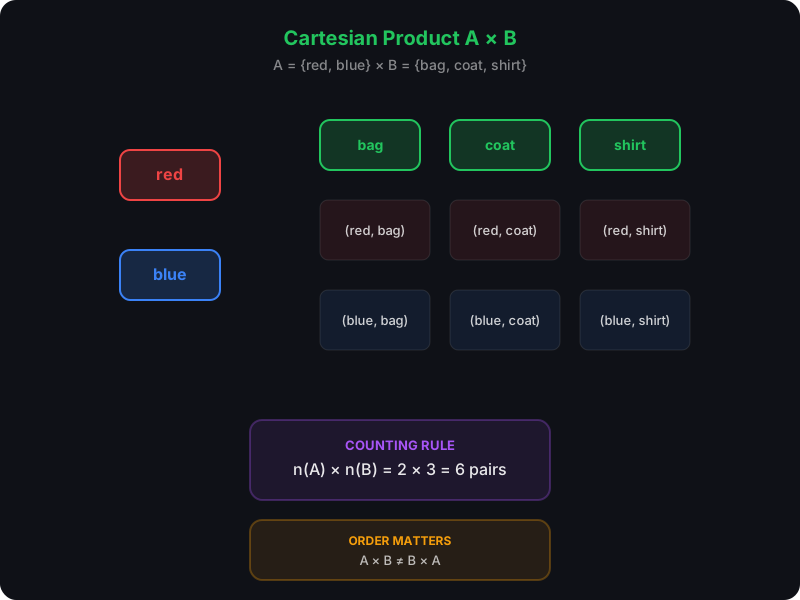
Suppose you have 2 colors (red, blue) and 3 objects (bag, coat, shirt). How many color-object pairs can you make?
- (red, bag), (red, coat), (red, shirt)
- (blue, bag), (blue, coat), (blue, shirt)
That's 6 pairs. This is the Cartesian product — the set of all possible ordered pairs.
Given two non-empty sets P and Q, the Cartesian product P × Q is the set of all ordered pairs:
P × Q = { (p,q) : p ∈ P, q ∈ Q }
If either P or Q is empty, then P × Q = φ.
License Plate Example
Consider states A = {DL, MP, KA} and codes B = {01, 02, 03}. The Cartesian product gives us all possible license plate combinations:
A × B = {(DL,01), (DL,02), (DL,03), (MP,01), (MP,02), (MP,03), (KA,01), (KA,02), (KA,03)}
That's 9 pairs — 3 states × 3 codes. Notice that (DL, 01) ≠ (01, DL) — the order matters!
Key Properties of Cartesian Products
Counting Rule
If set A has p elements and set B has q elements, then A × B has p × q elements.
Order Matters
A × B ≠ B × A in general. The pair (a, b) is different from (b, a) — just like (DL, 01) ≠ (01, DL) for license plates.
Empty Set
A × φ = φ and φ × A = φ. If either set is empty, the Cartesian product is empty.
Ordered Triplets
A × A × A = {(a, b, c) : a, b, c ∈ A}. These are called ordered triplets — used for 3D coordinates.
Distributive Properties
Cartesian products distribute over set operations, just like multiplication distributes over addition:
(i) A × (B ∩ C) = (A × B) ∩ (A × C)
(ii) A × (B ∪ C) = (A × B) ∪ (A × C)
Example: If A = {1,2,3}, B = {3,4}, C = {4,5,6}:
• A × (B ∩ C) = A × {4} = {(1,4), (2,4), (3,4)}
• (A × B) ∩ (A × C) = {(1,4), (2,4), (3,4)} ✓
R × R and R × R × R
The Cartesian product R × R represents all points in 2D space (coordinates (x, y)), and R × R × R represents all points in 3D space (coordinates (x, y, z)).
If A × B = {(p,q), (p,r), (m,q), (m,r)}, then:
• A = set of first elements = {p, m}
• B = set of second elements = {q, r}
2.2 Relations
Now that we can create ordered pairs, let's use them to define relations between sets.
Building a Relation
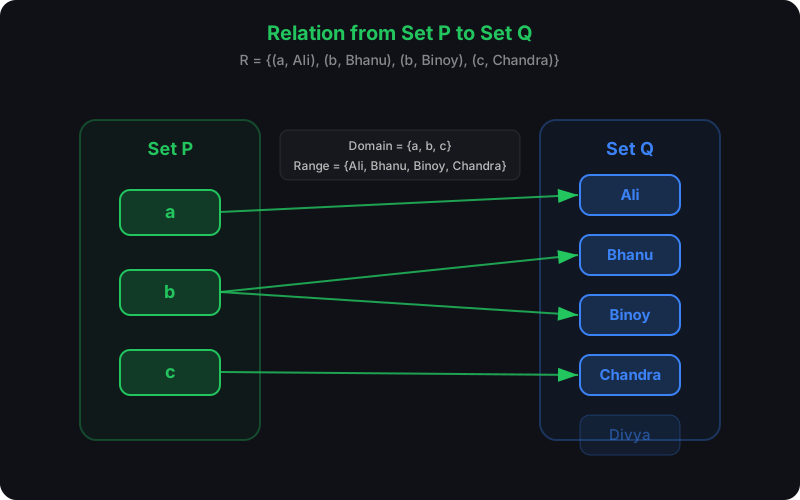
Consider sets P = {a, b, c} and Q = {Ali, Bhanu, Binoy, Chandra, Divya}. The Cartesian product P × Q has 15 ordered pairs. We can create a relation R by picking pairs that satisfy a rule — say, "x is the first letter of name y":
A relation R from set A to set B is a subset of A × B. It describes a relationship between the first element (x) and second element (y) of the ordered pairs. The second element is called the image of the first.
How to Represent Relations
Roster Form
List all pairs directly: R = {(1,2), (2,3), (3,4)}
Set-Builder Form
Describe the rule: R = {(x, y) : y = x + 1}
Arrow Diagram
Visual representation showing connections between elements of two sets.
Domain, Range, and Codomain
Think of a relation like a mapping machine:
• Domain = all inputs (first elements)
• Range = all outputs that are actually used (second elements)
• Codomain = all possible outputs (entire set B)
Key relationship: range ⊂ codomain
Domain of R = set of all first elements of ordered pairs in R
Range of R = set of all second elements of ordered pairs in R
Codomain of R = the entire set B (note: range is a subset of codomain)
Worked Example
Let A = {1, 2, 3, 4, 5, 6}. Define relation R from A to A by R = {(x, y) : y = x + 1}
Solution:
R = {(1,2), (2,3), (3,4), (4,5), (5,6)}
• Domain = {1, 2, 3, 4, 5} (first elements)
• Range = {2, 3, 4, 5, 6} (second elements)
• Codomain = {1, 2, 3, 4, 5, 6} (entire set A)
Note: 6 is in A but not in the domain because there's no y in A where y = 6 + 1 = 7.
Total Number of Relations
If n(A) = p and n(B) = q, then:
• n(A × B) = pq
• Total number of possible relations from A to B = 2^(pq)
Why? Because a relation is any subset of A × B, and a set with n elements has 2^n subsets.
2.3 Functions
Not all relations are functions. A function is a special type of relation with a strict rule: every input has exactly one output.
You press one button (input), and you get exactly one item (output). You can't press one button and get two different items. That's what makes a function special.
A relation f from set A to set B is a function if every element of A has one and only one image in B.
f: A → B, where f(a) = b means b is the image of a under f.
• Domain of f = A (every element in A must be used)
• No two pairs have the same first element (one input → one output)
• If (a, b) ∈ f, then f(a) = b, where b is the image of a and a is the preimage of b
Why These Relations are NOT Functions
Relation 1: R = {(2,1), (3,1), (4,2)} — Wait, this IS a function! Each input has exactly one output.
Relation 2: R = {(2,2), (2,4), (3,3)} — NOT a function! Input 2 has two outputs (2 and 4).
Relation 3: R = {(1,2), (2,3), (3,4), (4,5), (5,6), (6,7)} — This IS a function!
Is it a Function? — Quick Check
| Relation | Function? | Why? |
|---|---|---|
| R = {(2,1), (3,1), (4,2)} | ✅ Yes | Each input has exactly one output (outputs can repeat) |
| R = {(2,2), (2,4), (3,3)} | ❌ No | Input 2 has two outputs (2 and 4) |
| R = {(1,2), (2,3), (3,4)} | ✅ Yes | Each input has exactly one output |
Real-valued vs Real Function
Real-valued Function
A function whose range is R or a subset of R. The outputs are real numbers.
Real Function
A function where BOTH domain and range are R or subsets of R. Inputs and outputs are real numbers.
Function Notation
The notation f: A → B means:
• f is a function from set A to set B
• For each element x in A, f(x) gives a unique element in B
• f(x) is read as "f of x" or "the value of f at x"
Example: If f(x) = 2x + 1, then:
• f(1) = 2(1) + 1 = 3
• f(2) = 2(2) + 1 = 5
• f(0) = 2(0) + 1 = 1
2.4 Types of Functions
Functions come in many forms. Let's explore the most important types you'll encounter.
Identity Function
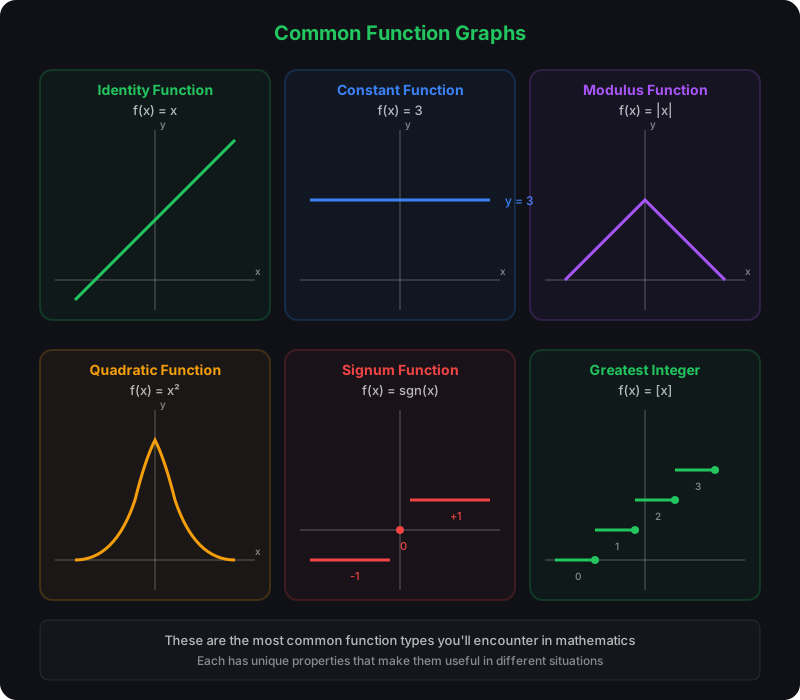
f: R → R defined by f(x) = x for each x ∈ R
• Domain = R, Range = R
• Every input equals its output
• Graph: straight line through origin at 45°
• The identity function does nothing to x — it's like looking in a mirror
Constant Function
f: R → R defined by f(x) = c for all x ∈ R, where c is a constant
• Domain = R, Range = {c} (just one value!)
• Every input maps to the same output c
• Graph: horizontal line at height c
• Example: f(x) = 3 gives the output 3 for every input
Polynomial Functions
f(x) = a₀ + a₁x + a₂x² + ... + aₙxⁿ, where n is a non-negative integer
• The degree is n (highest power of x)
• Examples:
- Linear (degree 1): f(x) = 2x + 1
- Quadratic (degree 2): f(x) = x² - 3x + 2
- Cubic (degree 3): f(x) = x³ - x² + 2
• NOT a polynomial: h(x) = x^(2/3) + 2x (fractional power)
Rational Functions
f(x) = p(x)/q(x), where p and q are polynomial functions
• Domain: all real numbers where q(x) ≠ 0
• Example: f(x) = 1/x — domain is R - {0}
• Example: f(x) = (x² + 1)/(x - 1) — domain is R - {1}
• The graph has vertical asymptotes where q(x) = 0
Modulus Function
f: R → R defined by f(x) = |x|
• f(x) = x if x ≥ 0, f(x) = -x if x < 0
• |5| = 5, |-5| = 5, |0| = 0
• Domain = R, Range = [0, ∞) (only non-negative values)
• Graph: V-shaped, touching the origin
• The modulus function strips away the negative sign
Signum Function
f: R → R defined by:
• f(x) = 1 if x > 0
• f(x) = 0 if x = 0
• f(x) = -1 if x < 0
• Domain = R, Range = {-1, 0, 1}
• It tells you only the sign of x, not its magnitude
• Example: sgn(5) = 1, sgn(-3) = -1, sgn(0) = 0
Greatest Integer Function
f: R → R defined by f(x) = [x], where [x] = greatest integer ≤ x
• [3.7] = 3 (largest integer ≤ 3.7)
• [5] = 5 (exactly 5)
• [-2.3] = -3 (largest integer ≤ -2.3)
• [-5] = -5 (exactly -5)
• Domain = R, Range = Z (integers only!)
• Graph: staircase pattern — steps going up
Quick Comparison Table
| Function | Formula | Domain | Range |
|---|---|---|---|
| Identity | f(x) = x | R | R |
| Constant | f(x) = c | R | {c} |
| Polynomial | f(x) = a₀ + a₁x + ... + aₙxⁿ | R | Depends on degree |
| Rational | f(x) = p(x)/q(x) | R - {zeros of q} | Varies |
| Modulus | f(x) = |x| | R | [0, ∞) |
| Signum | f(x) = sgn(x) | R | {-1, 0, 1} |
| Greatest Integer | f(x) = [x] | R | Z |
2.5 Algebra of Functions
Just like numbers, functions can be combined using arithmetic operations. If f and g are both functions from X to R (where X ⊂ R), we can create new functions:
Addition of Functions
(f + g)(x) = f(x) + g(x) for all x ∈ X
Example: If f(x) = x² and g(x) = 2x + 1, then:
(f + g)(x) = x² + (2x + 1) = x² + 2x + 1
Subtraction of Functions
(f - g)(x) = f(x) - g(x) for all x ∈ X
Example: If f(x) = x² and g(x) = 2x + 1, then:
(f - g)(x) = x² - (2x + 1) = x² - 2x - 1
Multiplication by a Scalar
(kf)(x) = k · f(x) for all x ∈ X, where k is a real number
Example: If f(x) = x² and k = 3, then:
(kf)(x) = 3 · x² = 3x²
Multiplication of Functions
(f · g)(x) = f(x) · g(x) for all x ∈ X
Example: If f(x) = x² and g(x) = 2x + 1, then:
(f · g)(x) = x² · (2x + 1) = 2x³ + x²
Division of Functions
(f/g)(x) = f(x) / g(x) for all x ∈ X, provided g(x) ≠ 0
Example: If f(x) = x² and g(x) = 2x + 1, then:
(f/g)(x) = x² / (2x + 1), where x ≠ -½
⚠️ Important: You must exclude values where g(x) = 0 from the domain!
Worked Example
Let f(x) = √x and g(x) = x be two functions defined on non-negative real numbers.
• (f + g)(x) = √x + x
• (f - g)(x) = √x - x
• (f · g)(x) = √x · x = x^(3/2)
• (f/g)(x) = √x / x = 1/√x, where x ≠ 0
Summary Table
| Operation | Formula | Example (f(x) = x², g(x) = 2x+1) |
|---|---|---|
| Addition | (f + g)(x) = f(x) + g(x) | x² + 2x + 1 |
| Subtraction | (f - g)(x) = f(x) - g(x) | x² - 2x - 1 |
| Scalar Multiple | (kf)(x) = k · f(x) | 3x² (if k=3) |
| Multiplication | (f·g)(x) = f(x) · g(x) | 2x³ + x² |
| Division | (f/g)(x) = f(x)/g(x), g(x)≠0 | x²/(2x+1), x ≠ -½ |
2.6 Summary
• Ordered pair — elements grouped in a specific order: (a, b).
• Cartesian product A × B = {(a, b) : a ∈ A, b ∈ B}. If n(A) = p, n(B) = q, then n(A×B) = pq.
• Relation from A to B is a subset of A × B. Domain = first elements, Range = second elements, Codomain = entire set B.
• Function f: A → B is a relation where every element in A has exactly one image in B.
• Types: Identity (f=x), Constant (f=c), Polynomial, Rational, Modulus (|x|), Signum, Greatest Integer ([x]).
• Algebra: Functions can be added, subtracted, multiplied, and divided (where defined).