Sets
The language of modern mathematics starts here — sets are the building blocks for everything from algebra to probability
In this chapter
1.1 What is a Set?
"In these days of conflict between ancient and modern studies; there must surely be something to be said for a study which did not begin with Pythagoras and will not end with Einstein; but is the oldest and the youngest." — G.H. Hardy
You already use sets every day without realizing it. When you say "the vowels in English" or "the players on a cricket team," you're describing a set — a well-defined collection of objects.
What does "well-defined" mean? It means there's no ambiguity about what belongs and what doesn't. The set of "tall students in your class" is not well-defined (what counts as tall?), but the set of "students taller than 170 cm" is.
A set is a well-defined collection of distinct objects. We use capital letters (A, B, C) for sets and small letters (a, b, c) for elements. If a belongs to set A, we write a ∈ A. If it doesn't, we write a ∉ A.
1.2 Representing Sets
There are two main ways to write a set. Think of them like two ways to describe your friend group — you can list everyone by name, or describe what they have in common.
Roster Form
Simply list all elements inside braces. The set of vowels = {a, e, i, o, u}. Order doesn't matter, and we don't repeat elements. The word "SCHOOL" gives us {S, C, H, O, L} — only 5 distinct letters.
Set-Builder Form
Describe the rule that all elements follow. V = {x : x is a vowel in English}. The colon means "such that." This form is powerful when listing everything is impractical — try listing all real numbers between 0 and 1!
Number Sets You'll Use Constantly
| Symbol | Set | Examples |
|---|---|---|
| N | Natural numbers | 1, 2, 3, 4, ... |
| Z | Integers | ..., −2, −1, 0, 1, 2, ... |
| Q | Rational numbers | ½, −3.7, 4, 0.333... |
| R | Real numbers | All numbers on the number line |
| Z⁺ | Positive integers | 1, 2, 3, ... |
| Q⁺ | Positive rationals | ½, 3.14, 7, ... |
| R⁺ | Positive reals | All positive numbers on number line |
In roster form, we list elements only once and order doesn't matter. So {1, 2, 3} = {3, 1, 2} = {2, 3, 1} — they're all the same set.
1.3 Types of Sets
The Empty Set
The simplest set is the one with nothing in it. The empty set (or null set) contains zero elements. We write it as φ or { }.
Example: {x : x² + 1 = 0, x ∈ R} is empty because no real number squared gives −1.
Finite vs Infinite Sets
Finite Set
You can count the elements and the counting ends. {1, 2, 3, 4, 5} has 5 elements. Even the empty set is finite — it has 0 elements.
Infinite Set
The elements never end. N = {1, 2, 3, ...} goes on forever. So does the set of points on a line — between any two points, there are infinitely more.
Equal Sets
Two sets are equal if they contain exactly the same elements. A = {1, 2, 3} and B = {3, 1, 2} are equal because they have the same members — even though the order differs.
Equal sets have the same elements. Equivalent sets have the same number of elements. {1, 2, 3} and {a, b, c} are equivalent (both have 3 elements) but not equal (different elements).
1.4 Subsets & Intervals
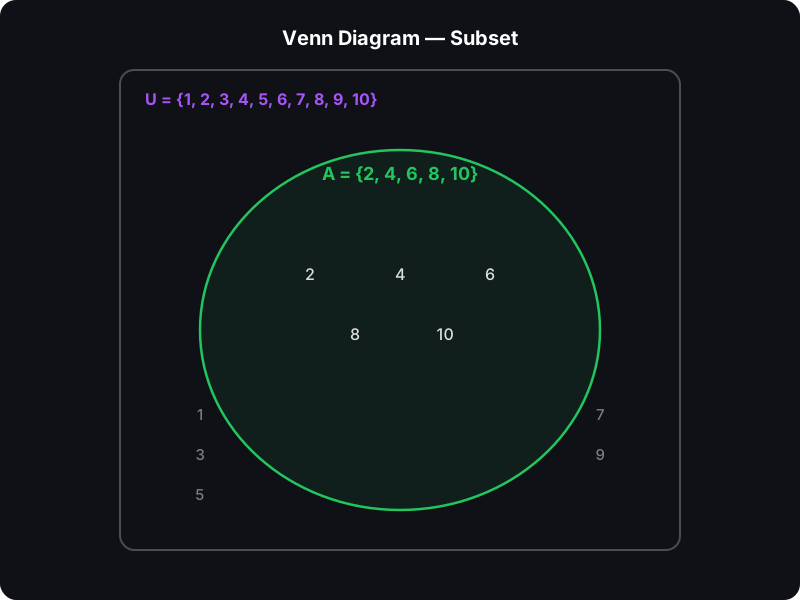
A set A is a subset of B if every element of A is also in B. We write A ⊂ B. Think of it like a smaller box inside a bigger one.
Some important facts about subsets:
- Every set is a subset of itself: A ⊂ A
- The empty set is a subset of every set: φ ⊂ A
- If A ⊂ B and A ≠ B, then A is a proper subset of B
- The number chain: N ⊂ Z ⊂ Q ⊂ R — naturals are inside integers, which are inside rationals, which are inside reals
Intervals on the Real Line
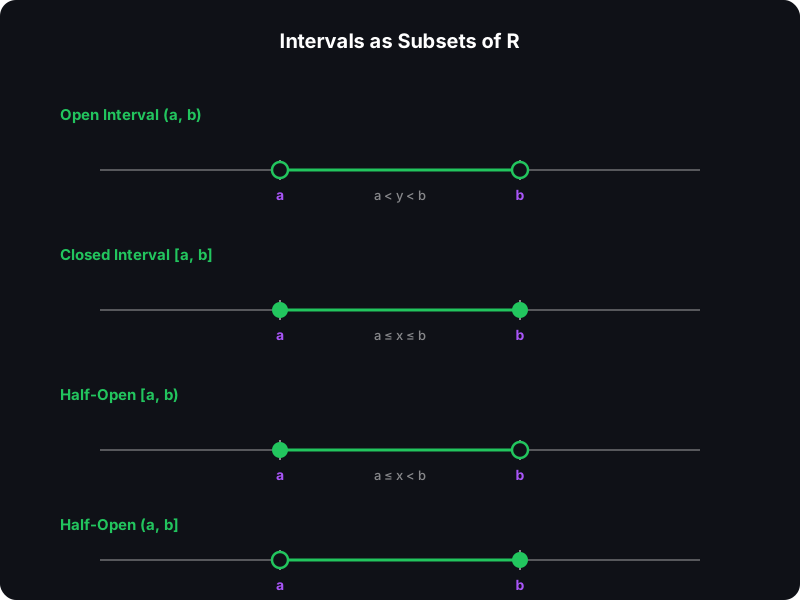
When we work with real numbers, subsets often take the form of intervals — continuous stretches of the number line between two endpoints.
| Type | Notation | Meaning | Endpoints |
|---|---|---|---|
| Open | (a, b) | {y : a < y < b} | Excluded |
| Closed | [a, b] | {x : a ≤ x ≤ b} | Included |
| Half-open | [a, b) | {x : a ≤ x < b} | a included, b excluded |
| Half-open | (a, b] | {x : a < x ≤ b} | a excluded, b included |
Square brackets [ ] mean the endpoint is included (the door is closed). Round brackets ( ) mean it's excluded (the door is open). That's why they're called "open" and "closed" intervals!
1.5 Venn Diagrams
How do you visualize relationships between sets? You draw them. Venn diagrams use circles inside a rectangle to show how sets overlap and interact.
The rectangle represents the universal set U — the "big set" containing everything we're talking about. The circles represent subsets of U.
The universal set U is the set containing all elements relevant to our discussion. When studying integers, U might be Q (rationals). When studying a class of students, U is all students in that class. It's the "universe" we're working within.
1.6 Operations on Sets
Just like numbers, sets have operations that combine them to create new sets. The three fundamental operations are union, intersection, and difference.
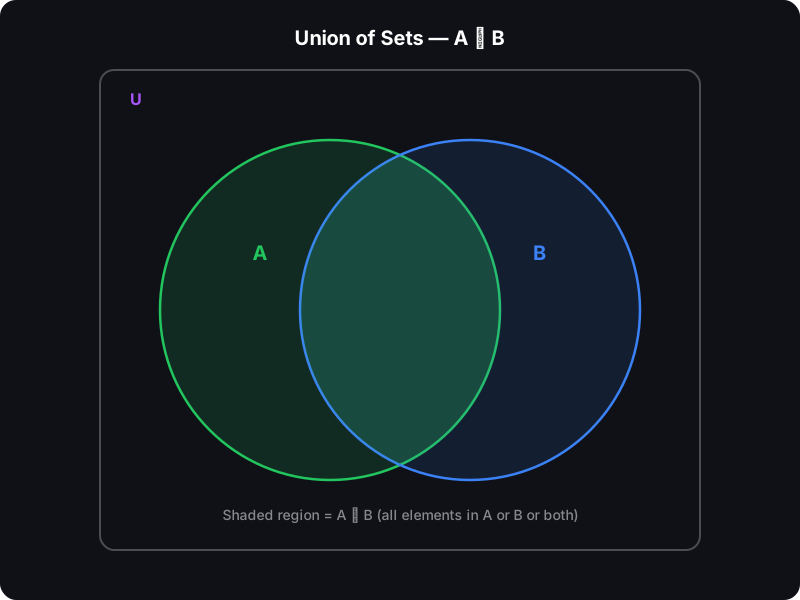
Union (∪) — "All of them"
The union of A and B combines everything from both sets. Common elements appear only once — no duplicates.
If A = {1, 2, 3} and B = {3, 4, 5}, then A ∪ B = {1, 2, 3, 4, 5}. The element 3 appears in both, but we write it only once.
Commutative: A ∪ B = B ∪ A
Associative: (A ∪ B) ∪ C = A ∪ (B ∪ C)
Identity: A ∪ φ = A (empty set adds nothing)
Idempotent: A ∪ A = A (combining with itself changes nothing)
Absorption: U ∪ A = U (universal set absorbs everything)
Intersection (∩) — "Only the common"
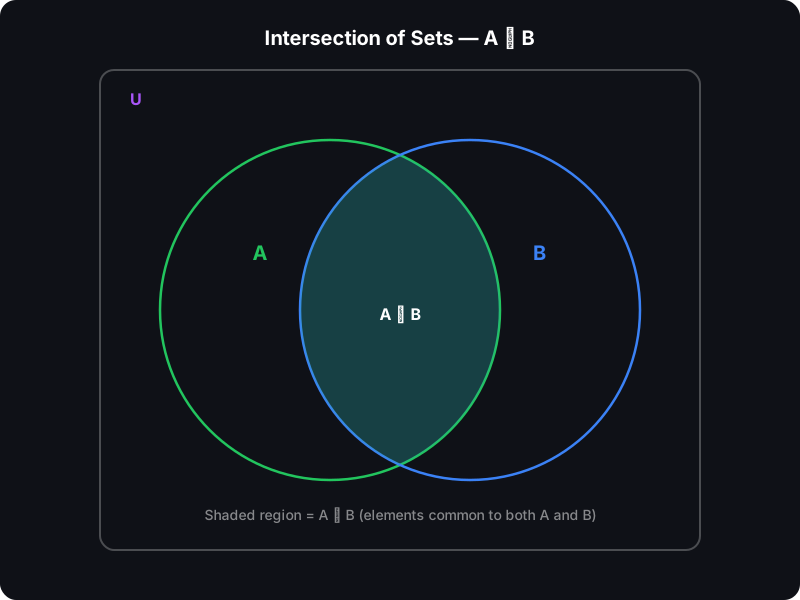
The intersection of A and B keeps only elements that appear in both sets.
Using the same example: A = {1, 2, 3} and B = {3, 4, 5}, then A ∩ B = {3} — the only element they share.
Disjoint Sets
If two sets have nothing in common (A ∩ B = φ), they're called disjoint sets. Their circles in a Venn diagram don't overlap at all.
Difference (−) — "This but not that"
The difference A − B gives you elements in A that are not in B. Think of it as "subtracting" one set from another.
Example: A = {1, 2, 3, 4}, B = {3, 4, 5, 6}. Then A − B = {1, 2} — the elements unique to A.
A − B and B − A are generally different. In the example above, B − A = {5, 6}. Also, A − B, A ∩ B, and B − A are mutually disjoint — they never overlap.
Commutative: A ∩ B = B ∩ A
Associative: (A ∩ B) ∩ C = A ∩ (B ∩ C)
Identity: U ∩ A = A, φ ∩ A = φ
Distributive: A ∩ (B ∪ C) = (A ∩ B) ∪ (A ∩ C)
1.7 Complement of a Set
What's left when you remove a set from the universal set? That's the complement. If U is everyone in a room and A is the students, then A′ is everyone who is not a student.
Think of A′ as "everything U has, except A."
De Morgan's Laws
These two elegant laws connect union, intersection, and complement. They're incredibly useful in proofs and problem-solving.
Law 1: (A ∪ B)′ = A′ ∩ B′
"The complement of a union is the intersection of complements."
Law 2: (A ∩ B)′ = A′ ∪ B′
"The complement of an intersection is the union of complements."
Properties of Complement
| Property | Law |
|---|---|
| Complement laws | A ∪ A′ = U | A ∩ A′ = φ |
| De Morgan's laws | (A ∪ B)′ = A′ ∩ B′ | (A ∩ B)′ = A′ ∪ B′ |
| Double complement | (A′)′ = A — complement of complement brings you back |
| Empty & universal | φ′ = U | U′ = φ |
1.8 Summary
• A set is a well-defined collection of distinct objects.
• Empty set (φ) has no elements. Finite sets have countable elements. Infinite sets go on forever.
• Two sets are equal if they have exactly the same elements. They're equivalent if they have the same count.
• A is a subset of B (A ⊂ B) if every element of A is in B. The chain N ⊂ Z ⊂ Q ⊂ R is fundamental.
• Intervals are subsets of R: open (a,b), closed [a,b], or half-open.
• Venn diagrams visualize set relationships with circles in a rectangle.
• Union (A ∪ B) = all elements from both. Intersection (A ∩ B) = only common elements. Difference (A − B) = elements in A but not B.
• Complement A′ = U − A. De Morgan's laws connect union, intersection, and complement.