Equilibrium
Chemical equilibria are vital in biological and environmental processes — from O₂ transport by hemoglobin to the dynamics of reversible reactions.
Contents
- Equilibrium in Physical Processes
- Equilibrium in Chemical Processes
- Law of Chemical Equilibrium
- Homogeneous Equilibria
- Heterogeneous Equilibria
- Applications of Equilibrium Constants
- Relationship between Kp and Kc
- Factors Affecting Equilibria — Le Chatelier's Principle
- Ionic Equilibrium in Solutions
- Acids, Bases and Salts
- Ionization of Acids and Bases
- Buffer Solutions
- Solubility Equilibria
6.1 Equilibrium in Physical Processes
Equilibrium can be established for both physical processes and chemical reactions. For physical processes, equilibrium is characterised by constant measurable properties at a given temperature.
Solid–Liquid Equilibrium
Ice and water at 273 K and atmospheric pressure are in equilibrium. The mass of ice and water doesn't change with time, and the temperature remains constant. However, the equilibrium is not static — molecules continuously transfer between phases at equal rates:
The temperature at which solid and liquid phases coexist at 1 atm is the normal melting point.
Liquid–Vapour Equilibrium
In a closed container, water evaporates until equilibrium vapour pressure is reached:
The vapour pressure is constant at a given temperature and increases with temperature. At 1.013 bar, the normal boiling point of water is 100°C.
Solid–Vapour Equilibrium
Sublimation examples: I₂(s) ⇌ I₂(vap), Camphor(s) ⇌ Camphor(vap), NH₄Cl(s) ⇌ NH₄Cl(vap).
Equilibrium Involving Dissolution
Solids in liquids: A saturated solution has dynamic equilibrium between dissolved and undissolved solute. Gases in liquids: Governed by Henry's Law — mass of gas dissolved is proportional to its pressure above the solvent.
- Equilibrium is possible only in a closed system at given temperature
- Both opposing processes occur at the same rate — dynamic but stable
- All measurable properties of the system remain constant
- Characterised by constant value of a parameter at given temperature
6.2 Equilibrium in Chemical Processes
Chemical reactions also attain equilibrium when rates of forward and reverse reactions become equal. Consider:
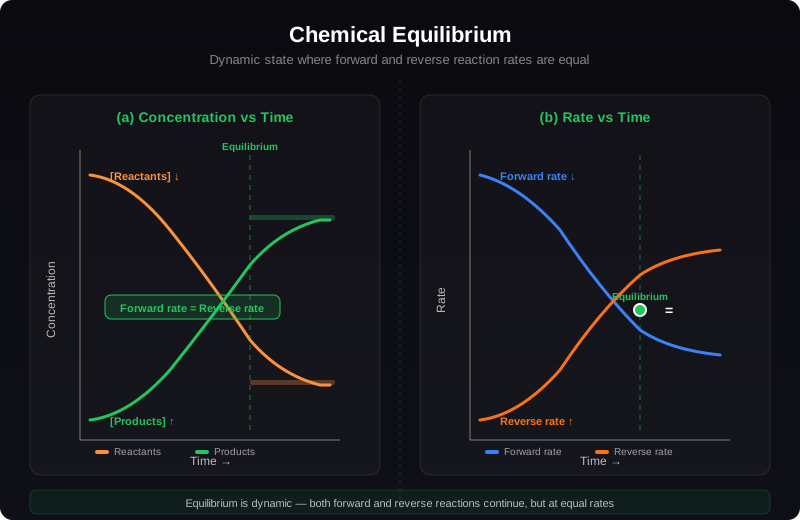
As the reaction proceeds, reactant concentrations decrease (forward rate decreases) and product concentrations increase (reverse rate increases) until both rates become equal. This is dynamic equilibrium.
Equilibrium is reached from either direction — starting with only reactants OR only products gives the same equilibrium composition. The Haber process demonstrates this: using D₂ instead of H₂ gives the same equilibrium composition with ND₃.
For the reaction N₂(g) + 3H₂(g) ⇌ 2NH₃(g), Haber showed that after a certain time, the composition of the mixture remains constant even though reactants are still present — both forward and reverse reactions continue at equal rates.
6.3 Law of Chemical Equilibrium
At equilibrium, the rate of forward reaction equals the rate of reverse reaction. For a general reaction:
The law of chemical equilibrium states that at a given temperature, the ratio of products of molar concentrations of products to the products of molar concentrations of reactants, each raised to the power of their stoichiometric coefficients, is constant:
6.4 Homogeneous Equilibria
In homogeneous equilibria, all reactants and products are in the same phase.
Equilibrium Constant in Gaseous Systems
For gas-phase reactions, equilibrium can also be expressed in partial pressures:
6.5 Heterogeneous Equilibria
In heterogeneous equilibria, reactants and products are in different phases. Pure solids and liquids have constant concentrations (activity = 1) and do not appear in the equilibrium expression.
Example: For CaCO₃(s) ⇌ CaO(s) + CO₂(g):
6.6 Applications of Equilibrium Constants
Predicting the Extent of a Reaction
Large K
Reaction proceeds nearly to completion. Products predominate at equilibrium.
Small K
Reaction does not proceed far. Mostly reactants at equilibrium.
Predicting the Direction of Reaction
The reaction quotient Q is calculated using initial concentrations. Comparing Q with K tells the direction:
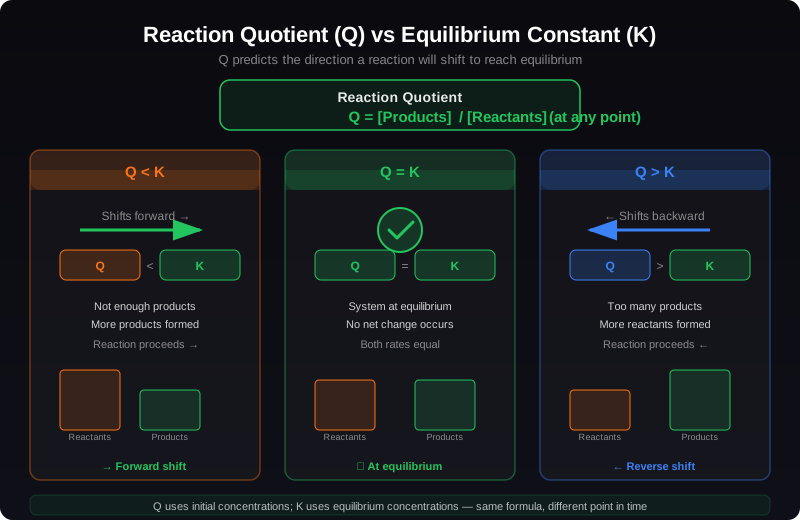
Q < K: Reaction proceeds forward (toward products)
Q = K: System is at equilibrium
Q > K: Reaction proceeds backward (toward reactants)
Calculating Equilibrium Concentrations
Set up an ICE table (Initial, Change, Equilibrium) and substitute into the Kc expression. Solve for the unknown.
6.7 Relationship between Kp and Kc
- When Δng = 0: Kp = Kc
- When Δng > 0: Kp > Kc
- When Δng < 0: Kp < Kc
6.8 Factors Affecting Equilibria — Le Chatelier's Principle
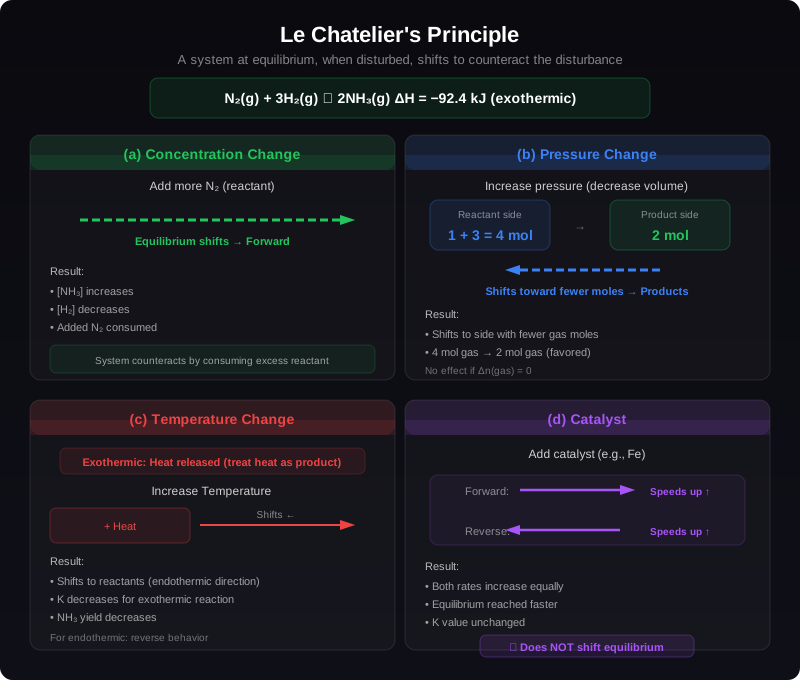
"When a system at equilibrium is subjected to a change in concentration, temperature, pressure, or volume, the system adjusts itself to partially counteract the imposed change and establish a new equilibrium."
Effect of Concentration Change
Adding reactant or removing product shifts equilibrium to the right (forward). Adding product or removing reactant shifts it to the left.
Effect of Pressure Change
Increasing pressure shifts equilibrium toward the side with fewer moles of gas. For N₂ + 3H₂ ⇌ 2NH₃: increasing pressure favours NH₃ formation (2 mol vs 4 mol).
Effect of Temperature Change
For exothermic reactions (ΔH < 0), increasing temperature shifts equilibrium to the left (K decreases). For endothermic reactions, increasing temperature shifts right (K increases).
Only temperature changes the value of K. Changes in concentration or pressure shift the equilibrium position but do NOT change K.
Effect of a Catalyst
A catalyst speeds up both forward and reverse reactions equally. It helps reach equilibrium faster but does not shift the equilibrium position or change K.
6.9 Ionic Equilibrium in Solutions
Electrolytes ionize in solution. Strong electrolytes ionize completely; weak electrolytes ionize partially, establishing an equilibrium between ions and undissociated molecules.
Example: CH₃COOH ⇌ CH₃COO⁻ + H⁺ (weak acid — partial ionization)
HCl → H⁺ + Cl⁻ (strong acid — complete ionization)
6.10 Acids, Bases and Salts
Arrhenius Concept
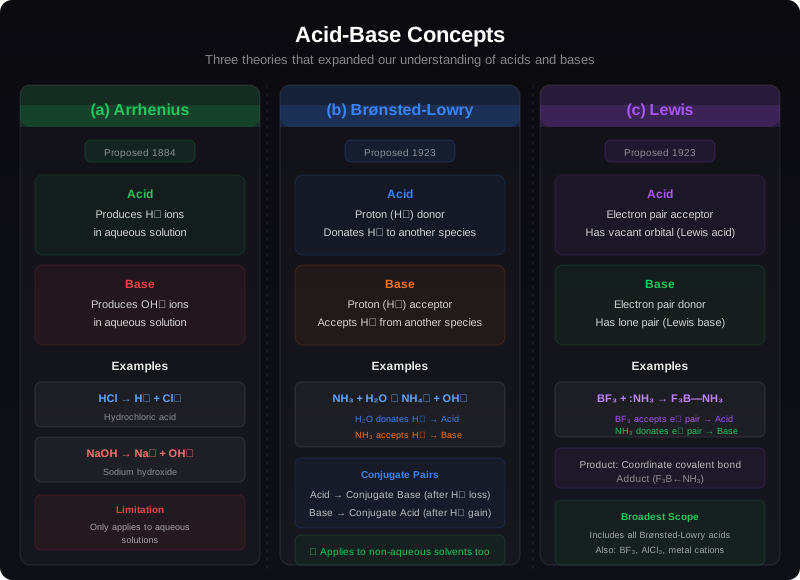
Acid: Produces H⁺ (or H₃O⁺) in aqueous solution. Base: Produces OH⁻ in aqueous solution.
HCl → H⁺ + Cl⁻ | NaOH → Na⁺ + OH⁻
Brønsted-Lowry Concept
Acid: Proton (H⁺) donor. Base: Proton acceptor.
NH₃ + H₂O ⇌ NH₄⁺ + OH⁻ (NH₃ accepts H⁺; H₂O donates H⁺)
A conjugate acid-base pair differs by one proton: H₂O/OH⁻, NH₃/NH₄⁺, CH₃COOH/CH₃COO⁻
Lewis Concept
Acid: Electron pair acceptor. Base: Electron pair donor.
BF₃ + :NH₃ → F₃B—NH₃ (BF₃ accepts electron pair; NH₃ donates it)
6.11 Ionization of Acids and Bases
Ionization Constant of Water
Water is amphoteric — it acts as both acid and base:
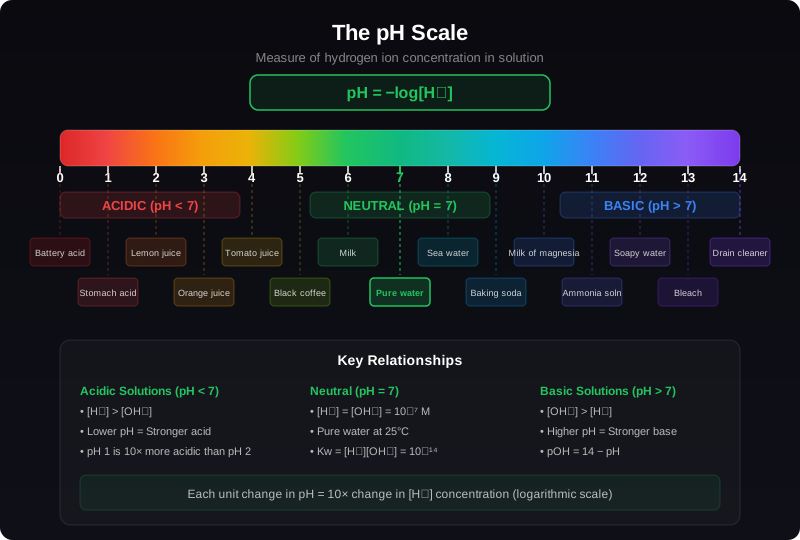
In pure water: [H₃O⁺] = [OH⁻] = 10⁻⁷ M (neutral solution)
The pH Scale
Ionization Constants of Weak Acids
For a weak acid HA ⇌ H⁺ + A⁻:
| Acid | Ka | pKa |
|---|---|---|
| HF | 6.8 × 10⁻⁴ | 3.17 |
| HCOOH | 1.77 × 10⁻⁴ | 3.75 |
| CH₃COOH | 1.77 × 10⁻⁵ | 4.75 |
| C₆H₅COOH | 6.45 × 10⁻⁵ | 4.19 |
| HCN | 4.9 × 10⁻¹⁰ | 9.31 |
Ionization of Weak Bases
For a weak base B + H₂O ⇌ BH⁺ + OH⁻:
Relation between Ka and Kb
Di- and Polybasic Acids
Diprotic acids ionize in steps: H₂A ⇌ H⁺ + HA⁻ (Ka1); HA⁻ ⇌ H⁺ + A²⁻ (Ka2). Generally Ka1 >> Ka2.
Common Ion Effect
The ionization of a weak electrolyte is suppressed by the presence of a strong electrolyte containing a common ion. Example: Adding NaOH to CH₃COOH solution suppresses the ionization of acetic acid because OH⁻ reacts with H⁺.
Hydrolysis of Salts
Salt of strong acid + strong base: pH = 7 (neutral). Salt of strong acid + weak base: pH < 7 (acidic). Salt of weak acid + strong base: pH > 7 (basic).
6.12 Buffer Solutions
A buffer solution resists change in pH when small amounts of acid or base are added. It consists of a weak acid and its conjugate base (or weak base and its conjugate acid).
Acidic Buffer
Weak acid + salt of its conjugate base. Example: CH₃COOH + CH₃COONa (pH ≈ 4.75)
Basic Buffer
Weak base + salt of its conjugate acid. Example: NH₄OH + NH₄Cl (pH ≈ 9.25)
Buffer capacity depends on the absolute amounts of acid and base components. A buffer is most effective when pH ≈ pKa (i.e., [HA] ≈ [A⁻]).
6.13 Solubility Equilibria
Solubility Product Constant
For a sparingly soluble salt MaXb(s) ⇌ aMb+(aq) + bXa−(aq):
Example: For AgCl(s) ⇌ Ag⁺(aq) + Cl⁻(aq): Ksp = [Ag⁺][Cl⁻] = 1.5 × 10⁻¹⁰ at 298 K
Common Ion Effect on Solubility
The solubility of a sparingly soluble salt is decreased by the addition of a strong electrolyte containing a common ion. For example, the solubility of AgCl decreases in the presence of NaCl due to the common Cl⁻ ion.
Ksp is the equilibrium constant for dissolution of a solid in water. It differs from Kc in that it applies specifically to saturated solutions of sparingly soluble salts.
Exercises
6.1 A liquid is in equilibrium with its vapour in a closed vessel at a fixed temperature. The vapour is pumped out. What happens to (a) rate of evaporation, (b) rate of condensation, (c) vapour pressure?
6.2 For the reaction PCl₅(g) ⇌ PCl₃(g) + Cl₂(g), at equilibrium, if the volume of the container is increased, what is the effect on the degree of dissociation?
6.3 The equilibrium constant for the reaction N₂(g) + 3H₂(g) ⇌ 2NH₃(g) is K. What is the equilibrium constant for ½N₂(g) + 3⁄2H₂(g) ⇌ NH₃(g)?
6.4 What is the pH of a solution obtained by mixing 10 mL of 0.2 M HCl with 40 mL of 0.1 M NaOH?
6.5 The Ka of CH₃COOH is 1.77 × 10⁻⁵. Calculate the degree of ionization of 0.1 M CH₃COOH solution.
6.6 Calculate the pOH of a 0.01 M NaOH solution at 298 K.
6.7 The solubility product of AgCl at 298 K is 1.5 × 10⁻¹⁰. Calculate the solubility of AgCl in mol/L at 298 K.
6.8 Predict whether the reaction 2NO₂(g) ⇌ N₂O₄(g) is spontaneous at 298 K, given ΔG° = −5.4 kJ mol⁻¹.
6.9 The Kw of water at 310 K is 2.4 × 10⁻¹⁴. What is the pH of pure water at 310 K?
6.10 A buffer solution contains 0.4 M NH₃ and 0.4 M NH₄Cl. What is the pH of the buffer? Kb(NH₃) = 1.8 × 10⁻⁵.