Thermodynamics
The study of energy transformations in chemical and physical processes — from internal energy and enthalpy to entropy and Gibbs free energy.
Contents
5.1 Thermodynamic Terms
The System and the Surroundings
A system in thermodynamics refers to that part of the universe in which observations are made. The remaining universe constitutes the surroundings. Together, the system and the surroundings form the universe:
For example, if we are studying a reaction in a beaker, the beaker and its contents are the system, and the room is the surroundings. The imaginary surface that separates the system from the surroundings is called the boundary.
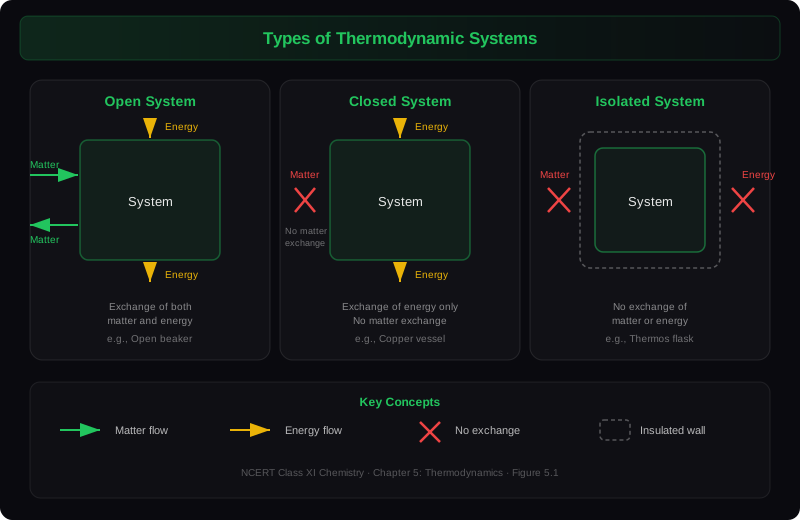
Types of Systems
Open System
There is exchange of both energy and matter between the system and surroundings. Example: reactants in an open beaker.
Closed System
There is no exchange of matter, but exchange of energy is possible. Example: reactants in a closed copper vessel.
Isolated System
No exchange of energy or matter with surroundings. Example: reactants in a thermos flask.
The State of the System
The state of a thermodynamic system is described by its measurable or macroscopic properties such as pressure (p), volume (V), temperature (T), and amount (n). Variables like p, V, T are called state variables or state functions because their values depend only on the state of the system and not on how it is reached.
Internal Energy as a State Function
The total energy of a system — chemical, electrical, mechanical, or any other type — is called the internal energy, U. Internal energy can change when:
- Heat passes into or out of the system
- Work is done on or by the system
- Matter enters or leaves the system
Work
In an adiabatic process (no heat transfer), the change in internal energy is equal to the adiabatic work done:
Joule showed (1840–50) that a given amount of work done on the system, no matter how it was done, produced the same change of state.
Heat
We can also change internal energy by transfer of heat (q) — a result of temperature difference. At constant volume with no work: ΔU = q.
Work (w): Positive when work is done on the system. Negative when work is done by the system.
Heat (q): Positive when heat is transferred to the system. Negative when heat is transferred from the system.
The General Case — First Law of Thermodynamics
When both work and heat are involved:
"The energy of an isolated system is constant." Energy can neither be created nor destroyed — it is the law of conservation of energy.
5.2 Applications
5.2.1 Work — Pressure-Volume Work
For a cylinder with ideal gas and a frictionless piston, when external pressure pex compresses the gas from Vi to Vf:
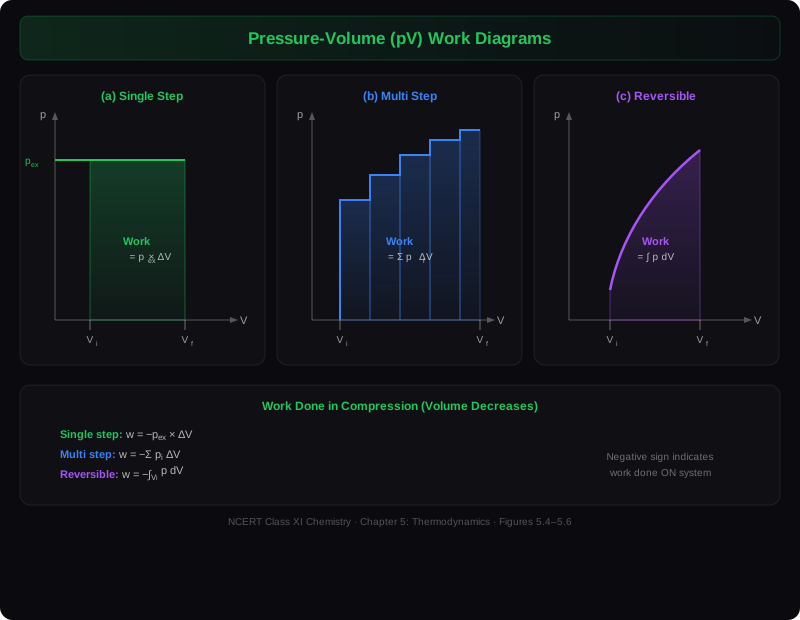
For reversible processes, the external pressure is always infinitesimally close to internal pressure (pex = pin ± dp). For isothermal reversible expansion of an ideal gas:
Expansion of a gas into vacuum (pex = 0) is called free expansion. No work is done during free expansion of an ideal gas, whether reversible or irreversible.
Special Cases
- Isothermal irreversible: q = −w = pex(Vf − Vi)
- Isothermal reversible: q = −w = nRT ln(Vf/Vi)
- Adiabatic change (q = 0): ΔU = wad
5.2.2 Enthalpy (H)
Most reactions occur at constant atmospheric pressure. We define a new state function called enthalpy:
At constant pressure, the heat absorbed equals the change in enthalpy: qp = ΔH. Also:
For reactions involving gases:
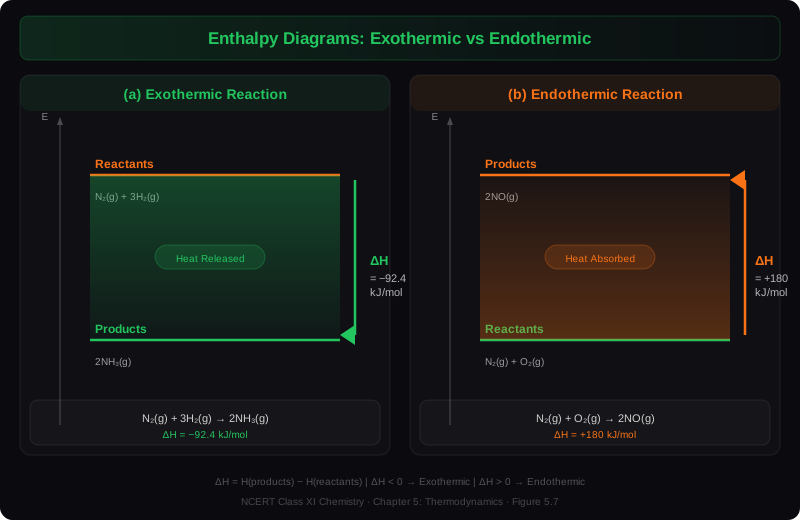
ΔH is negative for exothermic reactions (heat evolved). ΔH is positive for endothermic reactions (heat absorbed).
Extensive and Intensive Properties
Extensive properties depend on the quantity of matter (mass, volume, internal energy, enthalpy). Intensive properties do not (temperature, density, pressure). A molar property χm = χ/n is independent of amount.
Heat Capacity
The heat capacity C relates heat transferred to temperature change: q = CΔT. The molar heat capacity Cm = C/n is the heat needed to raise 1 mol by 1 K. Specific heat c is per unit mass: q = cmΔT.
Relationship between Cp and CV
For an ideal gas:
5.3 Measurement of ΔU and ΔH: Calorimetry
ΔU Measurements — Bomb Calorimeter
Heat absorbed at constant volume is measured in a bomb calorimeter. A combustible substance is burnt in pure O₂ in a sealed steel vessel (the bomb) immersed in a water bath. Since the volume doesn't change, ΔV = 0 and no work is done. The temperature change gives:
ΔH Measurements — Constant Pressure Calorimeter
At constant pressure (atmospheric), ΔH = qp. This is the heat of reaction or enthalpy of reaction ΔrH. In exothermic reactions, qp and ΔrH are negative. In endothermic reactions, they are positive.
5.4 Enthalpy Change, ΔrH of a Reaction
The enthalpy change accompanying a reaction is called the reaction enthalpy:
Standard Enthalpy of Reactions
The standard enthalpy of reaction is the enthalpy change when all participating substances are in their standard states — pure form at 1 bar. Denoted by ΔH°.
Enthalpy Changes during Phase Transformations
| Process | Example | ΔH |
|---|---|---|
| Fusion (melting) | H₂O(s) → H₂O(l) | ΔfusH° = +6.00 kJ mol⁻¹ |
| Vaporisation | H₂O(l) → H₂O(g) | ΔvapH° = +40.79 kJ mol⁻¹ |
| Sublimation | CO₂(s) → CO₂(g) | ΔsubH° = +25.2 kJ mol⁻¹ |
Standard Enthalpy of Formation
The standard molar enthalpy of formation (ΔfH°) is the enthalpy change for forming 1 mol of a compound from its elements in their most stable states. By convention, ΔfH° of an element in its reference state is zero.
H₂(g) + ½O₂(g) → H₂O(l); ΔfH° = −285.8 kJ mol⁻¹
C(graphite, s) + 2H₂(g) → CH₄(g); ΔfH° = −74.81 kJ mol⁻¹
Thermochemical Equations
A balanced chemical equation together with its ΔrH value is a thermochemical equation. Key conventions:
- Coefficients refer to moles, not molecules
- ΔrH° has units of kJ mol⁻¹
- Reversing the equation reverses the sign of ΔrH°
- ΔH is an extensive quantity — it scales with coefficients
Hess's Law of Constant Heat Summation
"If a reaction takes place in several steps, then its standard reaction enthalpy is the sum of the standard enthalpies of the intermediate reactions into which the overall reaction may be divided, at the same temperature."
This follows because enthalpy is a state function — ΔH is independent of path:
5.5 Enthalpies for Different Types of Reactions
Standard Enthalpy of Combustion (ΔcH°)
The enthalpy change per mole when a substance undergoes complete combustion. Combustion reactions are exothermic.
C₄H₁₀(g) + ¹³⁄₂O₂(g) → 4CO₂(g) + 5H₂O(l); ΔcH° = −2658.0 kJ mol⁻¹
C₆H₁₂O₆(g) + 6O₂(g) → 6CO₂(g) + 6H₂O(l); ΔcH° = −2802.0 kJ mol⁻¹
Enthalpy of Atomisation (ΔaH°)
The enthalpy change on breaking one mole of bonds completely to obtain atoms in the gas phase. For diatomic molecules, it equals the bond dissociation enthalpy.
Example: H₂(g) → 2H(g); ΔaH° = 435.0 kJ mol⁻¹
Bond Enthalpy (ΔbondH°)
Bond dissociation enthalpy is the enthalpy change when one mole of covalent bonds of a gaseous compound is broken. For polyatomic molecules, different bonds have different dissociation enthalpies; the mean bond enthalpy is the average.
Reaction enthalpy from bond enthalpies:
Lattice Enthalpy
The lattice enthalpy is the enthalpy change when one mole of an ionic compound dissociates into its gaseous ions. It is determined indirectly using a Born-Haber Cycle.
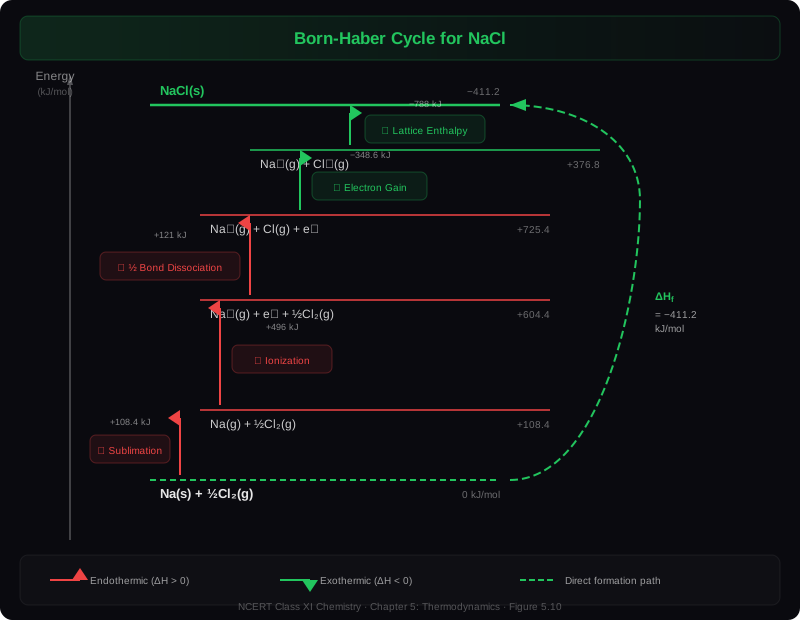
For NaCl:
- Na(s) → Na(g): ΔsubH° = +108.4 kJ mol⁻¹
- Na(g) → Na⁺(g) + e⁻: ΔiH° = +496 kJ mol⁻¹
- ½Cl₂(g) → Cl(g): ½ΔbondH° = +121 kJ mol⁻¹
- Cl(g) + e⁻ → Cl⁻(g): ΔegH° = −348.6 kJ mol⁻¹
- Na⁺(g) + Cl⁻(g) → NaCl(s): ΔlatticeH° = +788 kJ mol⁻¹
Enthalpy of Solution
The enthalpy change when 1 mol of a substance dissolves in a specified amount of solvent:
5.6 Spontaneity
All naturally occurring processes tend to proceed spontaneously in one direction. A spontaneous process is an irreversible process that may only be reversed by some external agency. But spontaneity does not tell about the rate of reaction.
Is Decrease in Enthalpy a Criterion for Spontaneity?
While many exothermic reactions are spontaneous (e.g., combustion of fuels), decrease in enthalpy alone is not a universal criterion. Some endothermic reactions are also spontaneous:
- ½N₂(g) + O₂(g) → NO₂(g); ΔrH° = +33.2 kJ mol⁻¹ (spontaneous)
- C(graphite) + 2S(l) → CS₂(l); ΔrH° = +128.5 kJ mol⁻¹ (spontaneous)
Entropy and Spontaneity
Consider two gases A and B in a closed container separated by a partition. When the partition is removed, the gases diffuse into each other — the system becomes more disordered. This disorder is measured by entropy (S).

Entropy is a state function. For a reversible process:
For a spontaneous process, the total entropy change (system + surroundings) must be positive:
In an isolated system, the entropy increases in the direction of spontaneous change. At equilibrium, entropy is maximum and ΔS = 0.
Gibbs Energy and Spontaneity
For most chemical reactions (closed systems), both enthalpy and entropy change. We define Gibbs energy (G):
At constant temperature:
ΔG < 0: Process is spontaneous
ΔG > 0: Process is non-spontaneous
ΔG = 0: System is at equilibrium
The entropy of any pure crystalline substance approaches zero as the temperature approaches absolute zero (0 K). This permits calculation of absolute entropy values from thermal data.
5.7 Gibbs Energy Change and Equilibrium
At equilibrium, the free energy of the system is minimum and ΔrG = 0. The relationship between standard Gibbs energy change and equilibrium constant:
This is combined with:
Large K (exothermic)
When ΔrH° is large and negative, K >> 1. Reaction goes nearly to completion.
Small K (endothermic)
When ΔrH° is large and positive, K << 1. Little product is formed.
By measuring ΔrH° and ΔrS°, we can calculate K at any temperature and predict the extent of reaction — crucial for optimising industrial yields.
Exercises
5.1 Choose the correct answer. A thermodynamic state function is a quantity
(i) used to determine heat changes (ii) whose value is independent of path (iii) used to determine pressure volume work (iv) whose value depends on temperature only.
5.2 For the process to occur under adiabatic conditions, the correct condition is: (i) ΔT = 0 (ii) Δp = 0 (iii) q = 0 (iv) w = 0
5.3 The enthalpies of all elements in their standard states are: (i) unity (ii) zero (iii) < 0 (iv) different for each element
5.4 ΔU° of combustion of methane is −X kJ mol⁻¹. The value of ΔH° is: (i) = ΔU° (ii) > ΔU° (iii) < ΔU° (iv) = 0
5.5 The enthalpy of combustion of methane, graphite and dihydrogen at 298 K are, −890.3 kJ mol⁻¹, −393.5 kJ mol⁻¹, and −285.8 kJ mol⁻¹ respectively. Enthalpy of formation of CH₄(g) will be: (i) −74.8 kJ mol⁻¹ (ii) −52.27 kJ mol⁻¹ (iii) +74.8 kJ mol⁻¹ (iv) +52.26 kJ mol⁻¹
5.6 A reaction, A + B → C + D + q is found to have a positive entropy change. The reaction will be: (i) possible at high temperature (ii) possible only at low temperature (iii) not possible at any temperature (iv) possible at any temperature
5.7 In a process, 701 J of heat is absorbed by a system and 394 J of work is done by the system. What is the change in internal energy for the process?
5.8 The reaction of cyanamide, NH₂CN(s), with dioxygen was carried out in a bomb calorimeter, and ΔU was found to be −742.7 kJ mol⁻¹ at 298 K. Calculate enthalpy change for the reaction at 298 K.
5.9 Calculate the number of kJ of heat necessary to raise the temperature of 60.0 g of aluminium from 35°C to 55°C. Molar heat capacity of Al is 24 J mol⁻¹ K⁻¹.
5.10 Calculate the enthalpy change on freezing of 1.0 mol of water at 10.0°C to ice at −10.0°C. ΔfusH = 6.03 kJ mol⁻¹ at 0°C. Cp[H₂O(l)] = 75.3 J mol⁻¹ K⁻¹, Cp[H₂O(s)] = 36.8 J mol⁻¹ K⁻¹
5.11 Enthalpy of combustion of carbon to CO₂ is −393.5 kJ mol⁻¹. Calculate the heat released upon formation of 35.2 g of CO₂ from carbon and dioxygen gas.
5.12 Enthalpies of formation of CO(g), CO₂(g), N₂O(g) and N₂O₄(g) are −110, −393, 81 and 9.7 kJ mol⁻¹ respectively. Find the value of ΔrH for the reaction: N₂O₄(g) + 3CO(g) → N₂O(g) + 3CO₂(g)
5.13 Given N₂(g) + 3H₂(g) → 2NH₃(g); ΔrH° = −92.4 kJ mol⁻¹. What is the standard enthalpy of formation of NH₃ gas?
5.14 Calculate the standard enthalpy of formation of CH₃OH(l) from the given data.
5.15 Calculate the enthalpy change for the process CCl₄(g) → C(g) + 4Cl(g) and calculate bond enthalpy of C–Cl in CCl₄(g).
5.16 For an isolated system, ΔU = 0, what will be ΔS?
5.17 For the reaction at 298 K, 2A + B → C; ΔH = 400 kJ mol⁻¹ and ΔS = 0.2 kJ K⁻¹ mol⁻¹. At what temperature will the reaction become spontaneous?
5.18 For the reaction 2Cl(g) → Cl₂(g), what are the signs of ΔH and ΔS?
5.19 For the reaction 2A(g) + B(g) → 2D(g); ΔU° = −10.5 kJ and ΔS° = −44.1 JK⁻¹. Calculate ΔG° for the reaction, and predict whether the reaction may occur spontaneously.
5.20 The equilibrium constant for a reaction is 10. What will be the value of ΔG°? R = 8.314 JK⁻¹ mol⁻¹, T = 300 K.
5.21 Comment on the thermodynamic stability of NO(g), given ½N₂(g) + ½O₂(g) → NO(g); ΔrH° = 90 kJ mol⁻¹ and NO(g) + ½O₂(g) → NO₂(g); ΔrH° = −74 kJ mol⁻¹.
5.22 Calculate the entropy change in surroundings when 1.00 mol of H₂O(l) is formed under standard conditions. ΔfH° = −286 kJ mol⁻¹.