Chemical Bonding and Molecular Structure
Why atoms bond, how they share or transfer electrons, and what determines the shape and properties of molecules
In this chapter
4.1 Kössel-Lewis Approach
In 1916, Kössel and Lewis succeeded in explaining chemical bonding in terms of electrons. Lewis pictured the atom in terms of a positively charged "kernel" (nucleus + inner electrons) surrounded by a valence shell of electrons. He postulated that atoms achieve stable noble gas configurations through chemical bonding.

4.2 Lewis Dot Structures & Octet Rule
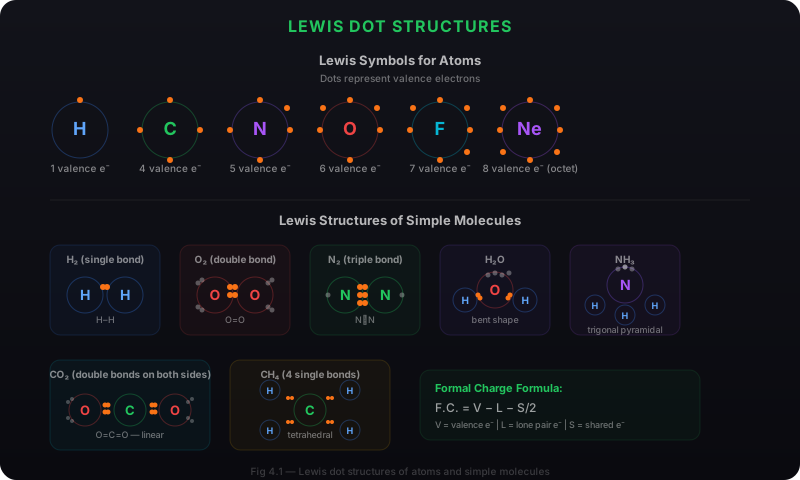
G.N. Lewis introduced Lewis symbols — notations showing the valence electrons of an atom as dots around the element symbol. The octet rule states that atoms tend to gain, lose, or share electrons to achieve 8 electrons in their valence shell (like noble gases).
Covalent Bond Formation
When two atoms share one or more pairs of electrons, a covalent bond is formed. The shared pair is called a bonding pair. Each atom also has non-bonding pairs called lone pairs.
- Single bond — one shared pair (e.g., H–H, Cl–Cl)
- Double bond — two shared pairs (e.g., O=O, C=O in CO₂)
- Triple bond — three shared pairs (e.g., N≡N, C≡O)
Writing Lewis Structures — Steps
- Count total valence electrons from all atoms
- Identify the central atom (usually the least electronegative)
- Draw single bonds between central atom and surrounding atoms
- Distribute remaining electrons to complete octets (start with outer atoms)
- If central atom lacks an octet, form multiple bonds
4.3 Formal Charge & Limitations of Octet Rule
Formal charge helps identify the most plausible Lewis structure. The structure with the lowest formal charges (closest to zero) on all atoms is preferred.
Limitations of the Octet Rule
- Electron-deficient molecules: BeH₂, BF₃ — central atom has < 8 electrons
- Expanded octet: PCl₅, SF₆ — central atom has > 8 electrons (possible for elements in period 3 and beyond with available d-orbitals)
- Odd-electron molecules: NO, NO₂ — have unpaired electrons
4.4 Ionic Bond (Electrovalent Bond)
An ionic bond is formed by the complete transfer of one or more electrons from a metal to a non-metal, resulting in the formation of cations and anions held together by electrostatic attraction.
Example: Na (2,8,1) → Na⁺ (2,8) + e⁻; Cl (2,8,7) + e⁻ → Cl⁻ (2,8,8)
The lattice enthalpy of an ionic solid is defined as the energy required to completely separate one mole of a solid ionic compound into gaseous constituent ions. Greater lattice enthalpy → more stable ionic compound.
4.5 Bond Parameters
Bond Length
Equilibrium distance between nuclei of two bonded atoms. For covalent bond: sum of covalent radii. E.g., H–H = 74 pm, C–C = 154 pm, C=C = 134 pm, C≡C = 120 pm.
Bond Enthalpy
Energy required to break one mole of bonds in gaseous state. Higher bond enthalpy → stronger bond. E.g., H–H = 435.8 kJ/mol, C≡C = 839 kJ/mol.
Bond Angle
Angle between two covalent bonds from the same atom. E.g., CH₄ = 109.5°, NH₃ = 107°, H₂O = 104.5°.
Bond Order
Number of chemical bonds between two atoms. H₂ = 1, O₂ = 2, N₂ = 3. Higher bond order → shorter and stronger bond.
Resonance
When a molecule can be represented by two or more Lewis structures that differ only in the distribution of electrons, the actual structure is a resonance hybrid of all contributing structures. Each resonance structure is called a canonical form.
Example: O₃ has two equivalent canonical forms. The actual bond lengths are identical (intermediate between single and double bond).
4.6 VSEPR Theory
The Valence Shell Electron Pair Repulsion (VSEPR) theory predicts the shape of molecules based on the repulsion between electron pairs (bonding + lone pairs) around the central atom.
Key Postulates
- The shape depends on the number of bonding pairs and lone pairs around the central atom.
- Electron pairs arrange themselves to minimize repulsion (maximize distance).
- Repulsion order: Lone pair–Lone pair > Lone pair–Bond pair > Bond pair–Bond pair
- Multiple bonds count as one effective electron pair for shape determination.
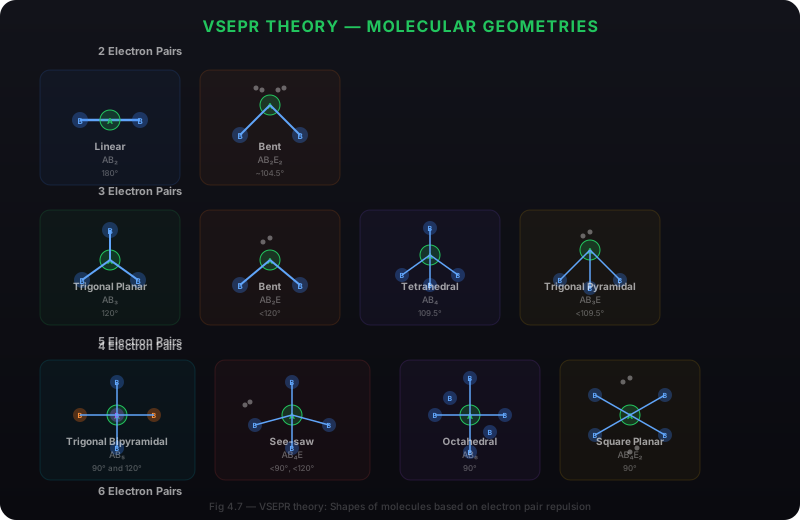
Lone pairs take up more space than bonding pairs, compressing bond angles: CH₄ (109.5°) → NH₃ (107°) → H₂O (104.5°) as lone pairs increase from 0 to 2.
4.7 Valence Bond Theory
The Valence Bond (VB) theory explains covalent bond formation as the overlap of half-filled atomic orbitals. The stronger the overlap, the stronger the bond.
Key Concepts
- Sigma (σ) bond: Formed by head-on (end-to-end) overlap along the bond axis. Can be formed by s-s, s-p, or p-p overlap. Stronger bond.
- Pi (π) bond: Formed by sideways (lateral) overlap of parallel p-orbitals. Weaker than sigma bond. Found in double and triple bonds.
- Directional overlap: Better overlap → stronger bond. Bond strength depends on extent of overlap.
Single bond = 1σ | Double bond = 1σ + 1π | Triple bond = 1σ + 2π
σ bonds are free to rotate; π bonds restrict rotation.
4.8 Hybridisation
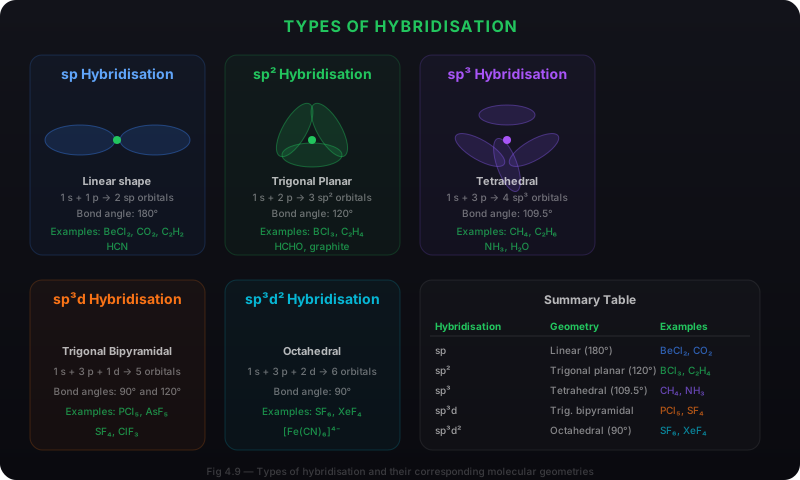
Hybridisation is the concept of intermixing atomic orbitals of slightly different energies to form a new set of equivalent hybrid orbitals.
Types of Hybridisation
| Type | Orbitals | Shape | Angle | Examples |
|---|---|---|---|---|
| sp | 1s + 1p | Linear | 180° | BeCl₂, CO₂, C₂H₂, HCN |
| sp² | 1s + 2p | Trigonal planar | 120° | BCl₃, C₂H₄, HCHO |
| sp³ | 1s + 3p | Tetrahedral | 109.5° | CH₄, C₂H₆, NH₃, H₂O |
| sp³d | 1s + 3p + 1d | Trigonal bipyramidal | 90°, 120° | PCl₅, SF₄, ClF₃ |
| sp³d² | 1s + 3p + 2d | Octahedral | 90° | SF₆, XeF₄, [Fe(CN)₆]⁴⁻ |
NH₃: N is sp³ hybridised. Three sp³ orbitals form bonds with H, one holds a lone pair. Shape is trigonal pyramidal (not tetrahedral). H₂O: O is sp³ hybridised. Two sp³ orbitals bond with H, two hold lone pairs. Shape is bent.
4.9 Molecular Orbital Theory
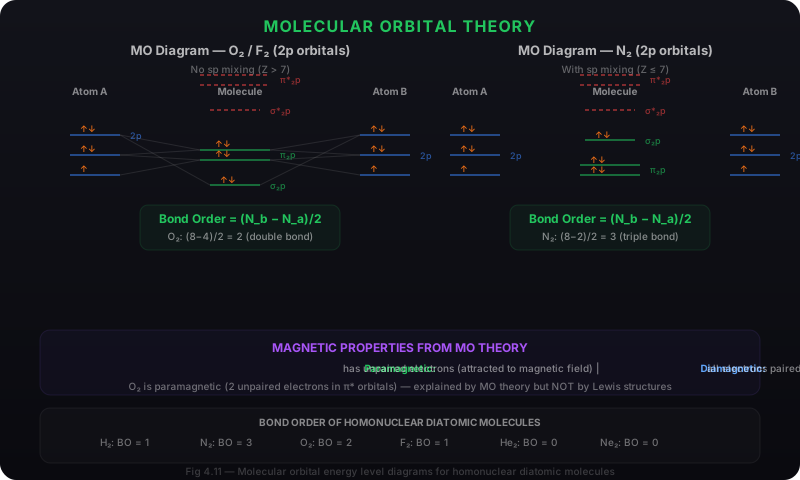
The Molecular Orbital (MO) theory was developed by Mulliken and Hund. It considers electrons to be delocalized over the entire molecule. When two atomic orbitals combine, they form two molecular orbitals: a bonding MO (lower energy) and an antibonding MO (higher energy, marked with *).
Bond Order from MO Theory
| Molecule | Configuration | Bond Order | Magnetic Behaviour |
|---|---|---|---|
| H₂ | (σ₁s)² | 1 | Diamagnetic |
| He₂ | (σ₁s)² (σ*₁s)² | 0 | Does not exist |
| N₂ | (σ₂s)² (σ*₂s)² (π₂p)⁴ (σ₂p)² | 3 | Diamagnetic |
| O₂ | (σ₂s)² (σ*₂s)² (σ₂p)² (π₂p)⁴ (π*₂p)² | 2 | Paramagnetic |
| F₂ | (σ₂s)² (σ*₂s)² (σ₂p)² (π₂p)⁴ (π*₂p)⁴ | 1 | Diamagnetic |
O₂ is paramagnetic (attracted by magnetic field) due to 2 unpaired electrons in π*₂p orbitals. This cannot be explained by Lewis structures — a major success of MO theory.
4.10 Hydrogen Bonding
A hydrogen bond is the attractive force between a hydrogen atom covalently bonded to a highly electronegative atom (F, O, or N) and another electronegative atom with a lone pair. It is weaker than covalent bonds but stronger than van der Waals forces.
Types of Hydrogen Bonds
Intermolecular
Between molecules (e.g., H₂O, HF, NH₃). Responsible for the abnormally high boiling points of water and HF.
Intramolecular
Within the same molecule (e.g., o-nitrophenol, salicylaldehyde). Lowers boiling point compared to intermolecular H-bonding isomers.
4.11 Summary
• Chemical bonds are formed to lower the energy of the system. Major types: ionic, covalent, and coordinate bonds.
• Lewis structures show bonding as shared electron pairs. The octet rule guides Lewis structure writing (with limitations for electron-deficient, expanded octet, and odd-electron molecules).
• VSEPR theory predicts molecular shapes based on electron pair repulsion. Lone pairs distort ideal geometries (bond angle compression).
• Valence Bond theory explains bonding as overlap of half-filled orbitals. σ bonds (head-on) are stronger than π bonds (sideways overlap).
• Hybridisation (sp, sp², sp³, sp³d, sp³d²) explains observed geometries by mixing atomic orbitals.
• Molecular Orbital theory describes delocalized electrons over the whole molecule. Explains paramagnetism of O₂ and provides bond order calculations.
• Hydrogen bonding (F, O, N···H) explains anomalies in boiling points and is crucial for biological molecules (DNA, proteins).