Classification of Elements and Periodicity in Properties
The evolution of the Periodic Table from early attempts to the modern long form, and the recurring patterns that govern elemental behaviour
In this chapter
- Genesis of Periodic Classification
- Mendeleev's Periodic Table
- Modern Periodic Law
- Nomenclature of Elements (Z > 100)
- Electronic Configurations
- s-, p-, d-, f- Blocks
- Metals, Non-metals & Metalloids
- Periodic Trends — Atomic Radius
- Periodic Trends — Ionization Enthalpy
- Periodic Trends — Electron Gain Enthalpy
- Periodic Trends — Electronegativity
- Chemical Properties — Valence & Anomalous Behaviour
- Summary
3.1 Genesis of Periodic Classification
The periodic table is arguably the most important concept in chemistry. It is the everyday support for students, it suggests new avenues of research to professionals, and it provides a succinct organisation of the whole of chemistry.
Classification of elements into groups and development of the Periodic Law and Periodic Table are the consequences of systematising the knowledge gained by a number of scientists through their observations and experiments.
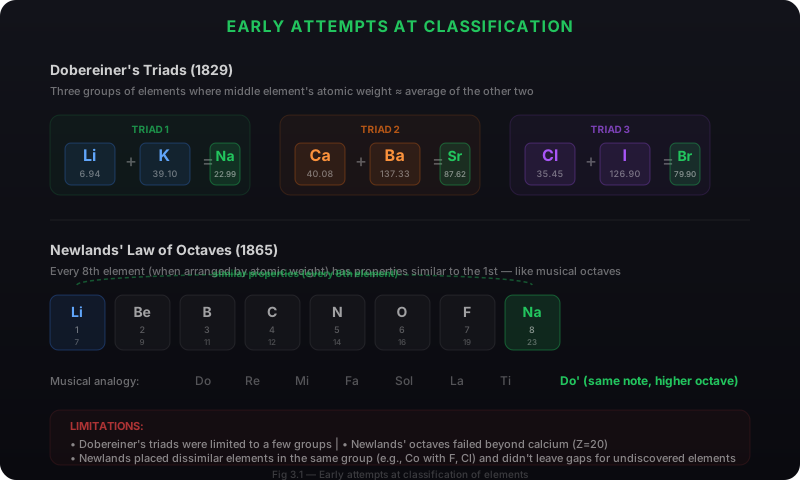
Dobereiner's Triads (1829)
The German chemist Johann Dobereiner was the first to consider the idea of trends among properties of elements. By 1829, he noted a similarity among the physical and chemical properties of several groups of three elements (Triads). In each case, the middle element had an atomic weight about halfway between the other two, and its properties were intermediate.
Dobereiner could identify only a few such triads among the elements known at that time. The law could not apply to elements with very low or very high atomic weights.
Newlands' Law of Octaves (1865)
The English chemist John Newlands arranged elements in order of increasing atomic weights and observed that every eighth element had properties similar to the first — like the octaves in music. He called this the Law of Octaves.
The law was applicable only up to calcium. Newlands placed dissimilar elements in the same group (e.g., cobalt with fluorine and chlorine) and did not leave gaps for undiscovered elements.
3.2 Mendeleev's Periodic Table
Dmitri Mendeleev (1834–1907) is generally credited with the development of the Periodic Table. He published his Periodic Law for the first time:
"The properties of the elements are a periodic function of their atomic weights." — Mendeleev's Periodic Law (1869)
Mendeleev arranged elements in horizontal rows and vertical columns in order of increasing atomic weights, such that elements with similar properties occupied the same vertical column (group).
Key Features
- Horizontal rows = Periods (series)
- Vertical columns = Groups (IA–VIII + Group 0)
- Elements in the same group show similar chemical properties
- Left gaps for undiscovered elements and predicted their properties
Eka-Aluminium → Gallium
Mendeleev predicted the existence and properties of an undiscovered element he called "eka-aluminium." When gallium was discovered in 1875, its properties matched his predictions remarkably well.
Eka-Silicon → Germanium
His prediction of "eka-silicon" was confirmed when germanium was discovered in 1886, with properties nearly identical to what he had predicted.
1. Placement of isotopes — isotopes have different atomic weights but should occupy the same position.
2. Certain elements placed in wrong groups to maintain periodicity (e.g., Tellurium before Iodine despite higher atomic weight).
3.3 Modern Periodic Law
In 1913, English physicist Henry Moseley observed regularities in the characteristic X-ray spectra of the elements. A plot of √ν (where ν is frequency of X-rays emitted) against atomic number (Z) gave a straight line, not a plot of √ν against atomic mass. He showed that atomic number is a more fundamental property than atomic mass.
"The physical and chemical properties of the elements are a periodic function of their atomic numbers." — Modern Periodic Law
The modern periodic table arranges elements in order of increasing atomic numbers in seven horizontal rows (periods) and eighteen vertical columns (groups).
3.4 Nomenclature of Elements (Z > 100)
IUPAC has recommended a systematic method for naming elements with atomic numbers above 100. The names are derived from the Latin/Greek numerals for the digits of the atomic number.
| Digit | Name | Symbol |
|---|---|---|
| 0 | nil | n |
| 1 | un | u |
| 2 | bi | b |
| 3 | tri | t |
| 4 | quad | q |
| 5 | pent | p |
| 6 | hex | h |
| 7 | sept | s |
| 8 | oct | o |
| 9 | enn | e |
Element 112: un + un + bi + um = Ununbium (Uub) → now officially named Copernicium (Cn)
Element 118: un + oct + oct + um = Ununoctium (Uuo) → now officially named Oganesson (Og)
3.5 Electronic Configurations of Elements
The modern periodic table is a powerful tool because the position of an element is directly related to its electronic configuration. Elements in the same group have the same valence shell electronic configuration.
Groupwise Electronic Configurations
| Group | Valence Configuration | Elements |
|---|---|---|
| 1 | ns¹ | Li, Na, K, Rb, Cs, Fr |
| 2 | ns² | Be, Mg, Ca, Sr, Ba, Ra |
| 13 | ns² np¹ | B, Al, Ga, In, Tl |
| 14 | ns² np² | C, Si, Ge, Sn, Pb |
| 15 | ns² np³ | N, P, As, Sb, Bi |
| 16 | ns² np⁴ | O, S, Se, Te, Po |
| 17 | ns² np⁵ | F, Cl, Br, I, At |
| 18 | ns² np⁶ | He, Ne, Ar, Kr, Xe, Rn |
Each period corresponds to the filling of a new principal energy level. Period 1 (n=1) has 2 elements, Period 2 (n=2) has 8 elements, Period 3 (n=3) has 8 elements, Period 4 (n=4) has 18 elements, Period 5 (n=5) has 18 elements, Period 6 (n=6) has 32 elements, and Period 7 (n=7) has 32 elements.
3.6 s-, p-, d-, f- Block Elements
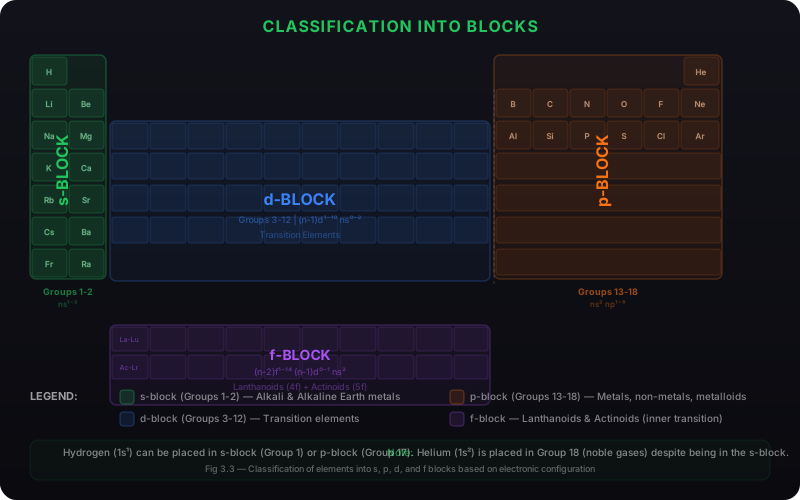
Based on the type of orbital being filled, elements are classified into four blocks:
s-Block Elements
Group 1 (alkali metals) and Group 2 (alkaline earth metals). Outermost electron enters the s-orbital. Configuration: ns¹⁻². They are all metals, highly reactive, and form ionic compounds.
p-Block Elements
Groups 13–18. Outermost electron enters the p-orbital. Configuration: ns² np¹⁻⁶. Includes metals, non-metals, and metalloids. Together with s-block, called Representative Elements.
d-Block Elements
Groups 3–12. Last electron enters the d-orbital. Configuration: (n-1)d¹⁻¹⁰ ns⁰⁻². These are the Transition Elements. They show variable oxidation states, coloured compounds, and catalytic behaviour.
f-Block Elements
Lanthanoids (4f) and Actinoids (5f). Last electron enters the f-orbital. Configuration: (n-2)f¹⁻¹⁴ (n-1)d⁰⁻¹ ns². Called Inner Transition Elements. Placed separately to maintain table structure.
3.7 Metals, Non-metals & Metalloids
Elements can also be classified as metals, non-metals, or metalloids based on their properties.
- Metals — Occupy the left side and centre of the periodic table. They are good conductors of heat and electricity, have lustre, are malleable and ductile, and tend to lose electrons (form cations). Metallic character increases down a group and decreases across a period.
- Non-metals — Occupy the top right corner. They are poor conductors, brittle as solids, and tend to gain electrons (form anions).
- Metalloids — Elements along the "staircase line" (B, Si, Ge, As, Sb, Te, At) show properties intermediate between metals and non-metals.
3.8 Periodic Trends — Atomic Radius
The atomic radius is the distance from the center of the nucleus to the outermost shell of electrons. It cannot be measured directly for isolated atoms, so it is estimated from bond distances.
Covalent Radius
Half the internuclear distance between two identical atoms joined by a single covalent bond. E.g., Cl–Cl bond = 198 pm → Cl radius = 99 pm.
Metallic Radius
Half the internuclear distance between two adjacent metal atoms in the metallic crystal. E.g., Cu–Cu = 256 pm → Cu radius = 128 pm.

Ionic Radius
A cation is always smaller than its parent atom (fewer electrons, same nuclear charge). An anion is always larger than its parent atom (more electrons, increased repulsion, reduced effective nuclear charge). Example: Na = 186 pm, Na⁺ = 95 pm; F = 64 pm, F⁻ = 136 pm.
Species with the same number of electrons but different nuclear charges: e.g., N³⁻, O²⁻, F⁻, Na⁺, Mg²⁺, Al³⁺ all have 10 electrons. As nuclear charge increases, size decreases: N³⁻ > O²⁻ > F⁻ > Na⁺ > Mg²⁺ > Al³⁺.
3.9 Periodic Trends — Ionization Enthalpy
Ionization enthalpy (ΔᵢH) is the energy required to remove the most loosely bound electron from an isolated gaseous atom:
The second ionization enthalpy (ΔᵢH₂) is always higher than the first, because it is harder to remove an electron from a positively charged ion.
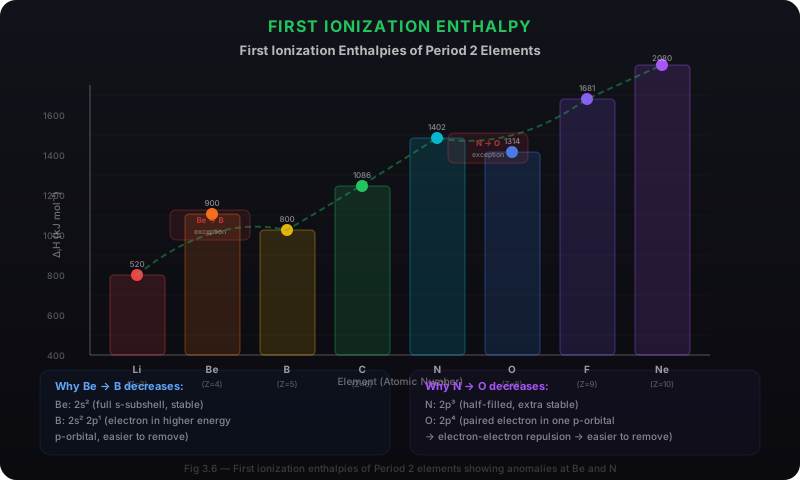
Periodic Trends
- Across a period: Ionization enthalpy generally increases (nuclear charge increases, radius decreases → harder to remove electron).
- Down a group: Ionization enthalpy decreases (new shells → electron farther from nucleus → easier to remove).
Be → B: Be (2s²) has a full s-subshell — extra stable. B (2s² 2p¹) — the p-electron is shielded by the s-electrons, so it is easier to remove. IE₁(B) < IE₁(Be).
N → O: N (2p³) has a half-filled p-subshell — extra stable. O (2p⁴) — one p-orbital has a paired electron with repulsion, so it is easier to remove. IE₁(O) < IE₁(N).
3.10 Periodic Trends — Electron Gain Enthalpy
Electron gain enthalpy (ΔₑH) is the energy change when an electron is added to a neutral gaseous atom:
Trends
- Across a period: Electron gain enthalpy becomes more negative (nuclear charge increases → stronger attraction for incoming electron).
- Down a group: Electron gain enthalpy becomes less negative (atomic radius increases → weaker attraction for incoming electron).
Noble gases have positive electron gain enthalpies (stable ns² np⁶ configuration — don't want extra electrons).
Group 2 elements (ns² — full s-subshell) also have positive values.
Group 15 elements (np³ — half-filled) have less negative values than expected due to extra stability of half-filled configuration.
3.11 Periodic Trends — Electronegativity
Electronegativity is the tendency of an atom in a bonded state to attract the shared pair of electrons towards itself. It is not a measurable quantity but is estimated using scales like the Pauling scale.
Trends
- Across a period: Electronegativity generally increases (left to right). Fluorine is the most electronegative element (4.0 on Pauling scale).
- Down a group: Electronegativity decreases. Francium and Cesium are the least electronegative elements (0.7).
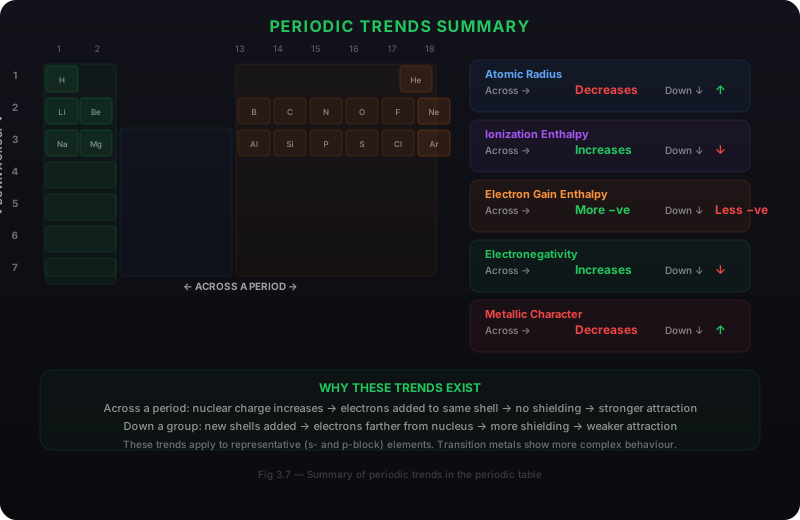
Electronegativity is directly related to non-metallic properties and inversely related to metallic properties. Elements with high electronegativity tend to be non-metals, while elements with low electronegativity tend to be metals.
3.12 Chemical Properties — Valence & Anomalous Behaviour
Valence (Oxidation State)
The valence of representative elements is usually equal to the number of electrons in the outermost shell or eight minus that number. The order of electronegativity is: F > O > Cl > N > Br > I > S > C > H.
| Group | Valence | Hydride Formula | Oxide Formula |
|---|---|---|---|
| 1 | 1 | MH | M₂O |
| 2 | 2 | MH₂ | MO |
| 13 | 3 | MH₃ | M₂O₃ |
| 14 | 4 | MH₄ | MO₂ |
| 15 | 3, 5 | MH₃ | M₂O₃, M₂O₅ |
| 16 | 2, 6 | H₂M | MO₂, MO₃ |
| 17 | 1, 7 | HM | M₂O₇ |
Anomalous Behaviour of Second Period Elements
The first element of each group (Li, Be, B, C, N, O, F) differs from other members due to:
- Small atomic size — high charge density
- High electronegativity — tendency to form covalent bonds
- Unavailability of d-orbitals — cannot expand octet (e.g., N cannot form NCl₅)
The second period element shows similarity with the third period element diagonally below it (Li–Mg, Be–Al, B–Si) due to similar charge/radius ratio and electronegativity.
3.13 Summary
• The Periodic Table is based on the Modern Periodic Law: properties of elements are a periodic function of their atomic numbers.
• Mendeleev's Periodic Table was based on atomic masses. He predicted properties of undiscovered elements (Eka-aluminium → Gallium, Eka-silicon → Germanium).
• The modern table arranges elements in 7 periods and 18 groups based on electronic configuration.
• Elements are classified into s, p, d, f blocks based on which subshell is being filled.
• Atomic radius decreases across a period and increases down a group.
• Ionization enthalpy increases across a period and decreases down a group. Exceptions at Be (full s²) and N (half-filled p³).
• Electron gain enthalpy becomes more negative across a period and less negative down a group.
• Electronegativity increases across a period and decreases down a group. Fluorine is the most electronegative element.
• Metallic character increases down a group and decreases across a period.