Electromagnetic Waves
Maxwell's unification of electricity and magnetism — the electromagnetic spectrum and its applications
Table of Contents
8.1 Introduction
In Chapter 4, we learnt that an electric current produces magnetic field and that two current-carrying wires exert a magnetic force on each other. Further, in Chapter 6, we have seen that a magnetic field changing with time gives rise to an electric field. James Clerk Maxwell argued that the converse is also true — an electric field changing with time gives rise to a magnetic field.
8.2 Maxwell's Equations
Maxwell's equations are the four fundamental equations that describe all classical electromagnetism:
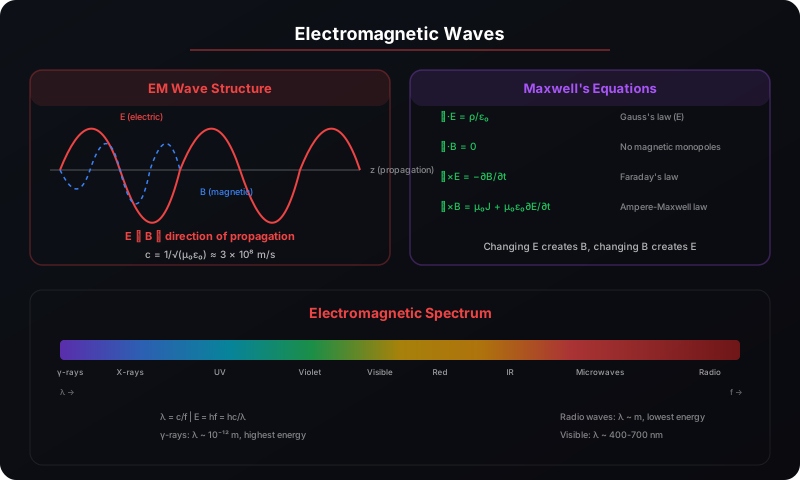
- ∇·E = ρ/ε₀ — Gauss's law for electricity
- ∇·B = 0 — Gauss's law for magnetism (no magnetic monopoles)
- ∇×E = −∂B/∂t — Faraday's law of electromagnetic induction
- ∇×B = μ₀J + μ₀ε₀∂E/∂t — Ampere-Maxwell law
8.3 Displacement Current
Maxwell introduced the concept of displacement current (I_d = ε₀dΦ_E/dt) to complete Ampere's law. This term accounts for the magnetic field produced by a changing electric field, even in the absence of conduction current.
8.4 Electromagnetic Waves
An electromagnetic wave is a self-propagating wave of oscillating electric and magnetic fields. The changing electric field creates a magnetic field, and the changing magnetic field creates an electric field — sustaining the wave indefinitely through space.
8.5 Properties of EM Waves
- E and B are perpendicular to each other and to the direction of propagation
- EM waves are transverse waves (both E and B are transverse)
- They can travel through vacuum (no medium required)
- They carry energy: energy density = ε₀E² = B²/μ₀
- They carry momentum and exert radiation pressure
- E₀/B₀ = c (amplitudes of E and B fields are related by c)
8.6 Electromagnetic Spectrum
The electromagnetic spectrum is the complete range of electromagnetic wave frequencies and wavelengths:
Gamma Rays
λ ~ 10⁻¹² m. Highest energy. Produced by nuclear reactions, radioactive decay. Used in cancer treatment.
X-Rays
λ ~ 10⁻¹⁰ m. Produced by electron transitions in inner shells. Used in medical imaging, security scanning.
Ultraviolet
λ ~ 10⁻⁸ m. Produced by hot bodies. Used in sterilization, fluorescence, vitamin D synthesis.
Visible Light
λ ~ 400-700 nm. Only part visible to human eyes. Red (longest λ) to violet (shortest λ).
Infrared
λ ~ 10⁻⁵ m. Produced by hot bodies. Used in thermal imaging, remote controls, night vision.
Microwaves
λ ~ 10⁻² m. Used in cooking, radar, satellite communication, WiFi.
8.7 Applications of EM Waves
Radio waves: broadcasting, communication. Microwaves: ovens, radar. Infrared: remote controls, heating. Visible light: illumination, vision. UV: sterilization, fluorescence. X-rays: medical imaging. Gamma rays: cancer therapy, sterilization of food.