Electromagnetic Induction
How changing magnetic fields create electric currents — Faraday's discovery that powers our world
Table of Contents
6.1 Introduction
Electricity and magnetism were considered separate and unrelated phenomena for a long time. In the early decades of the nineteenth century, experiments by Oersted, Ampere and others established that moving electric charges produce magnetic fields. This naturally raises the question: Is the converse effect possible? Can moving magnets produce electric currents?
6.2 Magnetic Flux
Magnetic flux through a surface is the number of magnetic field lines passing through it:
6.3 Faraday's Laws of Electromagnetic Induction
Michael Faraday's experiments led to two fundamental laws:
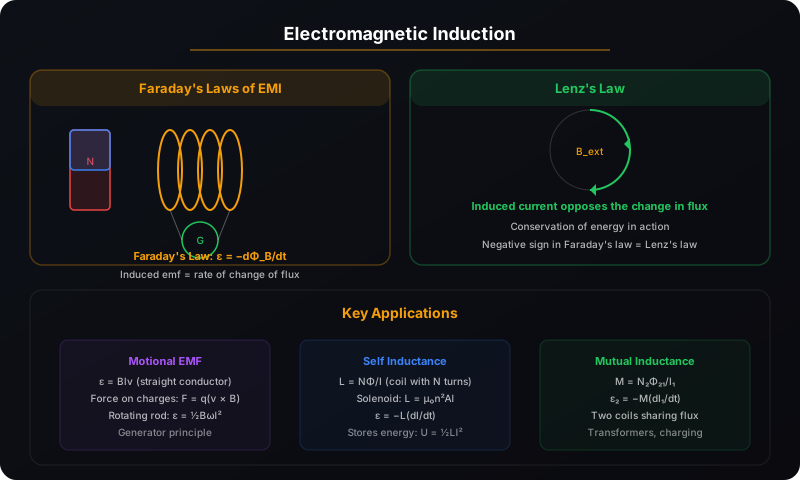
- First Law: Whenever the magnetic flux through a circuit changes, an emf is induced in the circuit
- Second Law: The induced emf is equal to the negative rate of change of magnetic flux through the circuit
6.4 Lenz's Law
Lenz's law states that the direction of the induced current is such that it opposes the change in magnetic flux that produced it. This is essentially a consequence of conservation of energy.
If the induced current aided the change instead of opposing it, we would get infinite energy from nothing — violating conservation of energy. Lenz's law ensures energy is always conserved.
6.5 Motional EMF
A conductor moving in a magnetic field develops an emf across its ends due to the Lorentz force on free charges:
For a rod of length l rotating with angular velocity ω about one end in a perpendicular B: ε = ½Bωl². This is the principle behind generators.
6.6 Eddy Currents
When a bulk conductor moves in a magnetic field or the magnetic flux through it changes, circulating currents called eddy currents are induced within the conductor.
- Causes energy loss (heating) in transformers and motors
- Used in electromagnetic braking (trains, roller coasters)
- Used in induction furnaces for melting metals
- Minimised by using laminated cores
6.7 Self Inductance
Self inductance is the property of a coil by which a change in current through it induces an emf in the same coil:
6.8 Mutual Inductance
Mutual inductance is the property of two coils by which a change in current in one coil induces an emf in the other coil: