Application of Derivatives
Where calculus meets the real world — rates, tangents, curves, and optimization
In this chapter
6.1 Introduction
"With the Calculus as a key, Mathematics can be successfully applied to the explanation of the course of Nature." — Whitehead
In Chapter 5, we learned to differentiate composite, inverse trigonometric, implicit, exponential, and logarithmic functions. In this chapter, we apply these derivatives to solve real-world problems: determining rates of change, finding equations of tangents, locating maxima and minima, and making approximations.
6.2 Rate of Change of Quantities
Whenever one quantity y varies with another quantity x, satisfying y = f(x), the derivative dy/dx represents the rate of change of y with respect to x.
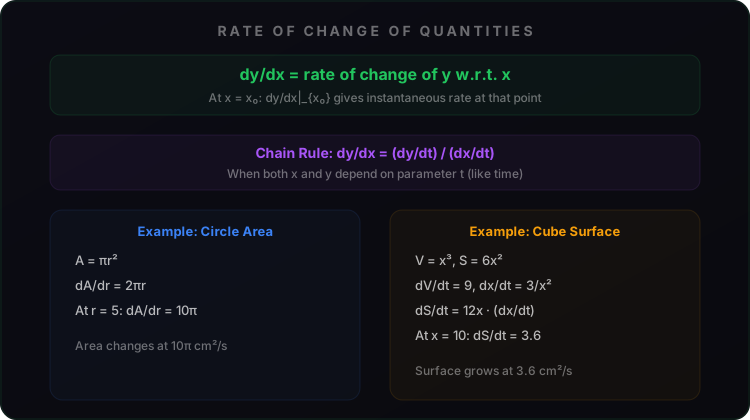
If x = f(t) and y = g(t), then:
dy/dx = (dy/dt) ÷ (dx/dt)
This lets us find the rate of y w.r.t. x even when both depend on a third variable like time.
6.3 Increasing and Decreasing Functions
The sign of the first derivative tells us whether a function is going up or down.

Increasing
f'(x) ≥ 0 on (a, b). As x increases, f(x) increases. Graph goes uphill.
Decreasing
f'(x) ≤ 0 on (a, b). As x increases, f(x) decreases. Graph goes downhill.
Step 1: Find f'(x)
Step 2: Solve f'(x) = 0 to get critical points
Step 3: These points divide the domain into intervals
Step 4: Test the sign of f'(x) in each interval
Step 5: + means increasing, − means decreasing
6.4 Tangents and Normals
The derivative at a point gives the slope of the tangent to the curve at that point. The normal is perpendicular to the tangent.
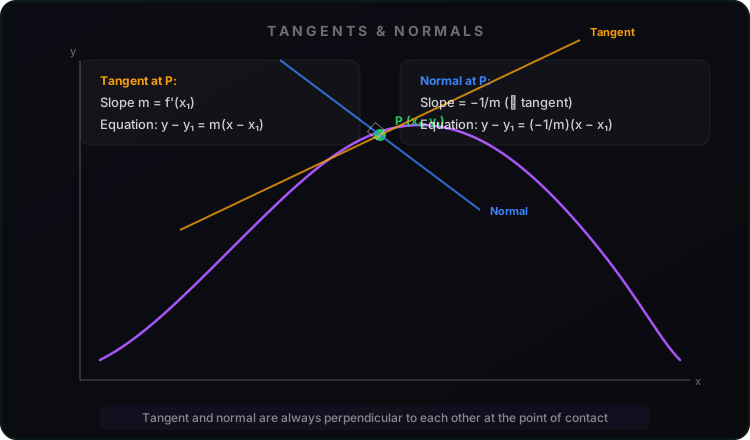
Normal: y − y₁ = (−1/f'(x₁))(x − x₁)
Horizontal tangent: f'(x₁) = 0 → tangent: y = y₁
Vertical tangent: f'(x₁) = ∞ → tangent: x = x₁
6.5 Approximations
Differentials allow us to approximate values of functions near a known point using the tangent line.
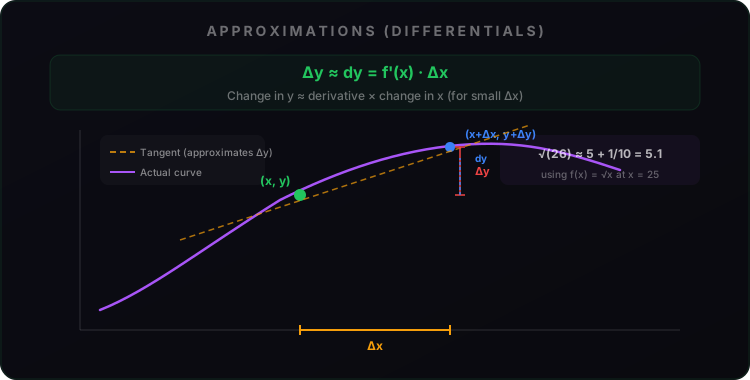
For small Δx:
f(x + Δx) ≈ f(x) + f'(x) · Δx
Example: √26 = √(25 + 1) ≈ 5 + (1/10)(1) = 5.1
6.6 Maxima and Minima
Finding the highest and lowest points on a curve — the crown jewel of optimization.

Local Maxima
f'(c) = 0 and f' changes + → − (or f''(c) < 0). The function peaks at c.
Local Minima
f'(c) = 0 and f' changes − → + (or f''(c) > 0). The function valleys at c.
Critical Points & Working Rule
Step 1: Find all critical points where f'(x) = 0 or f'(x) doesn't exist
Step 2: Include the endpoints a and b
Step 3: Evaluate f at all these points
Step 4: The largest value is the absolute maximum; the smallest is the absolute minimum
6.7 Summary
• dy/dx = rate of change of y w.r.t. x · chain rule: dy/dx = (dy/dt)/(dx/dt)
• f'(x) ≥ 0 → increasing · f'(x) ≤ 0 → decreasing
• Tangent: y − y₁ = f'(x₁)(x − x₁) · Normal: slope = −1/f'(x₁)
• Approximation: f(x + Δx) ≈ f(x) + f'(x)Δx for small Δx
• Critical point: where f'(x) = 0 or undefined
• First Derivative Test: sign change of f' at critical point → max/min
• Second Derivative Test: f'(c) = 0 and f''(c) < 0 → max; f''(c) > 0 → min
• Absolute extrema: compare f at critical points and endpoints