Mathematical Reasoning
The foundation of logical thinking — statements, negations, compound statements, and proofs
In this chapter
15.1 Statements
"Mathematics is the science of drawing necessary conclusions." — Benjamin Peirce
Mathematical reasoning is about making logical arguments and proving things rigorously. It starts with statements — sentences that are either true or false, but not both.
What is a Statement?
A statement (or proposition) is a sentence that is either true or false, but not both.
Examples of statements:
• "2 + 2 = 4" → TRUE
• "The Earth is flat" → FALSE
• "7 is a prime number" → TRUE
NOT statements:
• "x + 1 = 5" → depends on x (open sentence)
• "Is it raining?" → question, not true/false
• "Close the door!" → command, not true/false
Every statement has a truth value — either TRUE (T) or FALSE (F). We cannot have both or neither.
15.2 Negation
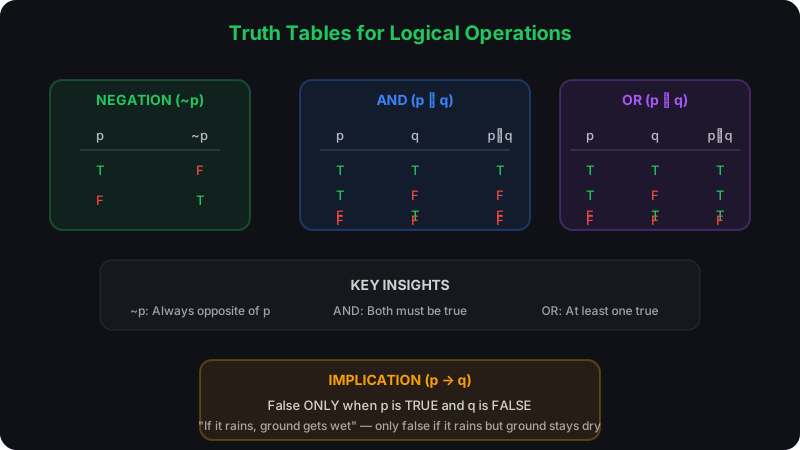
The negation of a statement is its opposite. If the original is true, the negation is false, and vice versa.
Statement p: "It is raining"
Negation ~p: "It is NOT raining"
Statement p: "2 + 3 = 5"
Negation ~p: "2 + 3 ≠ 5"
Rule: If p is TRUE, then ~p is FALSE. If p is FALSE, then ~p is TRUE.
• "All are" → "Some are not"
• "None are" → "Some are"
• "Some are" → "None are"
• "Always" → "Sometimes not"
• "Sometimes" → "Never"
15.3 Compound Statements
We can combine simple statements using AND (∧) and OR (∨) to create compound statements.
AND (∧)
p ∧ q is TRUE only when BOTH p and q are TRUE.
Example: "It is raining AND it is cold"
True only if both conditions are met.
OR (∨)
p ∨ q is TRUE when AT LEAST ONE of p or q is TRUE.
Example: "You can have cake OR ice cream"
True if you get cake, ice cream, or both.
15.4 Implications
An implication is an "if-then" statement. It's one of the most important structures in mathematics.
p → q means "if p is true, then q must be true"
Example: "If it rains, then the ground gets wet"
• p: It rains
• q: Ground gets wet
p → q is FALSE only when p is TRUE and q is FALSE.
Contrapositive
The contrapositive of p → q is: ~q → ~p
Example:
• Original: "If it rains, then ground gets wet"
• Contrapositive: "If ground doesn't get wet, then it didn't rain"
A statement and its contrapositive always have the same truth value!
Converse
The converse of p → q is: q → p
Example:
• Original: "If it rains, then ground gets wet"
• Converse: "If ground gets wet, then it rains"
Warning: A statement and its converse do NOT always have the same truth value! (Ground could get wet from a sprinkler)
Biconditional (If and Only If)
p ↔ q means both p → q AND q → p
Example: "A number is even if and only if it's divisible by 2"
This means: If even → divisible by 2, AND if divisible by 2 → even
15.5 Validating Statements
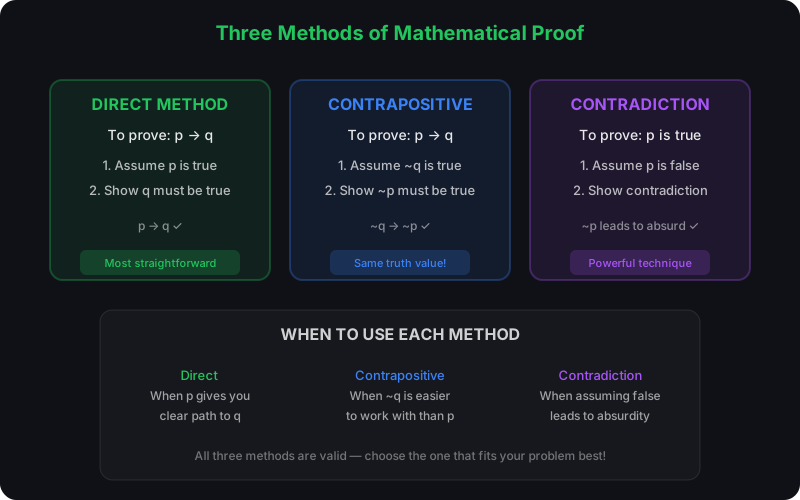
How do we prove a statement is true? There are several methods:
Direct Method
To prove p → q:
Assume p is true, then show q must be true.
Example: Prove "If n is even, then n² is even"
Assume n is even → n = 2k for some integer k
Then n² = (2k)² = 4k² = 2(2k²) → even ✓
Contrapositive Method
To prove p → q:
Instead prove ~q → ~p (the contrapositive)
Example: Prove "If n² is even, then n is even"
Contrapositive: "If n is odd, then n² is odd"
Assume n is odd → n = 2k+1
Then n² = (2k+1)² = 4k² + 4k + 1 = 2(2k²+2k) + 1 → odd ✓
Contradiction Method
Assume the statement is false, then show this leads to a contradiction.
Example: Prove √2 is irrational
Assume √2 is rational = p/q (in lowest terms)
Then 2 = p²/q² → p² = 2q² → p is even → p = 2k
Then 4k² = 2q² → q² = 2k² → q is even
But if both p and q are even, the fraction isn't in lowest terms — contradiction!
15.6 Summary
• Statement: A sentence that is either TRUE or FALSE, not both
• Negation (~p): Opposite truth value of p
• AND (p ∧ q): True only when both are true
• OR (p ∨ q): True when at least one is true
• Implication (p → q): False only when p is true and q is false
• Contrapositive (~q → ~p): Same truth value as original
• Converse (q → p): May have different truth value
• Proof methods: Direct, Contrapositive, Contradiction