Some Basic Concepts of Chemistry
Understanding the fundamental principles that govern the composition, structure, and properties of matter
In this chapter
"Chemistry is the science of molecules and their transformations. It is the science not so much of the one hundred elements but of the infinite variety of molecules that may be built from them." — Roald Hoffmann
Chemistry plays a central role in science and is often intertwined with other branches of science. Principles of chemistry are applicable in diverse areas, such as weather patterns, functioning of brain and operation of a computer, production in chemical industries, manufacturing fertilisers, alkalis, acids, salts, dyes, polymers, drugs, soaps, detergents, metals, alloys, etc.
People in ancient India, already had the knowledge of many scientific phenomenon much before the advent of modern science. In ancient India, chemistry was called Rasayan Shastra, Rastantra, Ras Kriya or Rasvidya. It included metallurgy, medicine, manufacture of cosmetics, glass, dyes, etc.
1.1 Importance of Chemistry
Chemistry contributes in a big way to the national economy. It also plays an important role in meeting human needs for food, healthcare products and other material aimed at improving the quality of life. This is exemplified by the large-scale production of a variety of fertilisers, improved variety of pesticides and insecticides.
Chemistry provides methods for the isolation of life-saving drugs from natural sources and makes possible synthesis of such drugs. Some of these drugs are cisplatin and taxol, which are effective in cancer therapy. The drug AZT (Azidothymidine) is used for helping AIDS patients.
In recent years, chemistry has helped in dealing with some of the pressing aspects of environmental degradation with a fair degree of success. Safer alternatives to environmentally hazardous refrigerants, like CFCs (chlorofluorocarbons), responsible for ozone depletion in the stratosphere, have been successfully synthesised.
1.2 Nature of Matter
You are already familiar with the term matter from your earlier classes. Anything which has mass and occupies space is called matter. Everything around us, for example, book, pen, pencil, water, air, all living beings, etc., are composed of matter.
1.2.1 States of Matter
You are aware that matter can exist in three physical states viz. solid, liquid and gas. The constituent particles of matter in these three states can be represented as shown in Fig. 1.1.
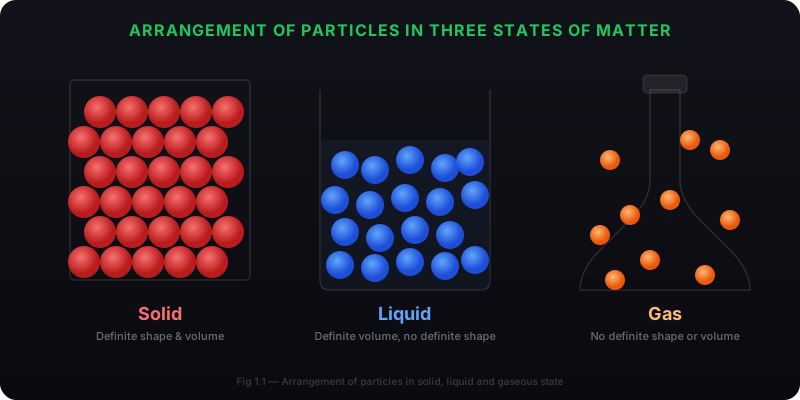
- Solids have definite volume and definite shape.
- Liquids have definite volume but do not have definite shape. They take the shape of the container in which they are placed.
- Gases have neither definite volume nor definite shape. They completely occupy the space in the container in which they are placed.
These three states of matter are interconvertible by changing the conditions of temperature and pressure.
Solid → Liquid (on heating) → Gas (on further heating)
Gas (on cooling) → Liquid (on further cooling) → Solid
1.2.2 Classification of Matter
At the macroscopic or bulk level, matter can be classified as mixture or pure substance. These can be further sub-divided as shown in Fig. 1.2.
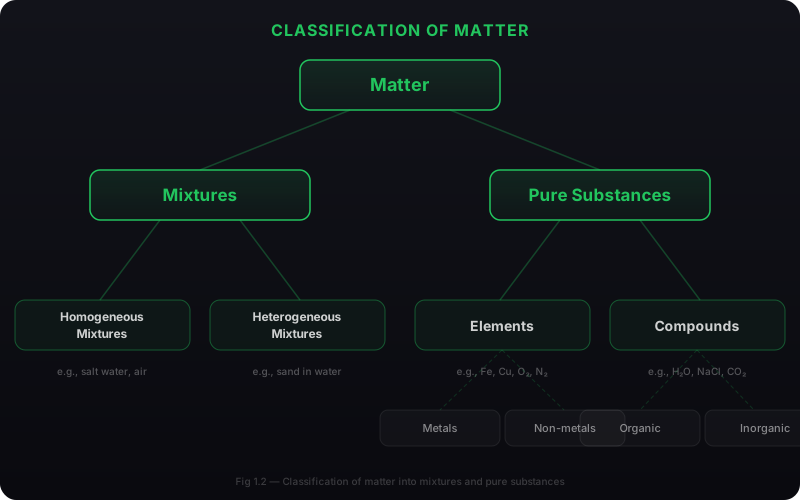
A mixture contains particles of two or more pure substances which may be present in it in any ratio. A mixture may be homogeneous or heterogeneous. Sugar solution and air are examples of homogeneous mixtures.
Pure substances have characteristics different from mixtures. Constituent particles of pure substances have fixed composition. Pure substances can further be classified into elements and compounds.
1.3 Properties of Matter and Their Measurement
Every substance has unique or characteristic properties. These properties can be classified into two categories — physical properties (such as colour, odour, melting point, boiling point, density, etc.) and chemical properties (like composition, combustibility, reactivity with acids and bases, etc.).
1.3.1 Atoms and Molecules
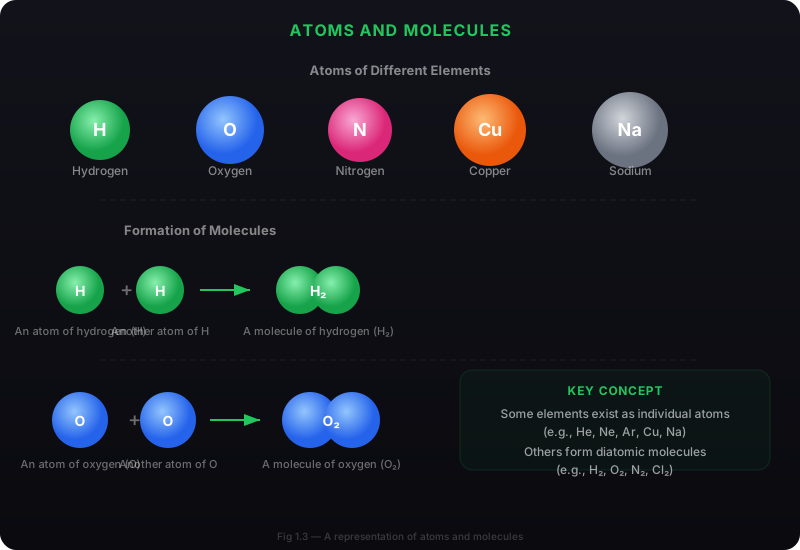
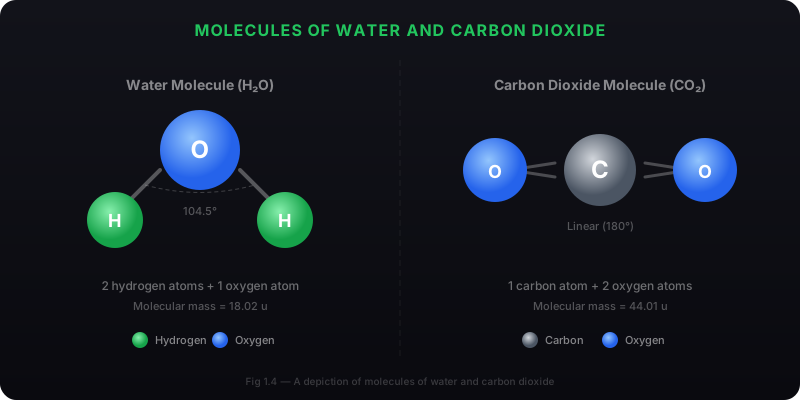
Sodium, copper, silver, hydrogen, oxygen, etc., are some examples of elements. Their all atoms are of one type. However, the atoms of different elements are different in nature. Some elements, such as sodium or copper, contain atoms as their constituent particles, whereas, in some others, the constituent particles are molecules which are formed by two or more atoms.
1.3.2 SI Units
In 1960, a unified system of measurement of the 7 base units was recommended by the General Conference of Weights and Measures. This system is called International System of Units (SI). The SI unit of mass is kilogram (kg), length is metre (m), time is second (s), temperature is kelvin (K), amount of substance is mole (mol), electric current is ampere (A), and luminous intensity is candela (cd).
1.3.3 Mass and Weight
Mass of a substance is the amount of matter present in it, while weight is the force exerted by gravity on an object. The mass of a substance is constant, whereas, its weight may vary from one place to another due to change in gravity.
The mass of a substance can be determined accurately in the laboratory by using an analytical balance. The SI unit of mass is kilogram (1 kg = 1000 g), is used in laboratories due to the smaller amounts of chemicals used in chemical reactions.
1.3.4 Volume
Volume is the amount of space occupied by a substance. It has the units of (length)3. In SI system, volume has units of m3. But again, in chemistry laboratories, smaller volumes are used. Hence, volume is often denoted in cm3 or dm3 units.
1.3.5 Density
1.3.6 Temperature
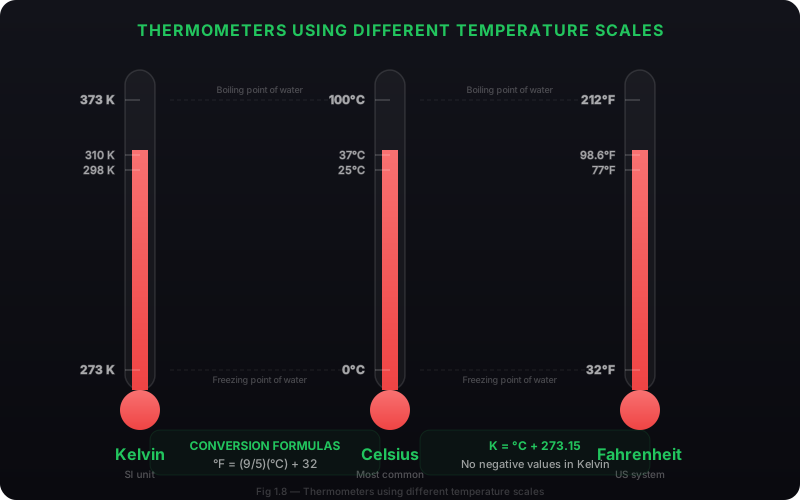
There are three common scales to measure temperature — °C (degree celsius), °F (degree fahrenheit) and K (kelvin). Here, K is the SI unit.
1.4 Uncertainty in Measurement
1.4.1 Scientific Notation
As chemistry is the study of atoms and molecules, which have extremely low masses and are present in extremely large numbers, a chemist has to deal with numbers as large as 602,200,000,000,000,000,000,000 for the molecules of 2 g of hydrogen gas or as small as 0.00000000000000000000000166 g mass of a H atom.
This problem is solved by using scientific notation for such numbers, i.e., exponential notation in which any number can be represented in the form N × 10n, where n is an exponent having positive or negative values and N is a number (called digit term) which varies between 1.000... and 9.999....
232.508 = 2.32508 × 10² | 0.00016 = 1.6 × 10⁻⁴
1.4.2 Significant Figures
Every experimental measurement has some amount of uncertainty associated with it because of limitation of measuring instrument and the skill of the person making the measurement. Significant figures are meaningful digits which are known with certainty plus one which is estimated or uncertain.
Rules for determining significant figures:
- All non-zero digits are significant (e.g., 285 cm has three significant figures).
- Zeros preceding to first non-zero digit are not significant (e.g., 0.03 has one significant figure).
- Zeros between two non-zero digits are significant (e.g., 2.005 has four significant figures).
- Zeros at the end of a number are significant if they are on the right side of the decimal point.
- Counting numbers have infinite significant figures (e.g., 2 balls = 2.000...).
1.4.3 Dimensional Analysis
In carrying out calculations involving unit conversion, the method used to convert from one unit to another is called dimensional analysis or factor-label method.
1.5 Laws of Chemical Combinations
The combination of elements to form compounds is governed by the following five basic laws.
1.5.1 Law of Conservation of Mass
This law was put forth by Antoine Lavoisier in 1789. He stated that in all physical and chemical changes, there is no net change in mass during the process. Hence, matter can neither be created nor destroyed.
1.5.2 Law of Definite Proportions
This law was given by a French chemist, Joseph Proust. He stated that a given compound always contains exactly the same proportion of elements by weight. This is also referred to as Law of Definite Composition.
1.5.3 Law of Multiple Proportions
This law was proposed by Dalton in 1803. According to this law, if two elements can combine to form more than one compound, the masses of one element that combine with a fixed mass of the other element, are in the ratio of small whole numbers.
Hydrogen combines with oxygen to form water (H₂O) and hydrogen peroxide (H₂O₂). The masses of oxygen (16 g and 32 g) which combine with a fixed mass of hydrogen (2 g) are in the ratio of 1:2.
1.5.4 Gay Lussac's Law of Gaseous Volumes
Gay Lussac discovered that when gases combine or are produced in a chemical reaction they do so in a simple ratio by volume, provided all gases are at the same temperature and pressure.
1.5.5 Avogadro's Law
In 1811, Avogadro proposed that equal volumes of all gases at the same temperature and pressure should contain equal number of molecules. Avogadro made a distinction between atoms and molecules which is quite understandable in present times.
1.6 Dalton's Atomic Theory
In 1808, Dalton published 'A New System of Chemical Philosophy', in which he proposed the following:
- Matter consists of indivisible atoms.
- All atoms of a given element have identical properties, including identical mass. Atoms of different elements differ in mass.
- Compounds are formed when atoms of different elements combine in a fixed ratio.
- Chemical reactions involve reorganisation of atoms. These are neither created nor destroyed in a chemical reaction.
Dalton's theory could explain the laws of chemical combination. However, it could not explain the laws of gaseous volumes. It could not provide the reason for combining of atoms, which was answered later by other scientists.
1.7 Atomic and Molecular Masses
1.7.1 Atomic Mass
The atomic mass of an element is the mass of its atom as compared to the mass of a carbon-12 atom taken as 12 units. The present system of atomic masses is based on carbon-12 as the standard and has been agreed upon in 1961. One atomic mass unit (amu) is defined as a mass exactly equal to one-twelfth of the mass of one carbon-12 atom.
1 amu = 1.66056 × 10⁻²⁴ g
1.7.2 Average Atomic Mass
Many naturally occurring elements exist as more than one isotope. When we take into account the existence of these isotopes and their relative abundance (per cent occurrence), the average atomic mass of that element can be computed.
| Isotope | Relative Abundance (%) | Atomic Mass (amu) |
|---|---|---|
| 12C | 98.892 | 12 |
| 13C | 1.108 | 13.00335 |
| 14C | 2 × 10⁻¹⁰ | 14.00317 |
Average atomic mass of carbon = (0.98892)(12 u) + (0.01108)(13.00335 u) + (2 × 10-12)(14.00317 u) = 12.011 u
1.7.3 Molecular Mass
Molecular mass is the sum of atomic masses of the elements present in a molecule. For example:
1.7.4 Formula Mass
Some substances, such as sodium chloride, do not contain discrete molecules as their constituent units. In such compounds, positive (sodium ion) and negative (chloride ion) entities are arranged in a three-dimensional structure. The formula, such as NaCl, is used to calculate the formula mass instead of molecular mass.
Formula mass of NaCl = 23.0 + 35.5 = 58.5 u
1.8 Mole Concept and Molar Masses
Atoms and molecules are extremely small in size and their numbers in even a small amount of any substance is really very large. To handle such large numbers, a unit of convenient magnitude is required.
In SI system, mole (symbol, mol) was introduced as seventh base quantity for the amount of a substance. One mole contains exactly 6.02214076 × 10²³ elementary entities. This number is the fixed numerical value of the Avogadro constant, NA, when expressed in the unit mol-1 and is called the Avogadro number.
1 mol of hydrogen atoms = 6.022 × 10²³ atoms
1 mol of water molecules = 6.022 × 10²³ water molecules
1 mol of sodium chloride = 6.022 × 10²³ formula units of NaCl
The mass of one mole of a substance in grams is called its molar mass. The molar mass in grams is numerically equal to atomic/molecular/formula mass in u.
1.9 Percentage Composition
Many a time, information regarding the percentage of a particular element present in a compound is required. The mass per cent of an element is:
For water (H2O): Mass % of H = (2.016/18.02) × 100 = 11.18%, Mass % of O = (16.00/18.02) × 100 = 88.79%
1.9.1 Empirical Formula for Molecular Formula
An empirical formula represents the simplest whole number ratio of various atoms present in a compound, whereas, the molecular formula shows the exact number of different types of atoms present in a molecule of a compound.
Step 1: Convert mass per cent to grams (use 100 g as starting material)
Step 2: Convert into number moles of each element
Step 3: Divide each mole value by the smallest number among them
Step 4: Write the empirical formula
Step 5: Determine molecular formula = n × (Empirical formula)
1.10 Stoichiometry and Stoichiometric Calculations
The word 'stoichiometry' is derived from two Greek words — stoicheion (meaning, element) and metron (meaning, measure). Stoichiometry, thus, deals with the calculation of masses (sometimes volumes also) of the reactants and the products involved in a chemical reaction.
Consider the combustion of methane:
1.10.1 Limiting Reagent
Reactions are carried out with the amounts of reactants that are different than the amounts as required by a balanced chemical reaction. The reactant which is present in the least amount gets consumed first and limits the amount of product formed. It is called the limiting reagent.
1.10.2 Reactions in Solutions
The concentration of a solution or the amount of substance present in its given volume can be expressed in any of the following ways:
1.11 Summary
• Chemistry is the science of the composition, structure, properties and reactions of matter. It plays an important role in meeting human needs.
• Matter can exist in three states — solid, liquid and gas. Matter can be classified into elements, compounds or mixtures.
• The SI unit of mass is kilogram (kg). The SI unit of temperature is kelvin (K). Volume has units of length3.
• Scientific notation and significant figures are important for handling experimental data with proper precision.
• The combination of elements is governed by five basic laws — Law of Conservation of Mass, Law of Definite Proportions, Law of Multiple Proportions, Gay Lussac's Law of Gaseous Volumes, and Avogadro's Law.
• Atomic mass is based on carbon-12. Molecular mass is sum of atomic masses. The mole is the SI unit for amount of substance containing 6.022 × 10²³ entities.
• Stoichiometry deals with the quantitative study of reactants and products. Concentration can be expressed as mass percent, mole fraction, molarity or molality.