Ecosystem
Understanding the structure, function and energy flow within nature’s self-sustaining units — from small ponds to the entire biosphere
In this chapter
An ecosystem can be visualised as a functional unit of nature, where living organisms interact among themselves and also with the surrounding physical environment. Ecosystems vary greatly in size — from a small pond to a large forest or even a sea. Many ecologists regard the entire biosphere as a global ecosystem, being a composite of all local ecosystems on Earth. Since this system is too vast and complex to study at one time, it is convenient to divide it into two basic categories: terrestrial and aquatic. Forest, grassland and desert are some examples of terrestrial ecosystems; pond, lake, wetland, river and estuary are some examples of aquatic ecosystems. Crop fields and an aquarium may also be considered as man-made ecosystems.
We will first look at the structure of the ecosystem, in order to appreciate the input (productivity), transfer of energy (food chain/web, nutrient cycling) and the output (degradation and energy loss). We will also look at the relationships — cycles, chains, webs — that are created as a result of these energy flows within the system and their inter-relationship.
12.1 Ecosystem — Structure and Function
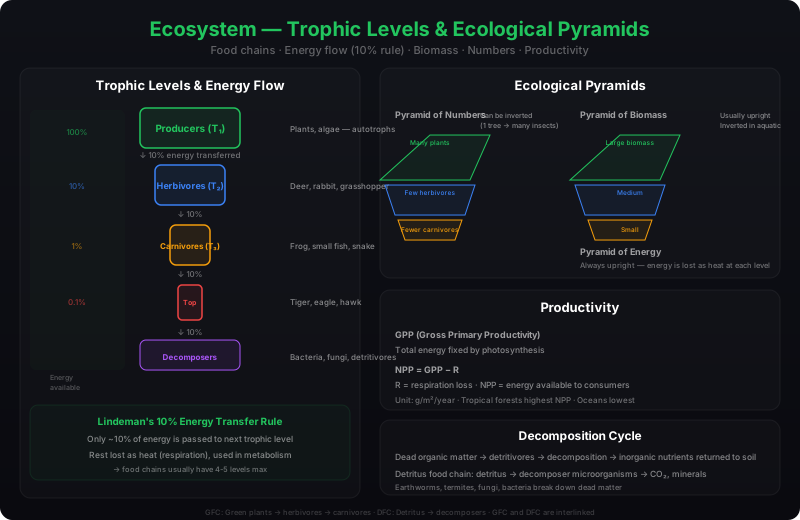
In earlier classes, you have studied the various components of the environment — abiotic and biotic. You looked at how individual biotic and abiotic factors affected each other and their surroundings. Let us now examine these components in a more integrated manner and see how the flow of energy takes place within the components of the ecosystem.
Interaction of biotic and abiotic components results in a physical structure that is characteristic for each type of ecosystem. Identification and enumeration of plant and animal species of an ecosystem gives its species composition. Vertical distribution of different species occupying different levels is called stratification. For example, trees occupy the top vertical strata of a forest, shrubs the second, and herbs and grasses occupy the bottom layers.
The components of an ecosystem are seen to function as a unit when you consider the following aspects:
- Productivity — the rate of biomass production
- Decomposition — breakdown of dead organic matter
- Energy flow — unidirectional transfer of energy through trophic levels
- Nutrient cycling — movement and storage of nutrient elements through ecosystem components
To understand the ethos of an aquatic ecosystem let us take a small pond as an example. This is a fairly self-sustainable unit and a rather simple example that explains even the complex interactions in an aquatic ecosystem. The abiotic component is the water with all dissolved inorganic and organic substances and the rich soil deposit at the bottom. Solar input, the cycle of temperature, day-length and other climatic conditions regulate the rate of function of the entire pond. The autotrophic components include phytoplankton, some algae, and the floating, submerged and marginal plants at the edges. The consumers are represented by zooplankton, free-swimming and bottom-dwelling forms. The decomposers are fungi, bacteria and flagellates, especially abundant at the bottom of the pond.
This system performs all the functions of any ecosystem: conversion of inorganic into organic material with the help of radiant energy of the sun by the autotrophs; consumption of the autotrophs by heterotrophs; decomposition and mineralisation of the dead matter to release them back for reuse by the autotrophs. These events are repeated over and over again.
There is unidirectional movement of energy towards the higher trophic levels and dissipation of energy as heat at each step. We will study all these processes in detail in the following sections.
12.2 Productivity
Decomposition and energy flow are the two important aspects of an ecosystem. We must understand one more concept before going into the details of these two processes — the concept of productivity.
Primary production in an ecosystem is defined as the amount of biomass or organic matter produced per unit area over a time period by plants during photosynthesis. It is expressed in terms of weight (g m⁻²) or energy (kcal m⁻²). The rate of biomass production is called productivity. It is expressed in terms of g m⁻² yr⁻¹ or (kcal m⁻²) yr⁻¹ to compare the productivity of different ecosystems.
Gross Primary Productivity & Net Primary Productivity
Productivity can be divided into gross primary productivity (GPP) and net primary productivity (NPP).
Gross Primary Productivity of an ecosystem is the rate of production of organic matter during photosynthesis. A considerable amount of GPP is utilised by plants in respiration. Gross primary productivity minus respiration losses (R) is the Net Primary Productivity (NPP).
Net primary productivity is the available biomass for the consumption to heterotrophs (herbivores and decomposers). Secondary productivity is defined as the rate of formation of new organic matter by consumers.
Factors Affecting Productivity
Primary productivity depends on the plant species inhabiting a particular area. It also depends on a variety of environmental factors, availability of nutrients and photosynthetic capacity of plants. Therefore, it varies in different types of ecosystems.
The annual net primary productivity of the whole biosphere is approximately 170 billion tons (dry weight) of organic matter. Of this, despite occupying about 70 per cent of the surface, the productivity of the oceans is only 55 billion tons. The rest, of course, is on land. The low productivity of oceans is mainly due to limited light penetration, lower nutrient availability and cold temperatures at greater depths.
12.3 Decomposition
You may have heard of the earthworm being referred to as the farmer’s ‘friend’. This is so because they help in the breakdown of complex organic matter as well as in loosening of the soil. Similarly, decomposers break down complex organic matter into inorganic substances like carbon dioxide, water and nutrients — the process is called decomposition.
Dead plant remains such as leaves, bark, flowers and dead remains of animals, including faecal matter, constitute detritus, which is the raw material for decomposition. The important steps in the process of decomposition are:
Fragmentation
Detritivores (e.g., earthworm) break down detritus into smaller particles. This process is called fragmentation.
Leaching
Water-soluble inorganic nutrients go down into the soil horizon and get precipitated as unavailable salts.
Catabolism
Bacterial and fungal enzymes degrade detritus into simpler inorganic substances. This is the actual process of decomposition.
Humification
Accumulation of a dark coloured amorphous substance called humus that is highly resistant to microbial action and undergoes decomposition at an extremely slow rate. Being colloidal in nature, it serves as a reservoir of nutrients.
- Mineralisation — The humus is further degraded by some microbes and release of inorganic nutrients occurs by the process known as mineralisation.
Decomposition is largely an oxygen-requiring process. The rate of decomposition is controlled by the chemical composition of detritus and climatic factors. In a particular climatic condition, decomposition rate is slower if detritus is rich in lignin and chitin, and quicker if detritus is rich in nitrogen and water-soluble substances like sugars. Temperature and soil moisture are the most important climatic factors that regulate decomposition through their effects on the activities of soil microbes. Warm and moist environments favour decomposition whereas low temperature and anaerobiosis inhibit decomposition, resulting in build-up of organic materials.
12.4 Energy Flow
Except for the deep-sea hydrothermal ecosystem, sun is the only source of energy for all ecosystems on Earth. Of the incident solar radiation, less than 50 per cent of it is photosynthetically active radiation (PAR). Plants and photosynthetic bacteria (autotrophs) fix Sun’s radiant energy to make food from simple inorganic materials. Plants capture only 2–10 per cent of the PAR and this small amount of energy sustains the entire living world.
Ecosystems are not exempt from the Second Law of thermodynamics. They need a constant supply of energy to synthesise the molecules they require, to counteract the universal tendency toward increasing disorderliness. This is why a constant input of solar energy is essential for the sustenance of life on Earth.
The green plants in the ecosystem are called producers. In a terrestrial ecosystem, major producers are herbaceous and woody plants. Producers in an aquatic ecosystem include various species like phytoplankton, algae and higher plants.
Grazing Food Chain (GFC)
Starting from the plants (producers), food chains or rather webs are formed such that an animal feeds on a plant or on another animal and in turn is food for another. The chain or web is formed because of this interdependency. No energy that is trapped into an organism remains in it for ever. The energy trapped by the producer is either passed on to a consumer or the organism dies. Death of the organism is the beginning of the detritus food chain/web.
All animals depend on plants (directly or indirectly) for their food needs. They are hence called consumers and also heterotrophs. If they feed on the producers (plants), they are called primary consumers; if the animals eat other animals which in turn eat the plants, they are called secondary consumers. Likewise, you could have tertiary consumers too. Obviously, primary consumers will be herbivores.
Trophic Levels
Organisms occupy a place in the natural surroundings or in a community according to their feeding relationship with other organisms. Based on the source of their nutrition or food, organisms occupy a specific place in the food chain that is known as their trophic level. Producers belong to the first trophic level, herbivores (primary consumers) to the second, and carnivores (secondary consumers) to the third.
Detritus Food Chain (DFC)
The detritus food chain begins with dead organic matter. It is made up of decomposers which are heterotrophic organisms, mainly fungi and bacteria. They meet their energy and nutrient requirements by degrading dead organic matter or detritus. These are also known as saprotrophs (sapro: to decompose). Decomposers secrete digestive enzymes that break down dead and waste materials into simple, inorganic materials, which are subsequently absorbed by them.
In an aquatic ecosystem, GFC is the major conduit for energy flow. As against this, in a terrestrial ecosystem, a much larger fraction of energy flows through the detritus food chain than through the GFC. Detritus food chain may be connected with the grazing food chain at some levels: some of the organisms of DFC are prey to the GFC animals, and in a natural ecosystem, some animals like cockroaches, crows, etc., are omnivores. These natural interconnections of food chains make it a food web.
12.5 Ecological Pyramids
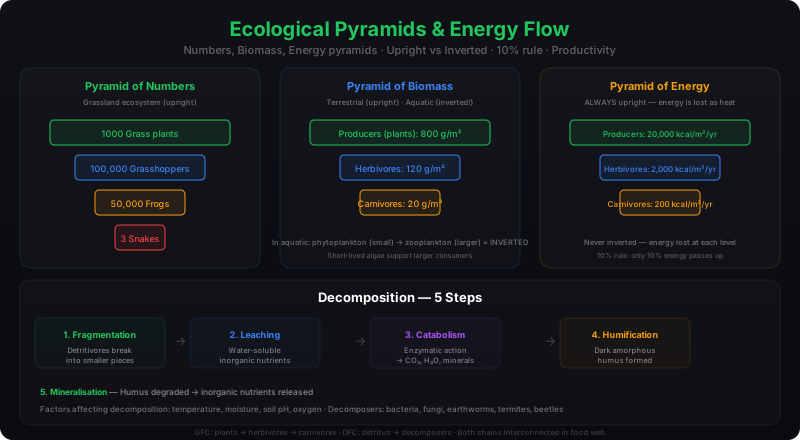
The relationship between organisms at different trophic levels can be expressed in terms of number, biomass or energy. The base of each pyramid represents the producers or the first trophic level while the apex represents tertiary or top-level consumer. The three types of ecological pyramids that are usually studied are:
Pyramid of Number
Represents the number of individual organisms at each trophic level. In a grassland, nearly 6 million plants support only about 3 top carnivores — showing a steep upright pyramid.
Pyramid of Biomass
Shows the amount of living or dead matter present at each trophic level. Generally upright on land, but inverted in aquatic ecosystems where a small standing crop of phytoplankton supports a large standing crop of zooplankton.
Pyramid of Energy
Always upright because energy is lost as heat at each trophic level. Primary producers convert only about 1% of available sunlight into NPP. Each bar shows the amount of energy present per unit area per unit time.
Limitations
Ecological pyramids do not account for the same species belonging to more than one trophic level. They assume a simple food chain, which is rarely found in nature.
Any calculations of energy content, biomass or numbers has to include all organisms at that trophic level. No generalisations we make will be true if we take only a few individuals at any trophic level into account. Also, a given organism may occupy more than one trophic level simultaneously. A sparrow is a primary consumer when it eats seeds and fruits, and a secondary consumer when it eats insects and worms.
In most ecosystems, all the pyramids — of number, energy and biomass — are upright: producers are more in number and biomass than herbivores, and herbivores more than carnivores. However, there are exceptions. The pyramid of biomass in the sea is generally inverted because the biomass of fishes far exceeds that of phytoplankton. The pyramid of energy is always upright and can never be inverted, because when energy flows from one trophic level to the next, some energy is always lost as heat at each step.
However, there are certain limitations of ecological pyramids: it does not take into account the same species belonging to two or more trophic levels. It assumes a simple food chain, something that almost never exists in nature. Decomposers, which are a very important component of any ecosystem, are not given a place in these pyramids.
12.6 Summary
• An ecosystem is a structural and functional unit of nature comprising abiotic and biotic components. Abiotic components are inorganic materials — air, water and soil — whereas biotic components are producers, consumers and decomposers.
• Species composition and stratification are the two main structural features of an ecosystem. Based on source of nutrition every organism occupies a place in an ecosystem.
• Productivity, decomposition, energy flow, and nutrient cycling are the four important components of an ecosystem.
• Primary productivity is the rate of capture of solar energy or biomass production of the producers. It is divided into gross primary productivity (GPP) and net primary productivity (NPP). Secondary productivity is the rate of assimilation of food energy by the consumers.
• In decomposition, complex organic compounds of detritus are converted to carbon dioxide, water and inorganic nutrients by the decomposers. Decomposition involves fragmentation, leaching and catabolism.
• Energy flow is unidirectional. Plants capture solar energy, which is transferred from producers to consumers. Organisms of different trophic levels are connected for food or energy relationship forming a food chain.
• Nutrient cycling is of two types — gaseous and sedimentary. The atmosphere or hydrosphere is the reservoir for gaseous cycles (carbon), whereas the Earth’s crust is the reservoir for sedimentary cycles (phosphorus).
• Products of ecosystem processes are named as ecosystem services, e.g., purification of air and water by forests.