Evolution
The origin of life, mechanisms of change, and the grand story of how life diversified on Earth over billions of years
Table of Contents
6.1 Origin of Life
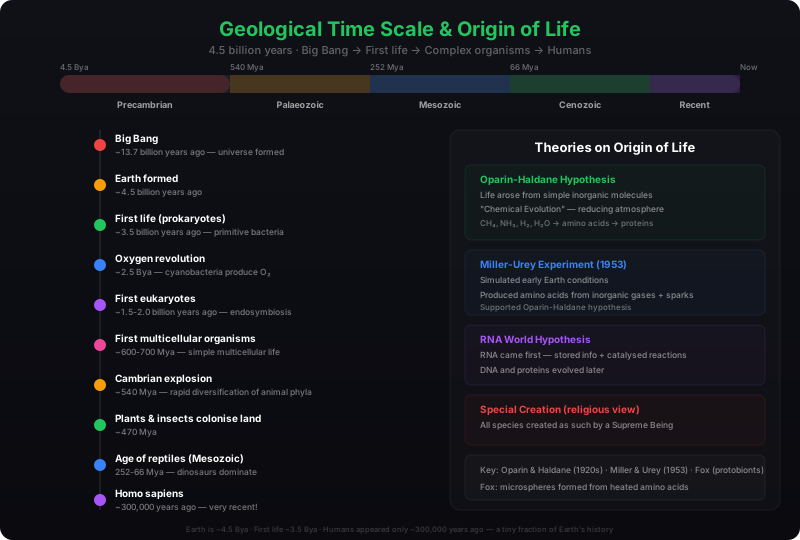
Evolutionary biology studies the history of life forms on Earth. To understand the changes in flora and fauna that have occurred over millions of years, we must first understand the context — the origin of life itself, the evolution of Earth, of stars, and indeed of the universe. This is the longest of all stories — one that spans billions of years and traces the journey from a featureless cosmos to the astonishing diversity of life we see today.
When we gaze at stars on a clear night, we are in a sense looking back in time. Stellar distances are measured in light years — the light reaching our eyes began its journey millions of years ago from trillions of kilometres away. Objects in our immediate surroundings appear instantly and in the present, but stars are windows into the distant past.
The Universe and the Big Bang
The universe is almost 13.8 billion years old. It is vast beyond comprehension — huge clusters of galaxies containing stars, clouds of gas, and dust. Earth, by comparison, is a mere speck. The Big Bang theory attempts to explain the origin of the universe: a singular, unimaginable explosion caused the universe to expand, and as it did, the temperature dropped. Hydrogen and helium formed, and these gases condensed under gravitation to form the galaxies of the present-day universe.
In the solar system of the Milky Way galaxy, Earth was formed approximately 4.5 billion years ago. There was no atmosphere initially. Water vapour, methane, carbon dioxide, and ammonia released from molten mass covered the surface. Ultraviolet rays from the sun broke water into hydrogen and oxygen. The lighter hydrogen escaped, while oxygen combined with ammonia and methane to form water, CO2, and other compounds. The ozone layer eventually formed. As the surface cooled, water vapour fell as rain, filling all depressions and forming the oceans.
Life appeared approximately 500 million years after the formation of Earth — roughly four billion years ago. This means life had existed for a very long time before complex multicellular organisms emerged.
Theories on the Origin of Life
Panspermia: Some scientists believe life came from outer space. Early Greek thinkers proposed that units of life called spores were transferred to different planets including Earth. This idea, known as Panspermia, remains a favourite hypothesis for some astronomers.
Spontaneous Generation: For a long time it was believed that life arose from decaying and rotting matter like straw, mud, etc. — the theory of spontaneous generation. However, Louis Pasteur's careful experiments demonstrated that life comes only from pre-existing life. In pre-sterilised flasks, life did not come from killed yeast, while in another flask open to air, new living organisms arose. Spontaneous generation was dismissed once and for all — but the question of how the first life form came to exist remained unanswered.
The Oparin-Haldane Hypothesis
Oparin of Russia and Haldane of England proposed that the first form of life could have come from pre-existing non-living organic molecules (e.g., RNA, protein, etc.). They argued that the formation of life was preceded by chemical evolution — the formation of diverse organic molecules from inorganic constituents. The conditions on early Earth were favourable: high temperature, volcanic storms, and a reducing atmosphere containing CH4, NH3, etc.
S.L. Miller, an American scientist, recreated these early Earth conditions in a laboratory-scale apparatus. He used a mixture of methane, ammonia, hydrogen, and water vapour at high temperature and passed electric discharge through it (simulating lightning). After one week, several amino acids were found in the trapped samples. This experiment provided experimental evidence for the Oparin-Haldane hypothesis and demonstrated that organic molecules could form from inorganic precursors under early Earth conditions.
After the formation of organic molecules, the primitive cell-like capsules (called protocells) could have gradually evolved. These capsules reproduced their molecules. The first cellular form of life did not possibly originate until about 2,000 million years ago. These were probably single cells, and all life forms existed in water. This version — that the first form of life arose slowly through evolutionary forces from non-living molecules — is accepted by the majority of scientists.
6.2 Evolution of Life Forms — A Theory
The Theory of Special Creation
Conventional religious literature speaks of the theory of special creation, which carries three connotations: (1) all living organisms seen today were created as such; (2) diversity has always been the same since creation and will remain unchanged; and (3) the Earth is only about 4,000 years old. All these ideas were strongly challenged during the nineteenth century.
Darwin's Theory of Natural Selection
Based on observations made during a voyage in a sail ship called H.M.S. Beagle, Charles Darwin concluded that existing living forms share similarities to varying degrees — not only among themselves but also with life forms that existed millions of years ago. Many such life forms do not exist any more. There have been extinctions of different life forms just as new forms of life arose at different periods in Earth's history. There has been a gradual evolution of life forms.
Any population has built-in variation in characteristics. Those characteristics which enable some individuals to survive better in natural conditions (climate, food, physical factors, etc.) would outbreed others that are less-endowed. Darwin used the term fitness, which refers ultimately and only to reproductive fitness — those who are better fit in an environment leave more progeny than others. These survivors are selected by nature. He called this natural selection and implied it as a mechanism of evolution.
Over time, apparently new types of organisms become recognisable. All existing life forms share similarities and share common ancestors — but these ancestors were present at different periods in Earth's history (epochs, periods, and eras). The geological history of Earth closely correlates with the biological history of Earth. A common conclusion is that Earth is very old — not thousands of years, but billions of years old.
6.3 What are the Evidences for Evolution?
Evidence that evolution has taken place on Earth has come from many quarters — from the study of fossils, comparative anatomy, embryology, and molecular biology.
Paleontological Evidence — Fossils
Fossils are remains or impressions of hard parts of life forms found in rocks. Rocks form sediments, and a cross-section of Earth's crust indicates the arrangement of sediments one over the other during the long history of Earth. Different-aged rock sediments contain fossils of different life forms who probably died during the formation of the particular sediment. Some fossils appear similar to modern organisms, while others represent extinct organisms (e.g., dinosaurs).
A study of fossils in different sedimentary layers indicates the geological period in which they existed. This study showed that life forms varied over time and certain life forms are restricted to certain geological time spans. Hence, new forms of life have arisen at different times in the history of Earth. This is called paleontological evidence. The ages of fossils are calculated using radioactive dating methods.
Embryological Support for Evolution
Ernst Haeckel proposed embryological support for evolution based on the observation that early embryos of different vertebrates show remarkable similarities. For example, the early embryos of reptiles, birds, and mammals all possess gill slits and a tail — features that are lost or modified during later development. This recapitulation theory suggests that during development, an organism goes through stages resembling its ancestral forms.
Homology and Analogy
Comparative study of the anatomy of different organisms reveals important clues about evolutionary relationships. For example, whales, bats, cheetahs, and humans (all mammals) share similarities in the pattern of bones of the forelimbs. Though these forelimbs perform different functions in these animals, they have a similar anatomical structure — all have the humerus, radius, ulna, carpals, metacarpals, and phalanges in their forelimbs. The same structure developed along different directions due to adaptation to different needs. This is called divergent evolution, and such structures are homologous. Homology indicates common ancestry.
- In plants, the thorn and tendrils of Bougainvillea and Cucurbita represent homology
- Vertebrate hearts and brains also show homologous patterns
- Homology is based on divergent evolution
In contrast, analogous structures are a result of convergent evolution — different structures evolving for the same function and hence having similarity. Wings of butterflies and birds look alike but are not anatomically similar structures despite performing similar functions.
Homologous Structures
Same anatomical structure, different functions. Example: forelimbs of whales, bats, cheetah, humans. Indicates common ancestry through divergent evolution.
Analogous Structures
Different anatomical structure, same function. Example: wings of butterfly and bird, eye of octopus and mammal. Result of convergent evolution.
Other examples of analogy include the flippers of penguins and dolphins, and the sweet potato (root modification) and potato (stem modification). Similar habitat results in selection of similar adaptive features in different groups of organisms toward the same function.
Biochemical Evidence
Similarities in proteins and genes performing a given function among diverse organisms give clues to common ancestry. These biochemical similarities point to the same shared ancestry as structural similarities among diverse organisms.
Artificial Selection
Man has bred selected plants and animals for agriculture, horticulture, sport, or security. Domesticated wild animals and crops have been developed through intensive breeding programmes, creating breeds that differ from others (e.g., dogs). If within hundreds of years humans could create new breeds, could nature not have done the same over millions of years?
Industrial Melanism — A Classic Example
In a collection of moths made in the 1850s (before industrialisation) in England, there were more white-winged moths on trees than dark-winged (melanised) moths. In the same area after industrialisation (around 1920), the proportion was reversed — there were more dark-winged moths.
Before industrialisation: Trees were covered with almost white-coloured lichen. White-winged moths survived because they blended in; dark-coloured moths were picked out by predators.
After industrialisation: Tree trunks became dark due to industrial smoke and soots. White-winged moths could not survive due to predators, while dark-winged moths survived. Moths that could camouflage themselves survived — demonstrating natural selection in action.
In areas where industrialisation did not occur, the count of melanic moths remained low. This showed that in a mixed population, those that can better adapt survive and increase in population size. Importantly, no variant is completely wiped out.
Evolution by Anthropogenic Action
Excess use of herbicides, pesticides, and antibiotics has resulted in the selection of resistant varieties in a much shorter time scale. Resistant organisms and cells appear in a time scale of months or years and not centuries — these are examples of evolution by human activity. This also tells us that evolution is not a directed process in the sense of determinism; it is a stochastic process based on chance events in nature and chance mutations in organisms.
6.4 What is Adaptive Radiation?
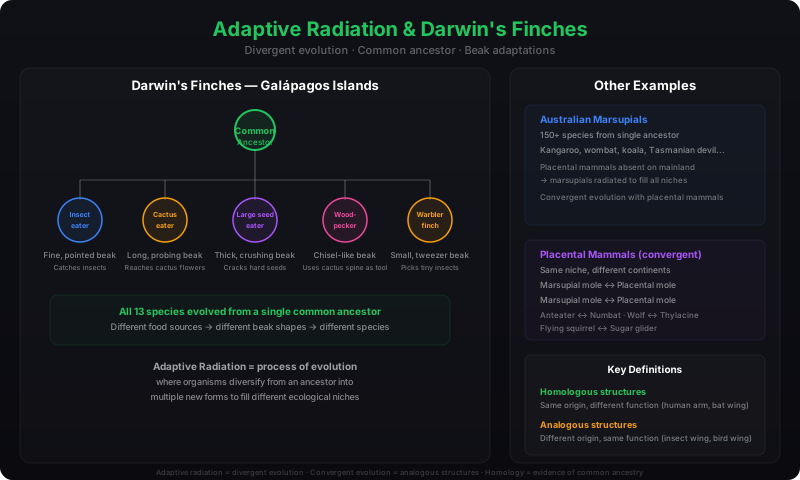
During his journey, Darwin went to the Galapagos Islands, where he observed an amazing diversity of creatures. Of particular interest were small black birds later called Darwin's Finches. He realised there were many varieties of finches on the same island, all conjectured to have evolved on the island itself. From the original seed-eating features, many other forms with altered beaks arose, enabling them to become insectivorous and vegetarian finches.
This process of evolution of different species in a given geographical area, starting from a point and literally radiating to other areas of geography (habitats), is called adaptive radiation. Darwin's finches represent one of the best examples of this phenomenon.
Adaptive Radiation of Australian Marsupials
Another classic example is Australian marsupials. A number of marsupials, each different from the other, evolved from an ancestral stock — all within the Australian island continent. This represents adaptive radiation in an isolated geographical area.
When more than one adaptive radiation appears to have occurred in an isolated geographical area (representing different habitats), this is called convergent evolution. Placental mammals in Australia exhibit adaptive radiation, evolving into varieties that appear similar to corresponding marsupials — for example, the placental wolf and the Tasmanian wolf (marsupial). This similarity between unrelated organisms adapted to similar environments is striking.
6.5 Biological Evolution
Evolution by natural selection, in a true sense, would have started when cellular forms of life with differences in metabolic capability originated on Earth. The essence of Darwinian theory about evolution is natural selection. The rate of appearance of new forms is linked to the life cycle or the life span of organisms.
Fitness and Natural Selection
Microbes that divide fast have the ability to multiply and become millions of individuals within hours. A colony of bacteria growing on a given medium has built-in variation in terms of ability to utilise a feed component. A change in medium composition would bring out only that part of the population that can survive under the new conditions. In due course, this variant population outgrows the others and appears as a new species — this could happen within days.
For the same thing to happen in a fish or fowl would take millions of years, as the life spans of these animals are in years. Here we say that fitness of the variant is better than the original under the new conditions. Nature selects for fitness.
Fitness is based on characteristics which are inherited. Hence, there must be a genetic basis for getting selected and to evolve. Another way of saying the same thing is that some organisms are better adapted to survive in an otherwise hostile environment. Adaptive ability is inherited and has a genetic basis. Fitness is the end result of the ability to adapt and get selected by nature.
Branching descent and natural selection are the two key concepts of Darwinian Theory of Evolution.
Lamarck's Theory — Use and Disuse
Even before Darwin, the French naturalist Lamarck proposed that evolution of life forms occurred, driven by the use and disuse of organs. He gave the example of giraffes who, in an attempt to forage leaves on tall trees, had to adapt by elongating their necks. As they passed on this acquired character of elongated neck to succeeding generations, giraffes slowly came to acquire long necks. Nobody believes this conjecture any more, as acquired characteristics are not inherited.
Is Evolution a Process or a Result?
The world we see — inanimate and animate — is only the success stories of evolution. When we describe the story of this world, we describe evolution as a process. When we describe the story of life on Earth, we treat evolution as a consequence of a process called natural selection. We are still not entirely clear whether to regard evolution and natural selection as processes or as the end result of unknown processes.
Influence of Thomas Malthus
It is possible that the work of Thomas Malthus on populations influenced Darwin. Natural selection is based on certain factual observations: natural resources are limited; populations are stable in size except for seasonal fluctuation; members of a population vary in characteristics (no two individuals are alike); and most variations are inherited. The fact that theoretically population size will grow exponentially if everybody reproduced maximally — and that population sizes in reality are limited — means that there has been competition for resources. Only some survived and grew at the cost of others that could not flourish.
Darwin's brilliant insight was this: he asserted that variations which are heritable and which make resource utilisation better for a few (adapted to habitat better) will enable only those to reproduce and leave more progeny. Hence, over many generations, survivors will leave more progeny and there would be a change in population characteristics, giving rise to new forms.
6.6 Mechanism of Evolution
What is the origin of variation, and how does speciation occur? Even though Mendel had talked of inheritable "factors" influencing phenotype, Darwin either ignored these observations or kept silent on them. In the first decade of the twentieth century, Hugo de Vries, based on his work on Evening Primrose (Oenothera lamarckiana), brought forth the idea of mutations — large differences arising suddenly in a population. He believed that it is mutation which causes evolution and not the minor heritable variations that Darwin had talked about.
Mutations are random and directionless, while Darwinian fitness is considered directional and purposeful. Small variations that are useful for adaptation are acted upon by natural selection, but mutations are the raw material on which natural selection acts. Hugo de Vries believed mutation caused speciation, hence called it saltation (a single-step large mutation).
Types of Natural Selection
Natural selection can lead to three types of outcomes in a population:
Stabilising Selection
More individuals acquire the mean character value. This reduces variation and keeps the population stable around an optimum phenotype.
Directional Selection
More individuals acquire a character value other than the mean. The population shifts in one direction over time.
Disruptive Selection
More individuals acquire peripheral character values at both ends of the distribution. The population splits into two distinct groups.
Speciation
Pre-existing advantageous mutations, when selected, result in observation of new phenotypes. Over few generations, this leads to the formation of new species.
6.7 Hardy-Weinberg Principle
In a given population, one can find out the frequency of occurrence of alleles of a gene or a locus. This frequency is supposed to remain fixed and even remain the same through generations. The Hardy-Weinberg principle stated this using algebraic equations.
This principle says that allele frequencies in a population are stable and constant from generation to generation. The gene pool (total genes and their alleles in a population) remains a constant. This is called genetic equilibrium. The sum total of all the allelic frequencies is 1.
The Mathematical Formulation
Individual frequencies can be named p, q, etc. In a diploid organism, p and q represent the frequency of allele A and allele a, respectively.

The frequency of AA individuals in a population is p². This is the probability that an allele A with frequency p appears on both chromosomes of a diploid individual — simply the product of the probabilities. Similarly, aa is q² and Aa is 2pq.
When measured frequencies differ from expected values, the difference (direction) indicates the extent of evolutionary change. Disturbance in genetic equilibrium (Hardy-Weinberg equilibrium) — that is, change of frequency of alleles in a population — would be interpreted as resulting in evolution.
Factors Affecting Hardy-Weinberg Equilibrium
Five factors are known to affect Hardy-Weinberg equilibrium:
| Factor | Description |
|---|---|
| Gene Migration / Gene Flow | When a section of the population migrates to another place, gene frequencies change in both the original and the new population. New genes/alleles are added to the new population and lost from the old. Repeated migration leads to gene flow. |
| Genetic Drift | Chance changes in allele frequency. When the change is so different in a new sample of population that they become a different species, the original drifted population becomes founders and the effect is called the founder effect. |
| Mutation | Random changes in DNA that introduce new alleles into the gene pool. |
| Genetic Recombination | During gametogenesis, the shuffling of genes creates new combinations of alleles. |
| Natural Selection | Heritable variations enabling better survival allow organisms to reproduce and leave greater numbers of progeny, changing allele frequencies over time. |
Coupled with enhanced reproductive success, natural selection makes it appear like different populations are diverging. Natural selection can lead to stabilisation, directional change, or disruption — all of which disturb the Hardy-Weinberg equilibrium and drive evolution.
6.8 A Brief Account of Evolution
About 2,000 million years ago, the first cellular forms of life appeared. Evolution of the primitive forms could have been similar to the light reaction in photosynthesis, where water is split with the help of solar energy captured by appropriate light-harvesting pigments. Slowly, single-celled organisms became multicellular life forms.
| Time (mya) | Event |
|---|---|
| ~2,000 | First cellular forms of life (single-celled organisms) |
| ~500 | Invertebrates formed and active |
| ~350 | Jawless fish evolved; fish with stout fins could move on land and return to water |
| ~320 | Sea weeds and few plants existed |
| ~200 | Reptiles of different shapes and sizes dominated; some land reptiles went back into water (e.g., Ichthyosaurs) |
| ~65 | Dinosaurs disappeared from the Earth |
| ~15 | Primates called Dryopithecus and Ramapithecus existed |
| ~3–4 | Man-like primates walked in eastern Africa |
| ~2 | Australopithecines lived in East African grasslands |
| ~75,000–10,000 | Modern Homo sapiens arose during the ice age |
| ~10,000 | Agriculture began; human settlements started |
From Water to Land
By around 500 mya, invertebrates were formed and active. Jawless fish probably evolved around 350 mya. Sea weeds and a few plants existed around 320 mya. The first organisms to invade land were plants, which were widespread on land before animals moved ashore.
Fish with stout and strong fins could move on land and go back to water — about 350 mya. In 1938, a fish caught in South Africa turned out to be a Coelacanth, which was thought to be extinct. These lobefins evolved into the first amphibians that lived on both land and water — ancestors of modern-day frogs and salamanders.
Reptiles, Dinosaurs, and Beyond
Amphibians evolved into reptiles. They lay thick-shelled eggs which do not dry up in the sun, unlike those of amphibians. Modern-day descendants include turtles, tortoises, and crocodiles. For the next 200 million years, reptiles of different shapes and sizes dominated on Earth. Giant ferns (pteridophytes) were present but all fell to form coal deposits slowly.
Some land reptiles went back into water to evolve into fish-like reptiles probably 200 mya (e.g., Ichthyosaurs). The land reptiles were, of course, the dinosaurs. The biggest of them — Tyrannosaurus rex — was about 20 feet in height and had huge, fearsome, dagger-like teeth. About 65 mya, the dinosaurs suddenly disappeared. Some say climatic changes killed them. Some say most of them evolved into birds. The truth may lie in between.
Mammals Take Over
The first mammals were like shrews, with small-sized fossils. Mammals were viviparous and protected their unborn young inside the mother's body. They were more intelligent in sensing and avoiding danger. When reptiles came down, mammals took over the Earth. In South America, mammals resembling horse, hippopotamus, bear, and rabbit existed. Due to continental drift, when South America joined North America, these animals were overridden by North American fauna. Due to the same continental drift, pouched mammals of Australia survived because of lack of competition from any other mammal.
Some mammals live wholly in water — whales, dolphins, seals, and sea cows. Evolution of horse, elephant, dog, etc., are special stories of evolution. The most successful story is the evolution of man with language skills and self-consciousness.
6.9 Origin and Evolution of Man
Understanding human evolution is one of the most fascinating chapters in the story of life on Earth. The fossil record reveals a gradual transition from ape-like ancestors to the modern human form.
Agriculture came around 10,000 years back, and human settlements started. The rest of what happened is part of human history — the growth and decline of civilisations. The evolution of man is marked by increasing brain size, tool use, language, and ultimately self-consciousness.
The skull of a baby chimpanzee is more like an adult human skull than an adult chimpanzee skull — a remarkable observation that underscores our close evolutionary relationship with the great apes. This comparison of skulls highlights how human evolution involved changes in brain size, facial structure, and skeletal form over millions of years.
📋 Chapter Summary
- The origin of life on Earth can be understood only against the background of the origin of the universe, especially Earth.
- Most scientists believe chemical evolution — the formation of biomolecules — preceded the appearance of the first cellular forms of life.
- The subsequent events as to what happened to the first form of life is a conjectured story based on Darwinian ideas of organic evolution by natural selection.
- Diversity of life forms on Earth has been changing over millions of years. Variations in a population result in variable fitness.
- Other phenomena like habitat fragmentation and genetic drift may accentuate these variations, leading to appearance of new species and hence evolution.
- Homology is accounted for by the idea of branching descent. Study of comparative anatomy, fossils, and comparative biochemistry provides evidence for evolution.
- Among the stories of evolution of individual species, the story of evolution of modern man is most interesting and appears to parallel evolution of human brain and language.