Principles of Inheritance and Variation
Understanding how traits are passed from parents to offspring — from Mendel's pea experiments to modern genetics
In this chapter
Have you ever wondered why an elephant always gives birth only to a baby elephant and not some other animal? Or why a mango seed forms only a mango plant and not any other plant?
Given that they do, are the offspring identical to their parents? Or do they show differences in some of their characteristics? Have you ever wondered why siblings sometimes look so similar to each other? Or sometimes even so different?
These and several related questions are dealt with, scientifically, in a branch of biology known as Genetics. This subject deals with the inheritance, as well as the variation of characters from parents to offspring.
Inheritance
The process by which characters are passed on from parent to progeny; it is the basis of heredity.
Variation
The degree by which progeny differ from their parents — the source of diversity in populations.
Humans knew from as early as 8000–1000 B.C. that one of the causes of variation was hidden in sexual reproduction. They exploited the variations that were naturally present in the wild populations of plants and animals to selectively breed and select for organisms that possessed desirable characters. For example, through artificial selection and domestication from ancestral wild cows, we have well-known Indian breeds, e.g., Sahiwal cows in Punjab.
4.1 Mendel's Laws of Inheritance
It was during the mid-nineteenth century that headway was made in the understanding of inheritance. Gregor Mendel conducted hybridisation experiments on garden peas for seven years (1856–1863) and proposed the laws of inheritance in living organisms.
During Mendel's investigations into inheritance patterns it was for the first time that statistical analysis and mathematical logic were applied to problems in biology. His experiments had a large sampling size, which gave greater credibility to the data that he collected.
Mendel investigated characters in the garden pea plant that were manifested as two opposing traits, e.g., tall or dwarf plants, yellow or green seeds. This allowed him to set up a basic framework of rules governing inheritance.
Mendel conducted artificial pollination/cross-pollination experiments using several true-breeding pea lines. A true-breeding line is one that, having undergone continuous self-pollination, shows the stable trait inheritance and expression for several generations.
Mendel selected 14 true-breeding pea plant varieties, as pairs which were similar except for one character with contrasting traits:
| S.No. | Characters | Contrasting Traits |
|---|---|---|
| 1. | Stem height | Tall / Dwarf |
| 2. | Flower colour | Violet / White |
| 3. | Flower position | Axial / Terminal |
| 4. | Pod shape | Inflated / Constricted |
| 5. | Pod colour | Green / Yellow |
| 6. | Seed shape | Round / Wrinkled |
| 7. | Seed colour | Yellow / Green |
4.2 Inheritance of One Gene
Let us take the example of one such hybridisation experiment carried out by Mendel where he crossed tall and dwarf pea plants to study the inheritance of one gene.
The Monohybrid Cross
Mendel crossed true-breeding tall and true-breeding dwarf pea plants. He collected the seeds produced as a result of this cross and grew them to generate plants of the first hybrid generation. This generation is also called the Filial₁ (F₁) progeny.
Mendel observed that all the F₁ progeny plants were tall, like one of its parents; none were dwarf. He made similar observations for the other pairs of traits — he found that the F₁ always resembled either one of the parents, and that the trait of the other parent was not seen in them.
Mendel then self-pollinated the tall F₁ plants and to his surprise found that in the Filial₂ (F₂) generation some of the offspring were 'dwarf'; the character that was not seen in the F₁ generation was now expressed.
The proportion of plants that were dwarf were 1/4th of the F₂ plants while 3/4th of the F₂ plants were tall. The tall and dwarf traits were identical to their parental type and did not show any blending — all the offspring were either tall or dwarf, none were of in-between height.
Similar results were obtained with the other traits that he studied: only one of the parental traits was expressed in the F₁ generation while at the F₂ stage both the traits were expressed in the proportion 3:1. The contrasting traits did not show any blending at either F₁ or F₂ stage.
Key Concepts: Genes, Alleles, Genotype and Phenotype
Based on these observations, Mendel proposed that something was being stably passed down, unchanged, from parent to offspring through the gametes, over successive generations. He called these things as 'factors'. Now we call them as genes. Genes are the units of inheritance. They contain the information that is required to express a particular trait in an organism.
Genes which code for a pair of contrasting traits are known as alleles — they are slightly different forms of the same gene.
The capital letter is used for the trait expressed at the F₁ stage (dominant) and the small alphabet for the other trait (recessive). For example, in the character of height, T is used for the Tall trait and t for dwarf. T and t are alleles of each other. Hence, the pair of alleles for height would be TT, Tt or tt.
Mendel also proposed that in a true-breeding, tall or dwarf pea variety the allelic pair of genes for height are identical or homozygous, TT and tt, respectively. TT and tt are called the genotype of the plant while the descriptive terms tall and dwarf are the phenotype.
Since the F₁ heterozygote Tt has a phenotype exactly like the TT parent, he proposed that in a pair of dissimilar factors, one dominates the other — hence T is the dominant factor (dominant allele) and t is recessive.
Since the Tt plant is heterozygous for genes controlling one character (height), it is a monohybrid and the cross between TT and tt is a monohybrid cross.
Segregation of Alleles
From the observation that the recessive parental trait is expressed without any blending in the F₂ generation, we can infer that, when the tall and dwarf plant produce gametes, by the process of meiosis, the alleles of the parental pair separate or segregate from each other and only one allele is transmitted to a gamete.
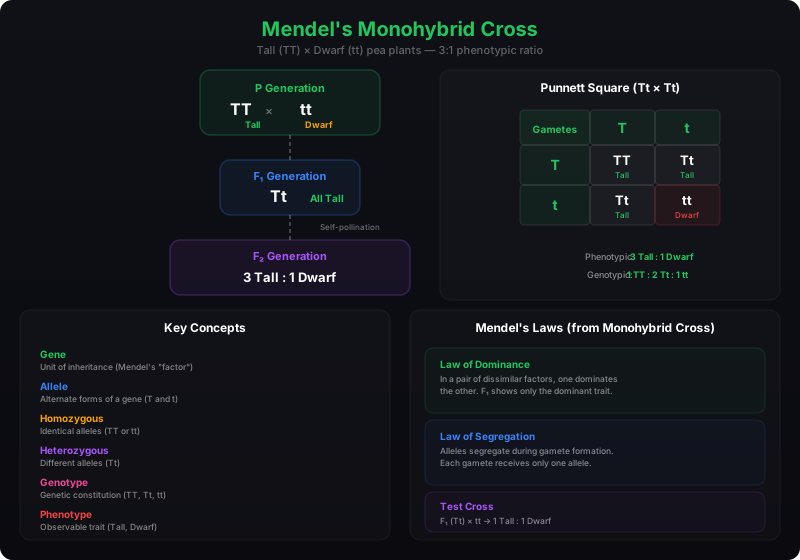
This leads to a phenotypic ratio of 3:1 (3/4 tall : 1/4 dwarf) but a genotypic ratio of 1:2:1 (1/4 TT : 2/4 Tt : 1/4 tt). The 1/4 : 1/2 : 1/4 ratio is mathematically condensable to the form of the binomial expression (½T + ½t)².
Test Cross
Though the genotypic ratios can be calculated using mathematical probability, by simply looking at the phenotype of a dominant trait, it is not possible to know the genotypic composition. To determine the genotype of a tall plant at F₂, Mendel crossed the tall plant from F₂ with a dwarf plant. This he called a test cross.
In a typical test cross, an organism showing a dominant phenotype (and whose genotype is to be determined) is crossed with the recessive parent instead of self-crossing. The progenies of such a cross can easily be analysed to predict the genotype of the test organism.
Law of Dominance (4.2.1)
Based on his observations on monohybrid crosses, Mendel proposed two general rules — the First Law or Law of Dominance:
- Characters are controlled by discrete units called factors.
- Factors occur in pairs.
- In a dissimilar pair of factors, one member dominates (dominant) the other (recessive).
Law of Segregation (4.2.2)
The Second Law or Law of Segregation states that alleles do not show any blending and that both the characters are recovered as such in the F₂ generation though one of these is not seen at the F₁ stage. During gamete formation, the factors or alleles of a pair segregate from each other such that a gamete receives only one of the two factors.
A homozygous parent produces all gametes that are similar while a heterozygous one produces two kinds of gametes each having one allele with equal proportion.
Incomplete Dominance (4.2.2.1)
When experiments on peas were repeated using other traits in other plants, it was found that sometimes the F₁ had a phenotype that did not resemble either of the two parents and was in between the two. The inheritance of flower colour in the dog flower (snapdragon or Antirrhinum sp.) is a good example.
In a cross between true-breeding red-flowered (RR) and true-breeding white-flowered plants (rr), the F₁ (Rr) was pink. When the F₁ was self-pollinated, the F₂ resulted in the ratio: 1 (RR) Red : 2 (Rr) Pink : 1 (rr) White.
Every gene contains the information to express a particular trait. In a diploid organism, there are two copies of each gene (alleles). These two alleles need not always be identical. The normal allele produces a normal enzyme needed for transformation of a substrate S. The modified allele could be responsible for producing: (i) the normal/less efficient enzyme, (ii) a non-functional enzyme, or (iii) no enzyme at all. If the allele produces a non-functional enzyme or no enzyme, the phenotype will be dependent on the functioning of the unmodified (functioning) allele, which is the dominant allele.
Co-dominance (4.2.2.2)
There are situations where the F₁ generation resembled both the parents. An example of this is the inheritance of blood groups in human beings. A, B and O are three multiple alleles of the gene I. The gene I has three alleles — IA, IB and i. IA and IB produce slightly different forms of the same sugar on the RBC membrane, whereas i does not produce any sugar.
| Genotype | Blood Group |
|---|---|
| IAIA or IAi | A |
| IBIB or IBi | B |
| IAIB | AB |
| ii | O |
Because a person has two alleles and any one of them could be inherited from either parent, we actually get six genotypes — IAIA, IAi, IBIB, IBi, IAIB and ii — giving rise to four phenotypes — A, B, AB and O blood groups. When IA and IB are together, neither is recessive — both express themselves. This is co-dominance.
Multiple Alleles (4.2.2.3)
So far we have discussed the cases where a gene has only two alleles. However, there may be more than two alternative forms of a gene (allele) governing a character. In human ABO blood type, the gene I has three alleles — IA, IB and i. When more than two alleles exist for a single gene locus, this is called multiple alleles.
4.3 Inheritance of Two Genes
Law of Independent Assortment (4.3.1)
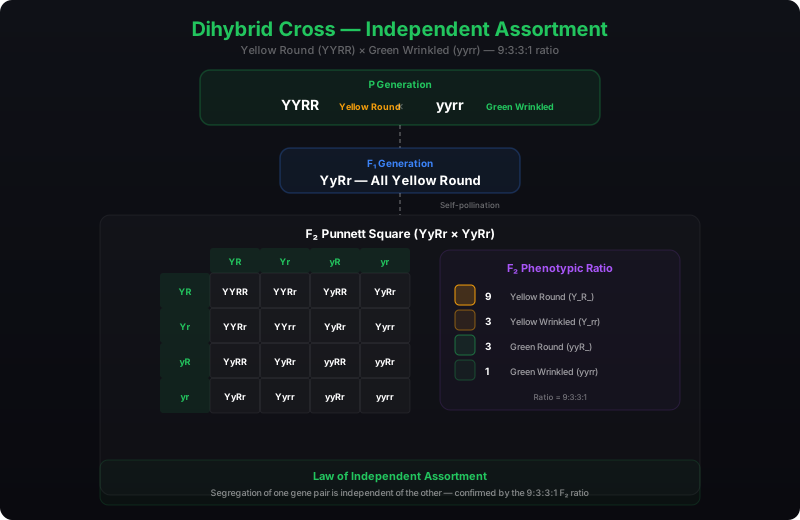
In addition to the laws of segregation, Mendel also studied the inheritance of two characters together. When he followed two characters simultaneously, the assortment of each gene occurs independently of the other. The Law of Independent Assortment states that when two pairs of contrasting traits are combined in a hybrid, segregation of one pair of characters is independent of the other pair of characters.
Mendel crossed pea plants with yellow round seeds (YYRR) and green wrinkled seeds (yyrr). All F₁ progeny showed yellow round seeds (YyRr). When the F₁ plants were self-pollinated, the F₂ generation gave a phenotypic ratio of 9 Yellow Round : 3 Yellow Wrinkled : 3 Green Round : 1 Green Wrinkled. This 9:3:3:1 ratio confirmed that the two genes segregate independently.
Chromosomal Theory of Inheritance (4.3.2)
Mendel's work suggested that factors (genes) were discrete units, but he could not provide any physical proof for their existence or say what they were made of.
In 1900, three scientists — de Vries, Correns and von Tschermak — independently rediscovered Mendel's results on the inheritance of characters. By this time, scientists were able to carefully observe cell division and the discovery of structures in the nucleus that appeared to double and divide just before each cell division. These were called chromosomes.
By 1902, the chromosome movement during meiosis had been worked out. Walter Sutton and Theodore Boveri noted that the behaviour of chromosomes was parallel to the behaviour of genes and used chromosome movement to explain Mendel's laws.
Sutton united the knowledge of chromosomal segregation with Mendelian principles and called it the chromosomal theory of inheritance. The key observations: chromosomes as well as genes occur in pairs; the two alleles of a gene pair are located on homologous sites on homologous chromosomes.
| Feature | Chromosomes | Genes |
|---|---|---|
| Occur in pairs | ✓ | ✓ |
| Segregate at gamete formation | Only one of each pair transmitted to a gamete | Only one of each pair transmitted to a gamete |
| Independent assortment | Independent pairs segregate independently of each other | One pair segregates independently of another pair |
The pairing and separation of a pair of chromosomes leads to the segregation of a pair of factors they carried. Experimental verification of the chromosomal theory was achieved by Thomas Hunt Morgan and his colleagues using Drosophila melanogaster (fruit fly).
Linkage and Recombination (4.3.3)
Morgan carried out several dihybrid crosses in Drosophila to study genes that were sex-linked. For example, Morgan hybridised yellow-bodied, white-eyed females to brown-bodied, red-eyed males and intercrossed their F₁ progeny. He observed that the two genes did not segregate independently of each other and the F₂ ratio deviated very significantly from the 9:3:3:1 ratio.
Morgan and his group knew that the genes were located on the X chromosome and saw that when the two genes in a dihybrid cross were situated on the same chromosome, the proportion of parental gene combinations were much higher than the non-parental type.
- Linkage — the physical association of genes on a chromosome.
- Recombination — the generation of non-parental gene combinations due to crossing over.
Morgan and his group also found that even when genes were grouped on the same chromosome, some genes were very tightly linked (showed very low recombination) while others were loosely linked (showed higher recombination). The studies of linkage permitted the mapping of genes on chromosomes. They are extensively used as a starting point in the sequencing of whole genomes as was done in the case of the Human Genome Sequencing Project.
4.4 Polygenic Inheritance
Mendel's studies mainly described those traits that have distinct alternate forms such as flower colour which are either purple or white. But many traits are not so distinct in their occurrence and are spread across a gradient. For example, in humans we don't just have tall or short people as two distinct alternatives but a whole range of possible heights.
Such traits are generally controlled by three or more genes and are thus called as polygenic traits. Besides the involvement of multiple genes, polygenic inheritance also takes into account the influence of environment.
Let us assume that three genes A, B, C control skin colour in humans with the dominant forms A, B and C responsible for dark skin colour and the recessive forms a, b and c for light skin colour. The genotype with all the dominant alleles (AABBCC) will have the darkest skin colour and that with all the recessive alleles (aabbcc) will have the lightest skin colour. The genotype with three dominant alleles and three recessive alleles will have an intermediate skin colour.
4.5 Pleiotropy
So far we have seen the effect of a gene on a single phenotype or trait. There are however instances where a single gene can exhibit multiple phenotypic expression. Such a gene is called a pleiotropic gene.
The underlying mechanism of pleiotropy in most cases is the effect of a gene on metabolic pathways which contribute towards different phenotypes.
The disease is caused by mutation in the gene that codes for the enzyme phenylalanine hydroxylase (single gene mutation). This manifests itself through phenotypic expression characterised by mental retardation and a reduction in hair and skin pigmentation.
4.6 Sex Determination
The mechanism of sex determination has always been a puzzle before the geneticists. The initial clue about the genetic/chromosomal mechanism of sex determination can be traced back to some of the experiments carried out in insects.
XO Type of Sex Determination
In 1891, Henking noticed that in some insects, one of the chromatin masses associated with the chromosomal material in certain cells did not take up the usual stains. Since he could not determine its function, he designated this as the X-chromosome.
It was observed that in a large number of insects the mechanism of sex determination is of the XO type: all eggs bear an additional X-chromosome besides the other chromosomes (autosomes). Some sperms bear the X-chromosome whereas some do not. Eggs fertilised by sperm having an X-chromosome become females, those fertilised by sperms without an X-chromosome become males.
Grasshopper is an example of XO type of sex determination in which the males have only one X-chromosome besides the autosomes, whereas females have a pair of X-chromosomes.
XY Type of Sex Determination
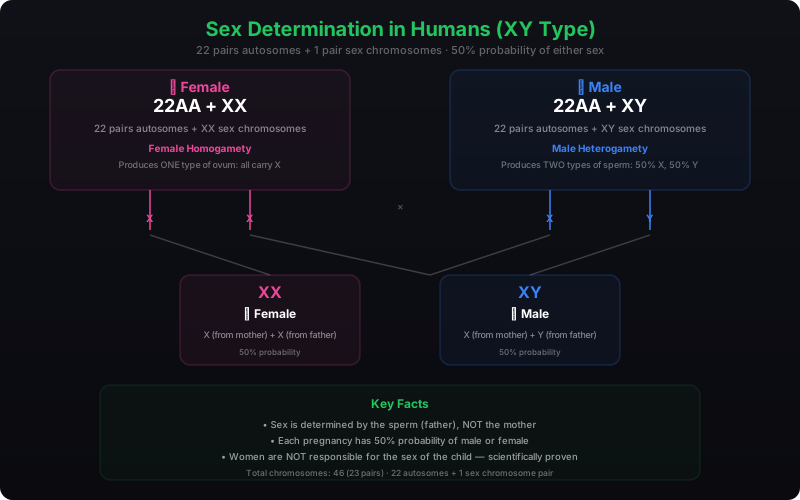
In a number of insects and mammals including humans, XY type of sex determination is seen where both male and female have the same number of chromosomes. Among the males an X-chromosome is present but its counterpart is distinctly smaller and called the Y-chromosome. Females have a pair of X-chromosomes.
Male (XY)
Autosomes + XY — produces two types of gametes: 50% carry X, 50% carry Y. This is male heterogamety.
Female (XX)
Autosomes + XX — produces only one type of ovum with an X-chromosome. This is female homogamety.
Sex Determination in Humans (4.6.1)
The sex-determining mechanism in humans is the XY type. Out of 23 pairs of chromosomes present, 22 pairs are exactly the same in both males and females — these are the autosomes. A pair of X-chromosomes is present in the female, whereas the presence of an X and Y chromosome determines the male.
There is an equal probability of fertilisation of the ovum with the sperm carrying either X or Y chromosome. In case the ovum fertilises with a sperm carrying X-chromosome, the zygote develops into a female (XX). The fertilisation of ovum with Y-chromosome carrying sperm results into a male offspring.
It is evident that it is the genetic makeup of the sperm that determines the sex of the child. In each pregnancy there is always 50% probability of either a male or a female child. Women are NOT responsible for the sex of the child — this is a scientifically verified fact.
Sex Determination in Honey Bee (4.6.2)
The sex determination in honey bee is based on the number of sets of chromosomes an individual receives. An offspring formed from the union of a sperm and an egg develops as a female (queen or worker), and an unfertilised egg develops as a male (drone) by means of parthenogenesis.
- Females are diploid — 32 chromosomes
- Males are haploid — 16 chromosomes
- This is called the haplodiploid sex-determination system
- Males produce sperms by mitosis (not meiosis) — they do not have a father and thus cannot have sons, but have a grandfather
4.7 Mutation
Mutation is a phenomenon which results in alteration of DNA sequences and consequently results in changes in the genotype and the phenotype of an organism. In addition to recombination, mutation is another phenomenon that leads to variation in DNA.
One DNA helix runs continuously from one end to the other in each chromatid, in a highly supercoiled form. Therefore loss (deletions) or gain (insertion/duplication) of a segment of DNA, result in alteration in chromosomes. Since genes are known to be located on chromosomes, alteration in chromosomes results in abnormalities or aberrations. Chromosomal aberrations are commonly observed in cancer cells.
Point Mutation
Change in a single base pair of DNA. A classical example is sickle cell anemia, caused by a single base substitution.
Frame-shift Mutation
Deletions and insertions of base pairs of DNA cause frame-shift mutations, shifting the entire reading frame.
The mechanism of mutation is beyond the scope of this discussion at this level. However, there are many chemical and physical factors that induce mutations. These are referred to as mutagens. UV radiations can cause mutations in organisms — it is a mutagen.
4.8 Genetic Disorders
A number of disorders in human beings have been found to be associated with the inheritance of changed or altered genes or chromosomes.
Pedigree Analysis (4.8.1)
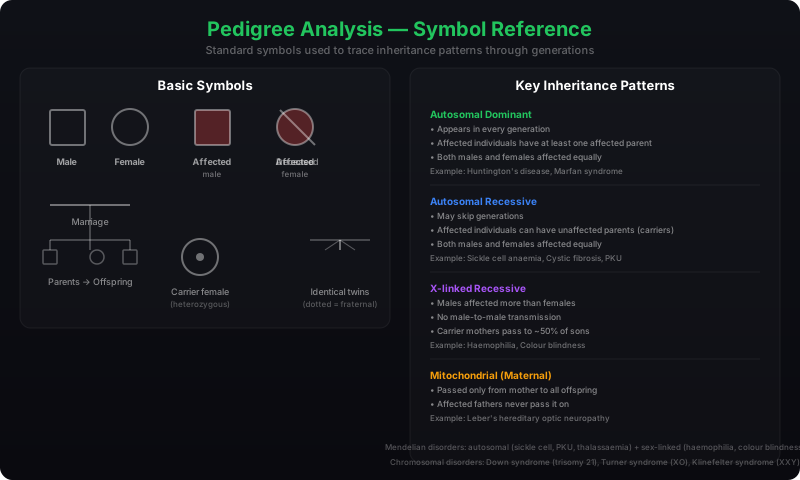
Since control crosses that can be performed in pea plants are not possible in human beings, study of the family history about inheritance of a particular trait provides an alternative. Such an analysis of traits in several generations of a family is called the pedigree analysis. In human genetics, pedigree study provides a strong tool which is utilised to trace the inheritance of a specific trait, abnormality or disease.
Mendelian Disorders (4.8.2)
Genetic disorders may be grouped into two categories — Mendelian disorders and Chromosomal disorders. Mendelian disorders are mainly determined by alteration or mutation in the single gene and are transmitted to the offspring on the same lines as studied in the principles of inheritance.
The most common and prevalent Mendelian disorders include:
It is a sex-linked recessive disorder due to defect in either red or green cone of eye resulting in failure to discriminate between red and green colour. This defect is due to mutation in certain genes present in the X chromosome. It occurs in about 8% of males and only about 0.4% of females. This is because the genes that lead to red-green colour blindness are on the X chromosome — males have only one X chromosome while females have two.
This sex-linked recessive disease shows transmission from unaffected carrier female to some of the male progeny. In this disease, a single protein that is a part of the cascade of proteins involved in the clotting of blood is affected. Due to this, in an affected individual a simple cut will result in non-stop bleeding. The possibility of a female becoming a haemophilic is extremely rare because mother of such a female has to be at least a carrier and the father should be haemophilic (unviable in the later stage of life). The family pedigree of Queen Victoria shows a number of haemophilic descendants as she was a carrier of the disease.
This is an autosomal linked recessive trait that can be transmitted from parents to the offspring when both the partners are carrier for the gene (or heterozygous). The disease is controlled by a single pair of alleles, HbA and HbS. Out of the three possible genotypes only homozygous individuals for HbS (HbSHbS) show the diseased phenotype.
The defect is caused by the substitution of Glutamic acid (Glu) by Valine (Val) at the sixth position of the beta globin chain of the haemoglobin molecule. The substitution of amino acid results due to the single base substitution at the sixth codon of the beta globin gene from GAG to GUG. The mutant haemoglobin molecule undergoes polymerisation under low oxygen tension causing the change in the shape of the RBC from biconcave disc to elongated sickle-like structure.
This inborn error of metabolism is also inherited as the autosomal recessive trait. The affected individual lacks an enzyme that converts the amino acid phenylalanine into tyrosine. As a result, phenylalanine is accumulated and converted into phenylpyruvic acid and other derivatives. Accumulation of these in brain results in mental retardation. These are also excreted through urine because of its poor absorption by kidney.
This is also an autosome-linked recessive blood disease transmitted from parents to the offspring when both the partners are unaffected carrier for the gene (or heterozygous). The defect could be due to either mutation or deletion which ultimately results in reduced rate of synthesis of one of the globin chains (α and β chains) that make up haemoglobin.
Thalassemia can be classified according to which chain of the haemoglobin molecule is affected:
- α Thalassemia — production of α globin chain is affected. Controlled by two closely linked genes HBA1 and HBA2 on chromosome 16.
- β Thalassemia — production of β globin chain is affected. Controlled by a single gene HBB on chromosome 11.
Thalassemia differs from sickle-cell anaemia in that the former is a quantitative problem of synthesising too few globin molecules while the latter is a qualitative problem of synthesising an incorrectly functioning globin.
Chromosomal Disorders (4.8.3)
Chromosomal disorders are caused due to absence or excess or abnormal arrangement of one or more chromosomes. Failure of segregation of chromatids during cell division cycle results in the gain or loss of a chromosome — situations known as trisomy or monosomy of a chromosome, respectively.
Down's Syndrome
Cause: Trisomy of chromosome 21 (presence of an additional copy). First described by Langdon Down (1866). Affected individual is short statured with small round head, furrowed tongue and partially open mouth. Physical, psychomotor and mental development is retarded. Total chromosomes = 47.
Klinefelter's Syndrome
Cause: Presence of an additional X-chromosome resulting in karyotype 47, XXY. Overall masculine development, however, the feminine development (development of breast, i.e., Gynaecomastia) is also expressed. Such individuals are sterile.
Turner's Syndrome
Cause: Absence of one X chromosome, i.e., 45 with X0. Such females are sterile as ovaries are rudimentary besides other features including lack of other secondary sexual characters.
4.9 Summary
• Genetics is a branch of biology which deals with principles of inheritance and its practices. Mendel was the first to study this phenomenon systematically.
• Mendel proposed that 'factors' (later named as genes) regulating the characters are found in pairs known as alleles. The dominant characters are expressed when factors are in heterozygous condition (Law of Dominance). Recessive characters are only expressed in homozygous conditions.
• Characters segregate while formation of gametes (Law of Segregation). Not all characters show true dominance — some show incomplete dominance, and some show co-dominance.
• When Mendel studied the inheritance of two characters together, it was found that the factors independently assort and combine in all permutations and combinations (Law of Independent Assortment).
• After knowing that the genes are located on the chromosomes, a good correlation was drawn between Mendel's laws and the behaviour of chromosomes during meiosis — extended as the Chromosomal Theory of Inheritance (Sutton & Boveri, verified by Morgan).
• Mendel's law of independent assortment does not hold true for genes that are located on the same chromosome. These genes were called 'linked genes'. Closely located genes assort together, and distantly located genes, due to recombination, assort independently.
• Traits controlled by three or more genes (polygenic inheritance) show a continuous range of phenotypes. A single gene can also exhibit multiple phenotypic expression (pleiotropy).
• Sex determination in humans is based on the XY type where the genetic makeup of the sperm determines the sex of the child. In honey bees, it follows the haplodiploid system.
• Genetic disorders can be Mendelian (single gene — e.g., colour blindness, haemophilia, sickle-cell anaemia, phenylketonuria, thalassemia) or Chromosomal (e.g., Down's syndrome, Klinefelter's syndrome, Turner's syndrome).