Structural Organisation in Animals
How cells organise into tissues, organs, and organ systems — a detailed study of the frog as a representative vertebrate
In this chapter
In the preceding chapters you came across a large variety of organisms — both unicellular and multicellular — of the animal kingdom. In unicellular organisms, all functions like digestion, respiration, and reproduction are performed by a single cell. But in the complex body of multicellular animals, the same basic functions are carried out by different groups of cells in a well-organised manner.
The body of a simple organism like Hydra is made of different types of cells, and the number of cells in each type can be in the thousands. The human body is composed of billions of cells to perform various functions. How do these cells in the body work together?
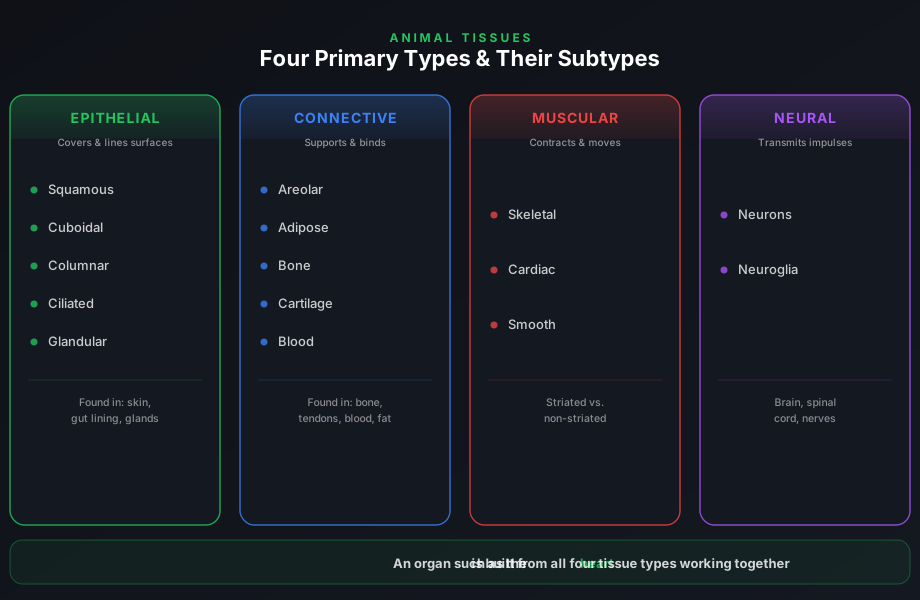
As you have already learnt, in multicellular animals, a group of similar cells along with intercellular substances perform a specific function. Such an organisation is called a tissue.
You may be surprised to know that all complex animals consist of only four basic types of tissues. These tissues are organised in specific proportions and patterns to form an organ like stomach, lung, heart, and kidney. When two or more organs perform a common function by their physical and/or chemical interaction, they together form an organ system — e.g., digestive system, respiratory system, etc.
Cells, tissues, organs, and organ systems split up the work in a way that exhibits division of labour and contribute to the survival of the body as a whole.
7.1 Organ and Organ System
The basic tissues organise to form organs, which in turn associate to form organ systems in multicellular organisms. Such an organisation is essential for more efficient and better-coordinated activities of millions of cells constituting an organism.
Each organ in our body is made of one or more types of tissues. For example, our heart consists of all four types of tissues — epithelial, connective, muscular, and neural. We also notice, after some careful study, that the complexity in organ and organ systems displays certain discernable trends. This discernable trend is called the evolutionary trend (you will study the details in Class XII).
In this chapter, you are being introduced to the morphology and anatomy of the frog. Morphology refers to the study of form or externally visible features. In the case of plants or microbes, the term morphology precisely means only this. In the case of animals, this refers to the external appearance of the organs or parts of the body. The word anatomy conventionally is used for the study of morphology of internal organs in the animals.
Morphology = External features visible from the outside
Anatomy = Internal structure revealed by dissection
7.2 Frogs — An Overview
Frogs can live both on land and in freshwater and belong to class Amphibia of phylum Chordata. The most common species of frog found in India is Rana tigrina — the Indian bullfrog.
They do not have constant body temperature, i.e., their body temperature varies with the temperature of the environment. Such animals are called cold-blooded or poikilotherms. You might have also noticed changes in the colour of the frogs while they are in grasses and on dry land. They have the ability to change the colour to hide them from their enemies — this is called camouflage. This protective coloration is called mimicry.
You may also know that frogs are not seen during peak summer and winter. During this period they take shelter in deep burrows to protect them from extreme heat and cold. This is known as:
Aestivation
Summer sleep — frogs burrow deep into the soil to escape extreme heat during the hottest months of the year.
Hibernation
Winter sleep — frogs hibernate in burrows to survive the cold temperatures of winter months.
7.2.1 Morphology
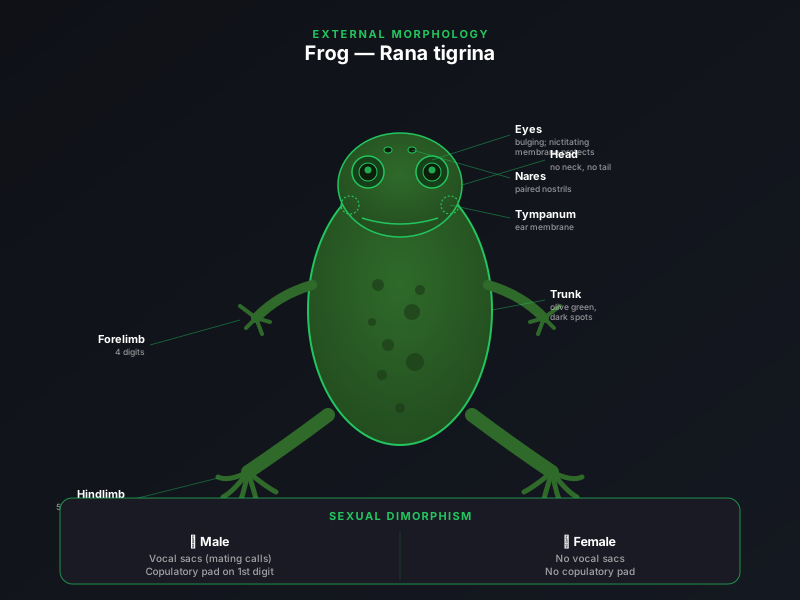
Have you ever touched the skin of a frog? The skin is smooth and slippery due to the presence of mucus. The skin is always maintained in a moist condition. The colour of the dorsal side of the body is generally olive green with dark irregular spots. On the ventral side, the skin is uniformly pale yellow.
The frog never drinks water but absorbs it through the skin! This is why the skin must always remain moist — it serves as both a protective barrier and a water-absorbing organ.
Body of a frog is divisible into head and trunk. A neck and tail are absent. Above the mouth, a pair of nostrils is present. Eyes are bulged and covered by a nictitating membrane that protects them while in water. On either side of eyes, a membranous tympanum (ear) receives sound signals.
Limbs and Locomotion
The forelimbs and hind limbs help in swimming, walking, leaping, and burrowing. The hind limbs end in five digits and they are larger and muscular than forelimbs that end in four digits. Feet have webbed digits that help in swimming.
Sexual Dimorphism
Frogs exhibit sexual dimorphism. Male frogs can be distinguished by the presence of:
- Vocal sacs — sound-producing structures used for mating calls
- Copulatory pad — present on the first digit of the forelimbs (absent in females)
7.2.2 Anatomy — An Overview
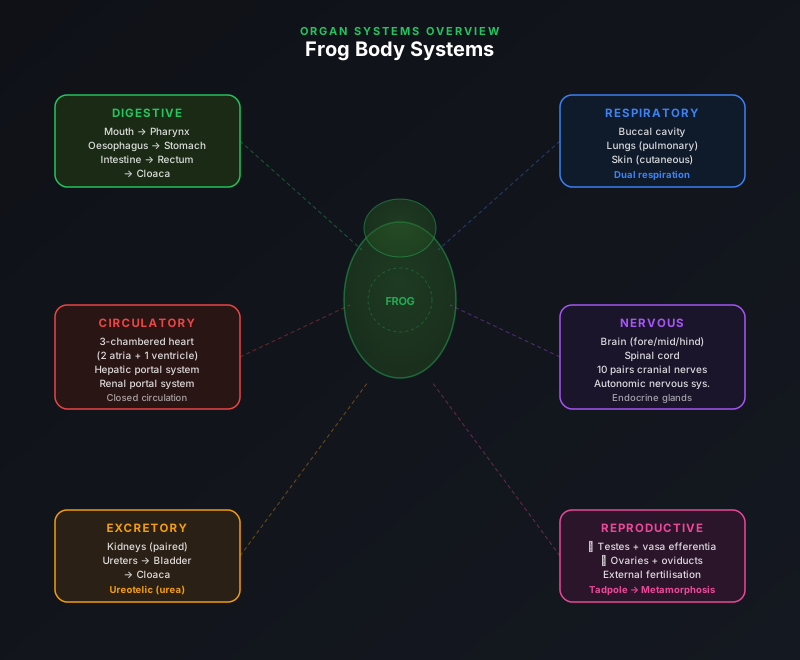
The body cavity of frogs accommodates different organ systems such as digestive, circulatory, respiratory, nervous, excretory, and reproductive systems with well-developed structures and functions.
7.2.3 Digestive System
The digestive system consists of the alimentary canal and digestive glands. The alimentary canal is short because frogs are carnivores and hence the length of intestine is reduced.
The journey of food through the frog's digestive system follows a clear pathway:
- Mouth opens into the buccal cavity
- Buccal cavity leads to the oesophagus through the pharynx
- Oesophagus is a short tube that opens into the stomach
- Stomach continues as the intestine, then rectum
- Finally opens outside by the cloaca
Digestive Glands
- Liver — secretes bile that is stored in the gall bladder
- Pancreas — produces pancreatic juice containing digestive enzymes
Digestion Process
Food is captured by the bilobed tongue. Digestion of food takes place by the action of HCl and gastric juices secreted from the walls of the stomach. Partially digested food called chyme is passed from stomach to the first part of the small intestine, the duodenum.
The duodenum receives bile from gall bladder and pancreatic juices from the pancreas through a common bile duct. Bile emulsifies fat and pancreatic juices digest carbohydrates and proteins. Final digestion takes place in the intestine.
Digested food is absorbed by the numerous finger-like folds in the inner wall of intestine called villi and microvilli. The undigested solid waste moves into the rectum and passes out through the cloaca.
7.2.4 Respiratory System
Frogs respire on land and in the water by two different methods. This dual mode of respiration is a remarkable adaptation for their amphibious lifestyle.
In Water — Cutaneous Respiration
Skin acts as the aquatic respiratory organ. Dissolved oxygen in the water is exchanged through the skin by diffusion. The skin must remain moist for this process.
On Land — Pulmonary Respiration
The buccal cavity, skin, and lungs act as the respiratory organs. Respiration by lungs is called pulmonary respiration. Air enters through nostrils into the buccal cavity and then to lungs.
The lungs are a pair of elongated, pink-coloured sac-like structures present in the upper part of the trunk region (thorax). During aestivation and hibernation, gaseous exchange takes place through the skin.
During aestivation (summer sleep) and hibernation (winter sleep), when the frog is buried underground, it relies entirely on cutaneous respiration — gas exchange through the skin — since the lungs are not in use.
7.2.5 Circulatory System
The vascular system of frog is well-developed and of the closed type. Frogs have a lymphatic system also. The blood vascular system involves heart, blood vessels, and blood. The lymphatic system consists of lymph, lymph channels, and lymph nodes.
Heart
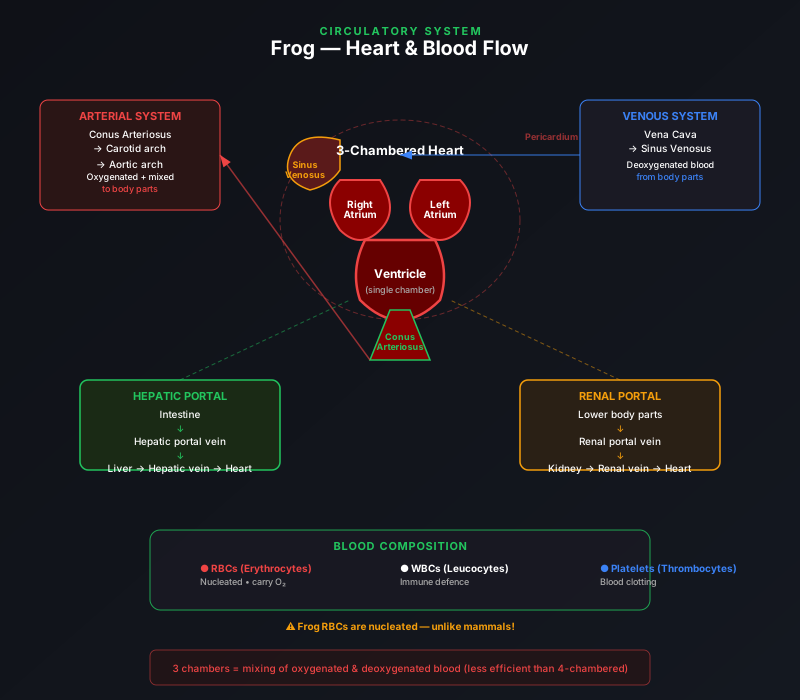
Heart is a muscular structure situated in the upper part of the body cavity. It has three chambers — two atria and one ventricle — and is covered by a membrane called pericardium.
- A triangular structure called sinus venosus joins the right atrium
- Sinus venosus receives blood through the major veins called vena cava
- The ventricle opens into a sac-like conus arteriosus on the ventral side of the heart
- Blood from the heart is carried to all parts by the arteries (arterial system)
- Veins collect blood from different parts to the heart — the venous system
Special Portal Systems
Special venous connections between organs are present in frogs:
- Hepatic portal system — connection between liver and intestine
- Renal portal system — connection between kidney and lower parts of the body
Blood Composition
The blood is composed of plasma and cells. The blood cells are:
| Cell Type | Scientific Name | Function |
|---|---|---|
| Red Blood Cells | Erythrocytes | Transport oxygen; contain nucleated RBCs in frogs (unlike mammals) |
| White Blood Cells | Leucocytes | Immune defence and protection against pathogens |
| Platelets | Thrombocytes | Blood clotting and wound healing |
Frog RBCs are nucleated — this is a key difference from mammalian red blood cells, which are enucleated (lack a nucleus). This is a characteristic feature of most non-mammalian vertebrates.
7.2.6 Excretory System
The excretory system of the frog consists of a pair of kidneys, a pair of ureters, a urinary bladder, and the cloaca.
- Kidneys — paired, dark-red, bean-shaped organs located on either side of the vertebral column
- Ureters — in males, the ureters also serve as urinogenital ducts carrying both urine and sperms; in females, the ureters carry only urine
- Urinary bladder — thin-walled, present ventral to the rectum, opens into the cloaca
- Cloaca — a small, median chamber that receives the digestive, excretory, and reproductive openings
The frog excretes urea and thus is a ureotelic animal. Excretory wastes are carried by blood into the kidney where it is separated and excreted. This is in contrast to ureotelic mammals and uricotelic birds and reptiles.
| Feature | Male Frog | Female Frog |
|---|---|---|
| Ureter function | Urinogenital duct (urine + sperms) | Carries only urine |
| Cloaca receives | Faeces, urine, sperms | Faeces, urine, ova |
| Oviduct | Absent | Present — opens separately into cloaca |
7.2.7 Nervous System & Sense Organs
The system for control and coordination is highly evolved in the frog. It includes both the neural system and endocrine glands. The chemical coordination of various organs of the body is achieved by hormones which are secreted by the endocrine glands.
Endocrine Glands
The prominent endocrine glands found in the frog are:
Brain-associated Glands
Pituitary (master gland), pineal body — located in the brain region, control growth and metabolic functions.
Metabolic Glands
Thyroid, parathyroid, thymus — regulate metabolism, calcium balance, and immune development.
Other Glands
Pancreatic islets, adrenals, and gonads — regulate blood sugar, stress response, and reproduction.
Reproductive Glands
Gonads (testes/ovaries) — produce sex hormones and gametes for reproduction.
Nervous System Organisation
- Central Nervous System (CNS) — Brain and spinal cord
- Peripheral Nervous System (PNS) — Cranial and spinal nerves
- Autonomic Nervous System (ANS) — Sympathetic and parasympathetic divisions
There are 10 pairs of cranial nerves arising from the brain. The brain is enclosed in a bony structure called the brain box (cranium).
Brain Structure
The brain is divided into three parts:
- Fore-brain — includes olfactory lobes, paired cerebral hemispheres, and unpaired diencephalon
- Mid-brain — characterised by a pair of optic lobes
- Hind-brain — consists of cerebellum and medulla oblongata
The medulla oblongata passes out through the foramen magnum and continues into the spinal cord, which is enclosed in the vertebral column.
Sense Organs
Frogs have different types of sense organs:
| Sense | Organ | Structure |
|---|---|---|
| Touch | Sensory papillae | Cellular aggregations around nerve endings |
| Taste | Taste buds | Cellular aggregations around nerve endings |
| Smell | Nasal epithelium | Cellular aggregations around nerve endings |
| Vision | Eyes | Simple eyes (one unit) — well-organised structure |
| Hearing | Tympanum + internal ears | Well-organised structure; also helps in balancing |
Eyes in a frog are a pair of spherical structures situated in the orbit in the skull. These are simple eyes (possessing only one unit). External ear is absent in frogs and only tympanum can be seen externally. The ear is an organ of hearing as well as balancing (equilibrium).
7.2.8 Reproductive System
Frogs have well-organised male and female reproductive systems. The reproductive organs are distinct and exhibit clear sexual dimorphism.
Male Reproductive System
Consists of a pair of yellowish ovoid testes found adhered to the upper part of kidneys by a double fold of peritoneum called mesorchium.
Female Reproductive System
Includes a pair of ovaries situated near kidneys. A pair of oviducts arising from the ovaries opens into the cloaca separately.
Male Reproductive System — Details
- Vasa efferentia — 10-12 in number, arise from testes
- They enter the kidneys on their side and open into Bidder's canal
- Finally communicates with the urinogenital duct that comes out of the kidneys and opens into the cloaca
Female Reproductive System — Details
- Ovaries — situated near kidneys, no functional connection with kidneys
- Oviducts — a pair arising from the ovaries, open into the cloaca separately
- A mature female can lay 2500 to 3000 ova at a time
Fertilisation & Development
Fertilisation is external and takes place in water. Development involves a larval stage called tadpole. Tadpole undergoes metamorphosis to form the adult frog. This transformation includes dramatic changes — loss of tail, development of limbs, change from aquatic to semi-terrestrial lifestyle.
The cloaca is a small, median chamber that is used to pass faecal matter, urine, and sperms/ova to the exterior. It is the common exit point for the digestive, excretory, and reproductive systems — a feature characteristic of amphibians and many other non-mammalian vertebrates.
7.2.9 Ecological Importance of Frogs
Frogs are beneficial for mankind because they eat insects and protect the crop. Frogs maintain ecological balance because these serve as an important link of food chain and food web in the ecosystem.
Agricultural Protection
Frogs are voracious insectivores. They consume large numbers of crop-damaging insects, acting as natural pest controllers and reducing the need for chemical pesticides.
Ecological Balance
Frogs serve as prey for snakes, birds, and fish, while they themselves feed on insects and worms — making them a vital link in food chains and food webs.
Food Source
In some countries, the muscular legs of frog are used as food by humans — a practice known as eating frog legs.
Scientific Research
Frogs are important model organisms in biology research, particularly in developmental biology, physiology, and environmental monitoring.
✦ Summary
Cells, tissues, organs, and organ systems split up the work in a way that ensures the survival of the body as a whole and exhibit division of labour. A tissue is defined as a group of cells along with intercellular substances performing one or more functions in the body. Epithelia are sheet-like tissues lining the body's surface and its cavities, ducts, and tubes.
• The Indian bullfrog, Rana tigrina, is the common frog found in India
• Body is covered by skin with mucous glands — highly vascularised, helps in respiration
• Body is divisible into head and trunk; no neck or tail
• Bilobed tongue used for capturing prey
• Alimentary canal: oesophagus → stomach → intestine → rectum → cloaca
• Main digestive glands: liver and pancreas
• Respires in water through skin, on land through lungs
• Circulatory system: closed type with single circulation; RBCs are nucleated
• Nervous system: central, peripheral, and autonomic divisions
• Excretory organ: kidneys; nitrogenous waste: urea (ureotelic)
• Male: pair of testes; Female: pair of ovaries
• Female lays 2500–3000 ova at a time
• Fertilisation and development are external
• Eggs hatch into tadpoles, which undergo metamorphosis to become adults