Morphology of Flowering Plants
Understanding the diverse external forms and structural features of angiosperms — from roots to flowers
In this chapter
The wide range in the structure of higher plants will never fail to fascinate us. Even though the angiosperms show such a large diversity in external structure or morphology, they are all characterised by the presence of roots, stems, leaves, flowers and fruits.
For any successful attempt at classification and at understanding any higher plant (or for that matter any living organism) we need to know standard technical terms and standard definitions. We also need to know about the possible variations in different parts, found as adaptations of the plants to their environment — e.g., adaptations to various habitats, for protection, climbing, storage, etc.
If you pull out any weed you will see that all of them have roots, stems and leaves. They may be bearing flowers and fruits. The underground part of the flowering plant is the root system while the portion above the ground forms the shoot system.
5.1 The Root
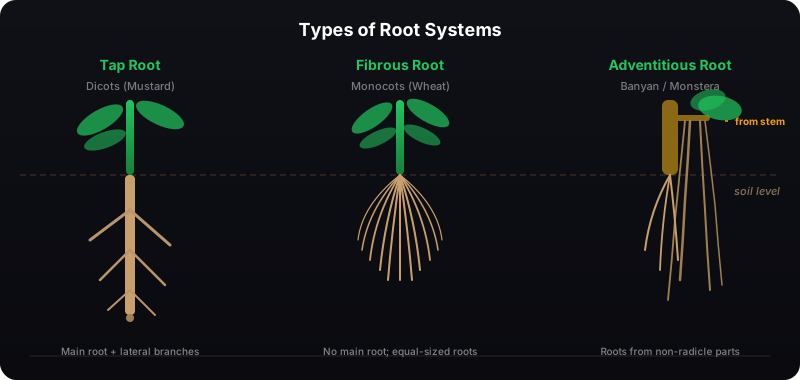
In majority of the dicotyledonous plants, the direct elongation of the radicle leads to the formation of primary root which grows inside the soil. It bears lateral roots of several orders that are referred to as secondary, tertiary, etc. roots. The primary root and its branches constitute the tap root system, as seen in the mustard plant.
In monocotyledonous plants, the primary root is short lived and is replaced by a large number of roots. These roots originate from the base of the stem and constitute the fibrous root system, as seen in the wheat plant.
In some plants, like grass, Monstera and the banyan tree, roots arise from parts of the plant other than the radicle and are called adventitious roots.
Absorption of water and minerals from the soil, providing a proper anchorage to the plant parts, storing reserve food material, and synthesis of plant growth regulators.
Tap Root
Direct elongation of the radicle forming a main root with lateral branches. Found in most dicots, e.g., mustard, neem, carrot.
Fibrous Root
Primary root short-lived, replaced by many thin roots from the stem base. Characteristic of monocots, e.g., wheat, rice, grass.
Adventitious Root
Roots arising from any plant part other than the radicle. Found in grass, Monstera, and the banyan tree.
Root Cap
A thimble-like structure at the root apex that protects the tender growing tip as it pushes through the soil.
Regions of the Root
The root is covered at the apex by a thimble-like structure called the root cap. It protects the tender apex of the root as it makes its way through the soil. A few millimetres above the root cap is the region of meristematic activity. The cells of this region are very small, thin-walled and with dense protoplasm. They divide repeatedly.
The cells proximal to this region undergo rapid elongation and enlargement and are responsible for the growth of the root in length. This region is called the region of elongation. The cells of the elongation zone gradually differentiate and mature. Hence, this zone, proximal to region of elongation, is called the region of maturation. From this region some of the epidermal cells form very fine and delicate, thread-like structures called root hairs. These root hairs absorb water and minerals from the soil.
5.2 The Stem
The stem is the ascending part of the axis bearing branches, leaves, flowers and fruits. It develops from the plumule of the embryo of a germinating seed. The stem bears nodes and internodes. The region of the stem where leaves are borne are called nodes while internodes are the portions between two nodes. The stem bears buds, which may be terminal or axillary. Stem is generally green when young and later often become woody and dark brown.
Spreading out branches bearing leaves, flowers and fruits. Conducting water, minerals and photosynthates. Some stems perform the function of storage of food, support, protection and of vegetative propagation.
5.3 The Leaf
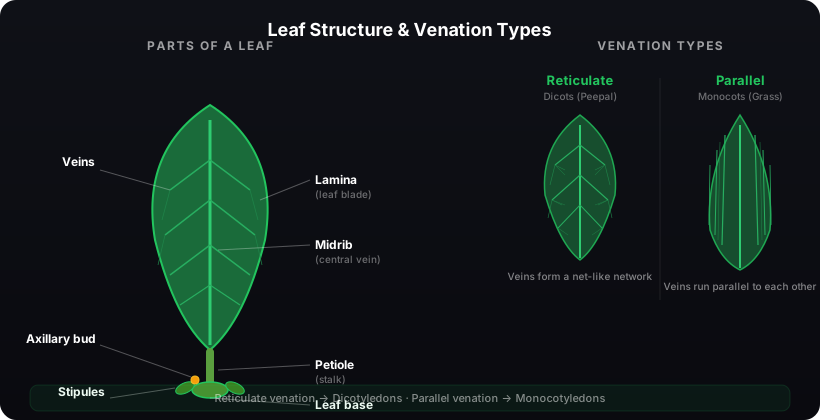
The leaf is a lateral, generally flattened structure borne on the stem. It develops at the node and bears a bud in its axil. The axillary bud later develops into a branch. Leaves originate from shoot apical meristems and are arranged in a definite pattern on the stem or branch. A typical leaf consists of three main parts: leaf base, petiole and lamina.
The leaf is attached to the stem by the leaf base and may bear two lateral small leaf-like structures called stipules. In monocotyledons, the leaf base expands into a sheath covering the stem partially or wholly. In some leguminous plants the leaf base may become swollen, which is called the pulvinus.
The petiole helps hold the blade to light. Long thin flexible petioles allow leaf blades to flutter in wind, thereby cooling the leaf and bringing fresh air to leaf surface.
The lamina or the leaf blade is the green expanded part of the leaf with veins and veinlets. There is, usually, a middle prominent vein, which is known as the midrib. Veins provide rigidity to the leaf blade and act as channels of transport for water, minerals and food materials. The shape, margin, apex, surface and extent of incision of lamina varies in different leaves.
Leaf Base
Attaches the leaf to the stem. May bear stipules. In monocots it expands into a sheath; in legumes it becomes swollen (pulvinus).
Petiole
The stalk that holds the leaf blade to light. Long flexible petioles allow leaves to flutter in wind, aiding cooling and gas exchange.
Lamina (Blade)
The green, flat, expanded portion with veins and veinlets. The midrib is the central prominent vein providing structural support.
Stipules
Small, lateral, leaf-like appendages at the leaf base. Present in many dicots; absent (exstipulate) in most monocots.
Venation
The arrangement of veins and the veinlets in the lamina of leaf is termed as venation. When the veinlets form a network, the venation is termed as reticulate. When the veins run parallel to each other within a lamina, the venation is termed as parallel. Leaves of dicotyledonous plants generally possess reticulate venation, while parallel venation is the characteristic of most monocotyledons.
Types of Leaves
A leaf is said to be simple, when its lamina is entire or when incised, the incisions do not touch the midrib. When the incisions of the lamina reach up to the midrib breaking it into a number of leaflets, the leaf is called compound. A bud is present in the axil of petiole in both simple and compound leaves, but not in the axil of leaflets of the compound leaf.
The compound leaves may be of two types. In a pinnately compound leaf a number of leaflets are present on a common axis, the rachis, which represents the midrib of the leaf as in neem. In palmately compound leaves, the leaflets are attached at a common point, i.e., at the tip of petiole, as in silk cotton.
Phyllotaxy
Phyllotaxy is the pattern of arrangement of leaves on the stem or branch. This is usually of three types:
- Alternate — A single leaf arises at each node in alternate manner, as in china rose, mustard and sun flower plants.
- Opposite — A pair of leaves arise at each node and lie opposite to each other as in Calotropis and guava plants.
- Whorled — If more than two leaves arise at a node and form a whorl, as in Alstonia.
| Feature | Simple Leaf | Compound Leaf |
|---|---|---|
| Lamina incision | Does not reach midrib | Reaches midrib, dividing into leaflets |
| Axillary bud | Present at base of petiole | Absent at base of leaflets |
| Example | Mango, Peepal | Neem (pinnate), Silk cotton (palmate) |
5.4 The Inflorescence
A flower is a modified shoot wherein the shoot apical meristem changes to floral meristem. Internodes do not elongate and the axis gets condensed. The apex produces different kinds of floral appendages laterally at successive nodes instead of leaves. When a shoot tip transforms into a flower, it is always solitary. The arrangement of flowers on the floral axis is termed as inflorescence.
Depending on whether the apex gets developed into a flower or continues to grow, two major types of inflorescences are defined:
Racemose Inflorescence
The main axis continues to grow indefinitely. Flowers are borne laterally in an acropetal succession — older flowers at the base, younger ones at the tip.
Cymose Inflorescence
The main axis terminates in a flower, hence is limited in growth. Flowers are borne in a basipetal order — older flowers at the apex, younger ones at the base.
Acropetal (racemose): Youngest at the top → oldest at the bottom.
Basipetal (cymose): Oldest at the top → youngest at the bottom.
5.5 The Flower
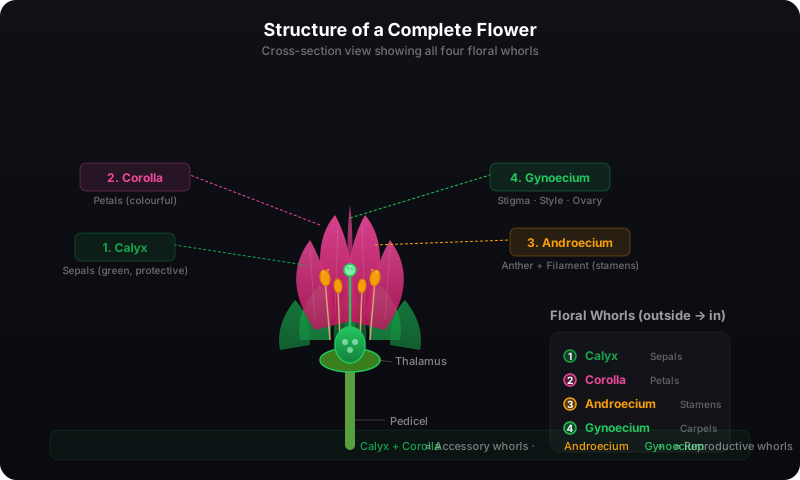
The flower is the reproductive unit in the angiosperms. It is meant for sexual reproduction. A typical flower has four different kinds of whorls arranged successively on the swollen end of the stalk or pedicel, called thalamus or receptacle. These are calyx, corolla, androecium and gynoecium. Calyx and corolla are accessory organs, while androecium and gynoecium are reproductive organs. In some flowers like lily, the calyx and corolla are not distinct and are termed as perianth.
When a flower has both androecium and gynoecium, it is bisexual. A flower having either only stamens or only carpels is unisexual.
Symmetry of the Flower
- Actinomorphic (radial symmetry) — Can be divided into two equal radial halves in any radial plane passing through the centre. Examples: mustard, datura, chilli.
- Zygomorphic (bilateral symmetry) — Can be divided into two similar halves only in one particular vertical plane. Examples: pea, gulmohur, bean, Cassia.
- Asymmetric (irregular) — Cannot be divided into two similar halves by any vertical plane passing through the centre. Example: canna.
Floral Symmetry & Merocity
A flower may be trimerous, tetramerous or pentamerous when the floral appendages are in multiples of 3, 4 or 5, respectively. Flowers with bracts — reduced leaves found at the base of the pedicel — are called bracteate and those without bracts, ebracteate.
Position of Floral Parts on Thalamus
Based on the position of calyx, corolla and androecium in respect of the ovary on thalamus, the flowers are described as:
| Type | Description | Ovary Position | Examples |
|---|---|---|---|
| Hypogynous | Gynoecium occupies the highest position; other parts are below it | Superior | Mustard, china rose, brinjal |
| Perigynous | Gynoecium in centre; other parts on rim of thalamus at the same level | Half inferior | Plum, rose, peach |
| Epigynous | Margin of thalamus grows upward enclosing the ovary; other parts arise above | Inferior | Guava, cucumber, sunflower (ray florets) |
Parts of a Flower
Each flower normally has four floral whorls: calyx, corolla, androecium and gynoecium.
5.5.1 Calyx
The calyx is the outermost whorl of the flower and the members are called sepals. Generally, sepals are green, leaf like and protect the flower in the bud stage. The calyx may be gamosepalous (sepals united) or polysepalous (sepals free).
5.5.2 Corolla
Corolla is composed of petals. Petals are usually brightly coloured to attract insects for pollination. Like calyx, corolla may also be gamopetalous (petals united) or polypetalous (petals free). The shape and colour of corolla vary greatly in plants. Corolla may be tubular, bell-shaped, funnel-shaped or wheel-shaped.
Aestivation
The mode of arrangement of sepals or petals in floral bud with respect to the other members of the same whorl is known as aestivation. The main types are:
| Type | Description | Examples |
|---|---|---|
| Valvate | Sepals or petals just touch one another at the margin, without overlapping | Calotropis |
| Twisted | One margin of the appendage overlaps that of the next one and so on | China rose, lady's finger, cotton |
| Imbricate | Margins overlap one another but not in any particular direction | Cassia, gulmohur |
| Vexillary | Five petals: largest (standard) overlaps two lateral petals (wings) which overlap two smallest anterior petals (keel); also called papilionaceous | Pea, bean |
5.5.3 Androecium
Androecium is composed of stamens. Each stamen which represents the male reproductive organ consists of a stalk or a filament and an anther. Each anther is usually bilobed and each lobe has two chambers, the pollen-sacs. The pollen grains are produced in pollen-sacs. A sterile stamen is called staminode.
Stamens of flower may be united with other members such as petals or among themselves:
- Epipetalous — Stamens attached to petals, as in brinjal.
- Epiphyllous — Stamens attached to the perianth, as in lily.
- Polyandrous — Stamens free from each other.
- Monoadelphous — Stamens united into one bundle, as in china rose.
- Diadelphous — Stamens united into two bundles, as in pea.
- Polyadelphous — Stamens united into more than two bundles, as in citrus.
There may be variation in the length of filaments within a flower, as in Salvia and mustard.
5.5.4 Gynoecium
Gynoecium is the female reproductive part of the flower and is made up of one or more carpels. A carpel consists of three parts namely stigma, style and ovary. Ovary is the enlarged basal part, on which lies the elongated tube, the style. The style connects the ovary to the stigma. The stigma is usually at the tip of the style and is the receptive surface for pollen grains. Each ovary bears one or more ovules attached to a flattened, cushion-like placenta.
When more than one carpel is present, they may be free (as in lotus and rose) and are called apocarpous. They are termed syncarpous when carpels are fused, as in mustard and tomato. After fertilisation, the ovules develop into seeds and the ovary matures into a fruit.
Placentation
The arrangement of ovules within the ovary is known as placentation. The placentation are of different types:
| Type | Description | Examples |
|---|---|---|
| Marginal | Placenta forms a ridge along the ventral suture; ovules borne on this ridge forming two rows | Pea |
| Axile | Placenta is axial; ovules attached to it in a multilocular ovary | China rose, tomato, lemon |
| Parietal | Ovules develop on the inner wall of ovary or peripheral part; ovary one-chambered but becomes two-chambered due to false septum | Mustard, Argemone |
| Free Central | Ovules borne on central axis; septa are absent | Dianthus, Primrose |
| Basal | Placenta develops at the base of ovary; a single ovule attached to it | Sunflower, marigold |
5.6 The Fruit
The fruit is a characteristic feature of the flowering plants. It is a mature or ripened ovary, developed after fertilisation. The fruit consists of the pericarp — the wall of the fruit — which develops from the wall of the ovary.
In some fruits, the thalamus also contributes to fruit formation. Such fruits are called false fruits, e.g., apple, strawberry. Most fruits, however, develop only from the ovary and are called true fruits.
True fruits develop solely from the ovary after fertilisation (e.g., mango, pea).
False fruits develop from the ovary along with other parts like the thalamus (e.g., apple, strawberry, cashew).
Fleshy Fruits — Mango and Coconut
In mango and coconut — both of which are drupes — the fruit wall is differentiated into three layers: an outer thin epicarp, a middle fleshy edible mesocarp and an inner stony hard endocarp. In coconut which is also a drupe, the mesocarp is fibrous.
5.7 The Seed
The ovules after fertilisation, develop into seeds. A seed is made up of a seed coat and an embryo. The embryo is made up of a radicle, an embryonal axis and one (as in wheat, maize) or two cotyledons (as in gram and pea).
Structure of a Dicotyledonous Seed
The outermost covering of a seed is the seed coat. The seed coat has two layers, the outer testa and the inner tegmen. The hilum is a scar on the seed coat through which the developing seeds were attached to the fruit. Above the hilum is a small pore called the micropyle. Within the seed coat is the embryo, consisting of an embryonal axis and two cotyledons. The cotyledons are often fleshy and full of reserve food materials. At the two ends of the embryonal axis are present the radicle and the plumule.
In some seeds such as castor the endosperm formed as a result of double fertilisation, is a food storing tissue and called endospermic seeds. In plants such as bean, gram and pea, the endosperm is not present in mature seeds and such seeds are called non-endospermous.
Structure of a Monocotyledonous Seed
Generally, monocotyledonous seeds are endospermic but some as in orchids are non-endospermic. In the seeds of cereals such as maize the seed coat is membranous and generally fused with the fruit wall. The endosperm is bulky and stores food. The outer covering of endosperm separates the embryo by a proteinous layer called aleurone layer.
The embryo is small and situated in a groove at one end of the endosperm. It consists of one large and shield shaped cotyledon known as scutellum and a short axis with a plumule and a radicle. The plumule and radicle are enclosed in sheaths which are called coleoptile and coleorhiza respectively.
| Feature | Dicot Seed | Monocot Seed |
|---|---|---|
| Cotyledons | Two (fleshy, food storage) | One — scutellum (shield-shaped) |
| Endosperm | Absent in mature seeds of many (non-endospermic) | Present and bulky (endospermic) |
| Seed coat | Two layers: testa + tegmen | Membranous, fused with fruit wall |
| Special structures | Hilum, micropyle clearly visible | Aleurone layer, coleoptile, coleorhiza |
| Examples | Gram, pea, bean, castor | Maize, wheat, rice |
5.8 Semi-technical Description of a Typical Flowering Plant
Various morphological features are used to describe a flowering plant. The description has to be brief, in a simple and scientific language and presented in a proper sequence. The plant is described beginning with its habit, vegetative characters — roots, stem and leaves — and then floral characters: inflorescence and flower parts. After describing various parts of plant, a floral diagram and a floral formula are presented.
Symbols in Floral Formula
| Symbol | Meaning |
|---|---|
| Br | Bracteate |
| K | Calyx |
| C | Corolla |
| P | Perianth |
| A | Androecium |
| G | Gynoecium |
| G̲ (line below) | Superior ovary |
| G̅ (line above) | Inferior ovary |
| ♂ | Male plant / flower |
| ♀ | Female plant / flower |
| ⚥ | Bisexual plant / flower |
| ⊕ | Actinomorphic (radial symmetry) |
| % | Zygomorphic (bilateral symmetry) |
Fusion is indicated by enclosing the figure within brackets (e.g., K(5) for gamosepalous). Adhesion is shown by a line drawn above the symbols of the floral parts (e.g., A over C for epipetalous stamens).
A floral diagram provides information about the number of parts of a flower, their arrangement and the relation they have with one another. The position of the mother axis with respect to the flower is represented by a dot on the top of the floral diagram. Calyx, corolla, androecium and gynoecium are drawn in successive whorls, calyx being the outermost and the gynoecium being in the centre.
⊕ K2+2 C4 A2+4 G(2)
Actinomorphic, bisexual flower with tetramerous perianth, diadelphous androecium and bicarpellary syncarpous gynoecium
5.9 Description of Some Important Families
Solanaceae — The Potato Family
It is a large family, commonly called as the 'potato family'. It is widely distributed in tropics, subtropics and even temperate zones.
Vegetative Characters
Plants mostly herbs, shrubs and rarely small trees. Stem: herbaceous, rarely woody; erect, cylindrical, branched, solid or hollow, hairy or glabrous; underground stem in potato (Solanum tuberosum). Leaves: alternate, simple, rarely pinnately compound, exstipulate; venation reticulate.
Floral Characters
Inflorescence: solitary, axillary or cymose as in Solanum. Flower: bisexual, actinomorphic. Calyx: sepals five, united, persistent, valvate aestivation. Corolla: petals five, united; valvate aestivation. Androecium: stamens five, epipetalous. Gynoecium: bicarpellary, syncarpous; ovary superior, bilocular, placenta swollen with many ovules, axile.
Fruits & Seeds
Fruits: berry or capsule. Seeds: many, endospermous.
Economic Importance
Food: tomato, brinjal, potato. Spice: chilli. Medicine: belladonna, ashwagandha. Fumigatory: tobacco. Ornamentals: petunia.
⊕ ⚥ K(5) C(5) A5 G(2)
Actinomorphic, bisexual, gamosepalous, gamopetalous, 5 epipetalous stamens, bicarpellary syncarpous ovary — superior, bilocular, axile placentation.
5.10 Summary
• Flowering plants exhibit enormous variation in shape, size, structure, mode of nutrition, life span, habit and habitat. They have well developed root and shoot systems.
• Root system is either tap root or fibrous. Generally, dicotyledonous plants have tap roots while monocotyledonous plants have fibrous roots. The roots in some plants get modified for storage of food, mechanical support and respiration.
• The shoot system is differentiated into stem, leaves, flowers and fruits. The morphological features of stems like the presence of nodes and internodes, multicellular hair and positively phototropic nature help to differentiate the stems from roots.
• Leaf is a lateral outgrowth of stem developed exogeneously at the node. These are green in colour to perform the function of photosynthesis. Leaves exhibit marked variations in their shape, size, margin, apex and extent of incisions of leaf blade (lamina).
• The flower is a modified shoot, meant for sexual reproduction. The flowers are arranged in different types of inflorescences. They exhibit enormous variation in structure, symmetry, position of ovary in relation to other parts, arrangement of petals, sepals, ovules etc.
• After fertilisation, the ovary is modified into fruits and ovules into seeds. Seeds either may be monocotyledonous or dicotyledonous.
• Morphological characters are used in classification and identification of flowering plants. This can be illustrated through semi-technical descriptions of families. Hence, a flowering plant is described in a definite sequence by using scientific terms. The floral features are represented in the summarised form as floral diagrams and floral formula.