Moving Charges and Magnetism
How electric currents create magnetic fields — from Oersted's discovery to cyclotrons
Table of Contents
4.1 Introduction
Both Electricity and Magnetism have been known for more than 2000 years. However, it was only about 200 years ago, in 1820, that it was realised that they were intimately related. Danish physicist Hans Christian Oersted noticed that a current in a straight wire caused a noticeable deflection in a nearby magnetic compass needle.
4.2 Oersted's Experiment
Oersted discovered that a current-carrying wire produces a magnetic field around it. The magnetic field lines form concentric circles around the wire, with the direction given by the right-hand thumb rule: point thumb in direction of current, fingers curl in direction of B.
Hold the current-carrying wire in your right hand with thumb pointing in direction of current. Your fingers curl in the direction of the magnetic field lines around the wire.
4.3 Biot-Savart Law
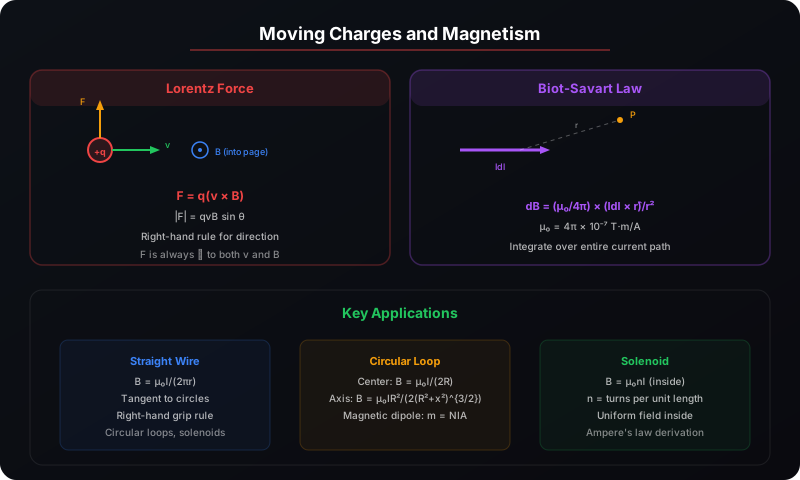
The Biot-Savart law gives the magnetic field due to a small current element:
4.4 Ampere's Circuital Law
Ampere's law provides an alternative way to calculate magnetic fields with symmetry:
4.5 Magnetic Field due to Current-Carrying Conductors
Straight Wire
B = μ₀I/(2πr)
Circular field lines. Direction by right-hand grip rule.
Circular Loop
Center: B = μ₀I/(2R)
Axis: decreases with distance. B ∝ 1/R² on axis.
Solenoid
B = μ₀nI (uniform inside)
n = turns per meter. Like a bar magnet outside.
Toroid
B = μ₀nI (inside toroid)
Zero outside. Used in transformers and inductors.
4.6 Force on a Current-Carrying Conductor
A wire carrying current I in a magnetic field B experiences a force:
4.7 Force between Parallel Conductors
Two parallel current-carrying wires exert forces on each other:
- Same direction: Wires attract each other
- Opposite direction: Wires repel each other
- Force per unit length: F/L = μ₀I₁I₂/(2πd)
- This force defines the Ampere: 1 A produces exactly 2 × 10⁻⁷ N/m between wires 1 m apart
4.8 Moving Coil Galvanometer
A galvanometer detects small currents. It works on the principle that a current-carrying coil in a magnetic field experiences a torque:
4.9 Cyclotron
A cyclotron accelerates charged particles to high energies using a combination of electric and magnetic fields:
Cyclotrons cannot accelerate electrons (too light, relativistic effects) and are limited for protons at very high energies. For electrons, synchrotrons are used instead.