Oscillations
To and fro motion about a mean position — from pendulums to vibrating strings
Table of Contents
13.1 Introduction
In our daily life we come across various kinds of motions. Some are non-repetitive (rectilinear, projectile) while others are repetitive (periodic). When an object moves to and fro about a mean position, the motion is called oscillatory motion.
Examples: a rocking cradle, a swinging pendulum, a boat tossing in a river, the piston in a steam engine, guitar strings, and vibrating air molecules. Oscillatory motion is fundamental to understanding sound, AC circuits, and many other physical phenomena.
13.2 Periodic and Oscillatory Motions
A motion that repeats itself at regular intervals of time is called periodic motion. The smallest interval after which the motion repeats is called the period (T). The number of repetitions per unit time is the frequency (f = 1/T).
Periodic Motion
Repeats after fixed time interval. Examples: Earth's rotation, hands of a clock, AC voltage, planets orbiting Sun.
Oscillatory Motion
To and fro about a mean position. A special case of periodic motion. Examples: pendulum, tuning fork, spring-mass system.
Period (T)
Time for one complete cycle. SI unit: seconds (s). T = 2π/ω where ω = angular frequency.
Frequency (f)
Number of cycles per second. Unit: Hertz (Hz). f = 1/T = ω/2π. Higher frequency = faster oscillations.
The angular frequency ω = 2πf = 2π/T relates the rate of oscillation to circular motion. It has units of rad/s and is crucial in SHM equations.
13.3 Simple Harmonic Motion
A special kind of periodic motion where the restoring force is directly proportional to displacement and directed towards the mean position is called Simple Harmonic Motion (SHM).
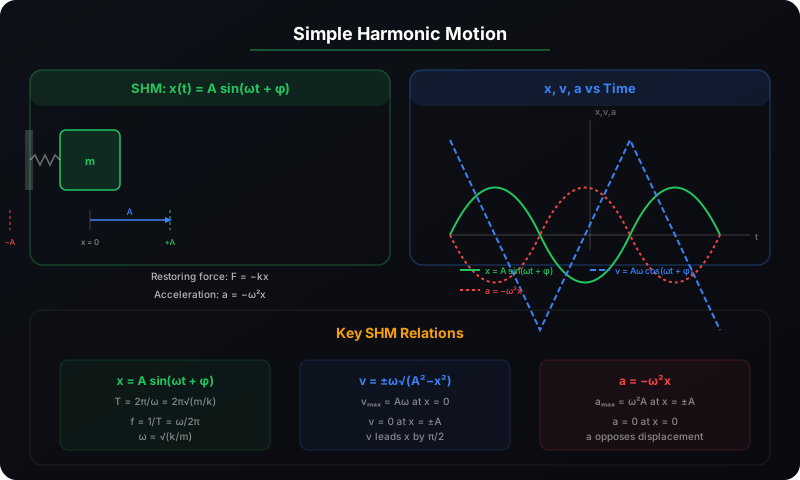
For SHM, three conditions must be met: (1) Force is restoring (directed toward mean position), (2) Force is proportional to displacement (F ∝ −x), (3) No damping (no energy loss). Real systems approximate SHM for small displacements.
13.4 SHM and Uniform Circular Motion
SHM can be thought of as the projection of uniform circular motion onto a diameter. A particle moving in a circle of radius A with constant angular speed ω has a projection on the x-axis that executes SHM:
The phase (ωt + φ) determines the state of the oscillator at any instant. Two oscillations are in phase if their phase difference is a multiple of 2π.
13.5 Velocity and Acceleration in SHM
Differentiating the displacement equation gives velocity and acceleration:
Velocity
v = dx/dt = ±ω√(A² − x²)
Maximum at mean position (x=0): vₘₐₓ = Aω
Zero at extreme positions (x = ±A)
Acceleration
a = dv/dt = −ω²x
Maximum at extremes: aₘₐₓ = ω²A
Zero at mean position (x=0)
Always opposes displacement
In SHM: displacement leads velocity by π/2 (velocity is 90° behind), velocity leads acceleration by π/2. So displacement leads acceleration by π (they are always in opposite phase).
13.6 Energy in SHM
The total energy of a simple harmonic oscillator is constant and is the sum of kinetic and potential energies:
Kinetic Energy
KE = ½mv² = ½k(A² − x²)
Maximum at mean position (x=0)
Zero at extremes (x = ±A)
Potential Energy
PE = ½kx²
Maximum at extremes (x = ±A)
Zero at mean position (x=0)
Total energy: KE + PE = ½kA² = constant
In ideal SHM, energy continuously converts between kinetic and potential, but total energy remains constant. KE = PE at x = A/√2. At extremes, all energy is PE; at mean position, all energy is KE.
13.7 Oscillations of a Spring
A mass attached to a spring executes SHM. The period depends on mass and spring constant:
For a spring, ω = √(k/m). A heavier mass oscillates more slowly; a stiffer spring oscillates more rapidly.
Series: 1/k_eff = 1/k₁ + 1/k₂ (softer overall). Parallel: k_eff = k₁ + k₂ (stiffer overall). Two identical springs in series: k_eff = k/2, period increases by √2.
13.8 Simple Pendulum
A simple pendulum consists of a point mass suspended by a light, inextensible string from a fixed point. For small angular displacements (θ < 5°), it executes SHM:
Seconds Pendulum
A pendulum with T = 2 seconds (1 second each way). Its length is about 0.994 m ≈ 1 m. Used in clocks.
Measuring g
By measuring T and L of a pendulum, we can calculate g = 4π²L/T². This is how g was first accurately measured.
g at Different Locations
g varies with altitude (decreases) and latitude (increases from equator to poles). Pendulum clocks run slower at high altitudes.
Small Angle Approximation
The formula T = 2π√(L/g) works only for small oscillations (θ < 5°). For large angles, period increases and motion is not truly SHM.
Léon Foucault's famous pendulum in the Panthéon (Paris, 1851) demonstrated Earth's rotation. As the pendulum oscillates, its plane of oscillation slowly rotates due to Earth's rotation beneath it.