Thermodynamics
The laws governing heat, work, and energy — from steam engines to thearrow of time
Table of Contents
11.1 Introduction
Thermodynamics is the branch of physics that deals with the concepts of heat and temperature and the inter-conversion of heat and other forms of energy. In winter, when we rub our palms together, we feel warmer — here work done in rubbing produces heat. Conversely, in a steam engine, the heat of the steam is used to do useful work.
11.2 Thermal Equilibrium
When two bodies at different temperatures are placed in contact, heat flows from the hotter to the colder body until they reach the same temperature. This state is called thermal equilibrium.
At thermal equilibrium, the net heat flow between the two bodies is zero. The condition for thermal equilibrium is simply: T₁ = T₂. This is the foundation of temperature measurement.
11.3 Zeroth Law of Thermodynamics
The Zeroth law establishes the concept of temperature as a measurable quantity:
If systems A and B are each in thermal equilibrium with a third system C, then A and B are in thermal equilibrium with each other. This law validates the use of thermometers and allows us to define a universal temperature scale.
11.4 Heat, Internal Energy and Work
Understanding the distinction between these three quantities is crucial:
Heat (Q)
Energy transferred between a system and surroundings due to temperature difference. Not contained in a body — it's energy in transit.
Internal Energy (U)
Total kinetic + potential energy of all molecules in a system. For ideal gas: U depends only on temperature.
Work (W)
Energy transferred when a force acts through a displacement. In thermodynamics: W = ∫P dV (work done by/on the gas).
Sign Convention
Q > 0: heat added to system. W > 0: work done by system. These conventions are consistent with ΔU = Q − W.
11.5 First Law of Thermodynamics
The first law is simply the conservation of energy applied to thermal processes:
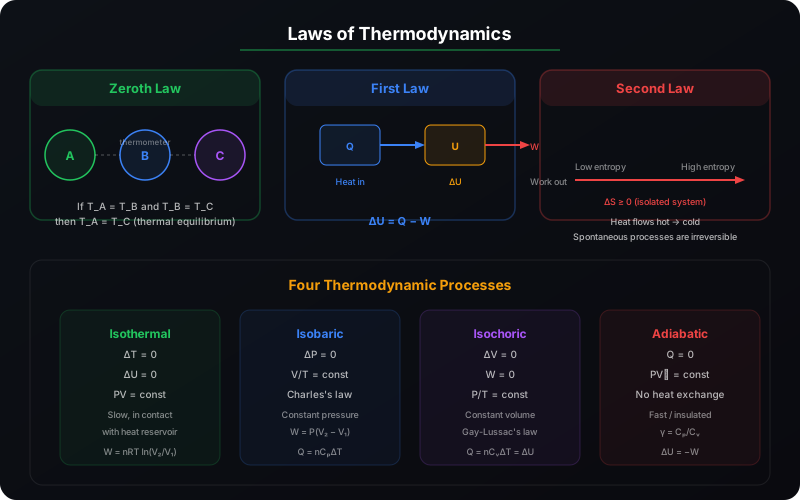
The first law tells us that energy cannot be created or destroyed — only converted from one form to another. Heat can do work, work can produce heat, but the total energy is always conserved.
11.6 Specific Heat Capacity
In thermodynamics, we distinguish between two molar specific heats for gases:
Cᵥ (Constant Volume)
Heat required to raise temperature of 1 mole by 1K at constant volume. All heat goes to internal energy: Q = nCᵥΔT
Cₚ (Constant Pressure)
Heat required at constant pressure. Some heat does work (expansion): Q = nCₚΔT. Always Cₚ > Cᵥ.
11.7 Thermodynamic Processes
A process is a transformation from one state to another. The four special processes each fix one variable:
| Process | Condition | Equation | W |
|---|---|---|---|
| Isothermal | ΔT = 0 | PV = const | nRT ln(V₂/V₁) |
| Isobaric | ΔP = 0 | V/T = const | P(V₂ − V₁) |
| Isochoric | ΔV = 0 | P/T = const | 0 |
| Adiabatic | Q = 0 | PVᵞ = const | −ΔU = nCᵥ(T₁−T₂) |
In an adiabatic expansion, the gas cools (T drops) because no heat enters. In isothermal expansion, heat flows in to maintain constant temperature. The adiabatic curve is steeper than the isothermal on a PV diagram.
11.8 Second Law of Thermodynamics
The second law places fundamental limits on what processes are possible:
No process can have the sole result of absorbing heat from a reservoir and converting it completely into work. In other words, no heat engine can be 100% efficient.
Heat cannot spontaneously flow from a colder body to a hotter body without external work being done. This explains why refrigerators need electricity.
Entropy
The second law can be stated in terms of entropy — a measure of disorder:
11.9 Reversible and Irreversible Processes
A reversible process is one where both the system and surroundings can be returned to their original states. All natural processes are irreversible.
- Reversible examples: Frictionless piston, quasi-static compression, ideal Carnot cycle
- Irreversible examples: Heat conduction, gas expansion into vacuum, all real engines
- Why irreversible? They involve dissipative forces (friction, viscosity) and finite temperature differences
- Clausius inequality: ∮(dQ/T) ≤ 0, with equality only for reversible cycles
11.10 Carnot Engine
The Carnot engine is an idealized heat engine that operates on the reversible Carnot cycle. It provides the maximum possible efficiency for any heat engine operating between two temperatures.

Four Carnot Steps
A→B: Isothermal expansion at T₁ (absorb Q₁)
B→C: Adiabatic expansion (T₁ → T₂)
C→D: Isothermal compression at T₂ (reject Q₂)
D→A: Adiabatic compression (T₂ → T₁)
Real vs Ideal
No real engine achieves Carnot efficiency because of friction, heat losses, and finite-time processes. Carnot efficiency sets the theoretical upper limit.
Car engines: ~25%. Steam turbines: ~40%. Combined cycle gas turbines: ~60%. The Carnot limit for T₁ = 600K, T₂ = 300K is 50%. Engineering aims to get as close to Carnot as practically possible.