Binomial Theorem
Expanding powers of binomials elegantly — from Pascal's triangle to powerful algebraic formulas
In this chapter
7.1 Pascal's Triangle
"Mathematics is a most exact science and its conclusions are capable of absolute proofs." — C.P. Steinmetz
In earlier classes, you learned to expand (a + b)² and (a + b)³. But what about (a + b)⁵ or (a + b)¹⁰? Repeated multiplication becomes tedious. The Binomial Theorem gives us a shortcut!
Building the Pattern
(a + b)⁰ = 1
(a + b)¹ = a + b
(a + b)² = a² + 2ab + b²
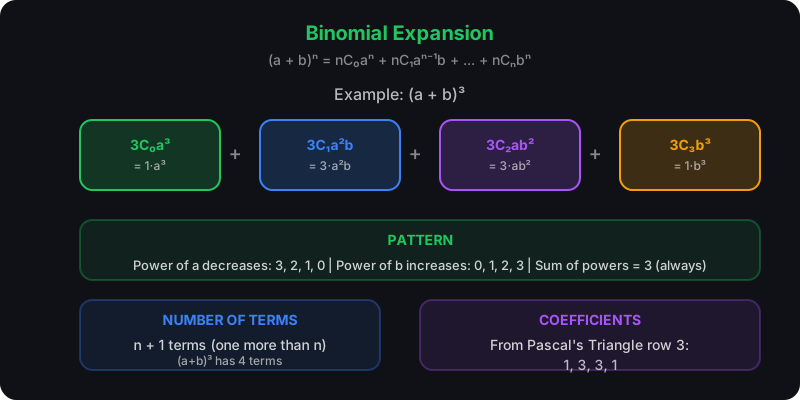
(a + b)³ = a³ + 3a²b + 3ab² + b³
(a + b)⁴ = a⁴ + 4a³b + 6a²b² + 4ab³ + b⁴
Pascal's Triangle
If we extract just the coefficients, we get a beautiful pattern called Pascal's Triangle:
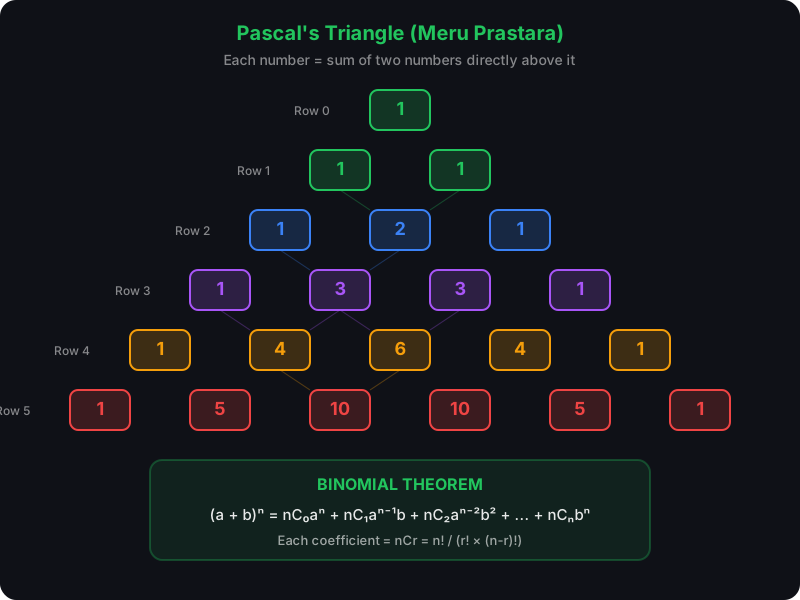
Rule: Each number = sum of the two numbers directly above it
• Row 0: 1
• Row 1: 1, 1
• Row 2: 1, 2, 1 (because 1+1=2)
• Row 3: 1, 3, 3, 1 (because 1+2=3, 2+1=3)
• Row 4: 1, 4, 6, 4, 1
Pattern 1: Term Count
Row n has (n+1) terms. Row 5 has 6 terms.
Pattern 2: Symmetry
Each row is symmetric. First = last, second = second-last, etc.
Pattern 3: Powers
In each term, power of a decreases by 1, power of b increases by 1.
Pattern 4: Sum of Powers
In every term, power of a + power of b = n (the index).
7.2 Binomial Theorem Formula
Using combinations (nCr), we can write a direct formula for any row of Pascal's triangle:
(a + b)ⁿ = Σ (nCr × aⁿ⁻ʳ × bʳ) for r = 0 to n
Each term = (nCr) × (a to some power) × (b to some power)
Example: Expand (2x + 3y)⁵
Row 5 of Pascal's triangle: 1, 5, 10, 10, 5, 1
(2x + 3y)⁵ = 1(2x)⁵ + 5(2x)⁴(3y) + 10(2x)³(3y)² + 10(2x)²(3y)³ + 5(2x)(3y)⁴ + 1(3y)⁵
= 32x⁵ + 240x⁴y + 720x³y² + 1080x²y³ + 810xy⁴ + 243y⁵
Example: Expand (x + 2)⁶
(x + 2)⁶ = 6C₀x⁶ + 6C₁x⁵(2) + 6C₂x⁴(2²) + 6C₃x³(2³) + 6C₄x²(2⁴) + 6C₅x(2⁵) + 6C₆(2⁶)
= x⁶ + 12x⁵ + 60x⁴ + 160x³ + 240x² + 192x + 64
7.3 General Term
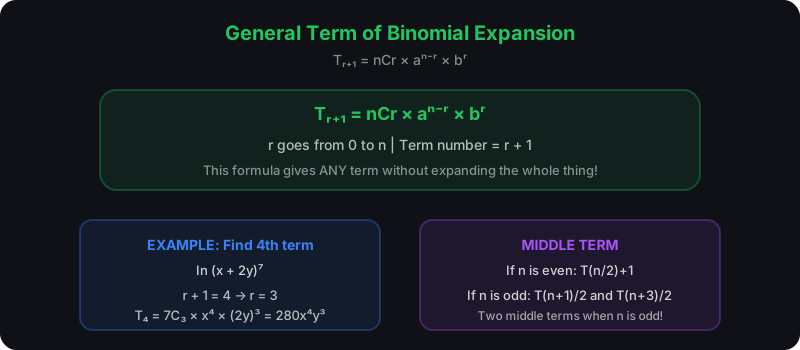
The general term (r+1)th term) in the expansion of (a + b)ⁿ is:
To find the 4th term in (x + 2y)⁷:
• r + 1 = 4, so r = 3
• T₄ = 7C₃ × x⁷⁻³ × (2y)³
• T₄ = 35 × x⁴ × 8y³
• T₄ = 280x⁴y³
If n is even, there's one middle term: T(n/2)+1
If n is odd, there are two middle terms: T(n+1)/2 and T(n+3)/2
7.4 Special Cases
(x - y)ⁿ Expansion
(x - y)ⁿ = nC₀xⁿ - nC₁xⁿ⁻¹y + nC₂xⁿ⁻²y² - ... + (-1)ⁿnCₙyⁿ
The signs alternate: +, -, +, -, ...
Example: (x - 2y)⁵ = x⁵ - 10x⁴y + 40x³y² - 80x²y³ + 80xy⁴ - 32y⁵
(1 + x)ⁿ Expansion
(1 + x)ⁿ = nC₀ + nC₁x + nC₂x² + nC₃x³ + ... + nCₙxⁿ
When x = 1: 2ⁿ = nC₀ + nC₁ + nC₂ + ... + nCₙ (sum of all coefficients)
When x = -1: 0 = nC₀ - nC₁ + nC₂ - ... + (-1)ⁿnCₙ
Sum of all coefficients: Put x = 1 → (1+1)ⁿ = 2ⁿ
Alternating sum: Put x = -1 → (1-1)ⁿ = 0
Sum of even-indexed: (2ⁿ + 0) / 2 = 2ⁿ⁻¹
Sum of odd-indexed: (2ⁿ - 0) / 2 = 2ⁿ⁻¹
7.5 Applications
Computing Large Powers
Write 98 = 100 - 2
(98)⁵ = (100 - 2)⁵
= 5C₀(100)⁵ - 5C₁(100)⁴(2) + 5C₂(100)³(2²) - 5C₃(100)²(2³) + 5C₄(100)(2⁴) - 5C₅(2⁵)
= 10,000,000,000 - 1,000,000,000 + 40,000,000 - 800,000 + 8,000 - 32
= 9,039,207,968
Comparing Large Numbers
(1.01)¹⁰⁰⁰⁰⁰⁰ = (1 + 0.01)¹⁰⁰⁰⁰⁰⁰
= 1 + 1000000(0.01) + other positive terms
= 1 + 10,000 + (more positive terms)
> 10,000 ✓
Divisibility Problems
Using (1 + 5)ⁿ:
6ⁿ = 1 + 5n + 25(nC₂) + 125(nC₃) + ...
6ⁿ - 5ⁿ = 1 + 25(nC₂ + 5nC₃ + ...)
= 1 + 25k (where k is an integer)
So 6ⁿ - 5ⁿ = 25k + 1 → remainder is 1 ✓
7.6 Summary
• Binomial Theorem: (a+b)ⁿ = nC₀aⁿ + nC₁aⁿ⁻¹b + ... + nCₙbⁿ
• Pascal's Triangle: Each number = sum of two numbers above. Row n has n+1 terms.
• General term: Tᵣ₊₁ = nCr × aⁿ⁻ʳ × bʳ
• (x-y)ⁿ: Same as (x+y)ⁿ but with alternating signs
• (1+x)ⁿ: Simplified form using just coefficients
• Sum of coefficients: Put x=1 → 2ⁿ
• Applications: Computing powers, comparisons, divisibility proofs