Unit 10: Biomolecules
The molecular building blocks of life — carbohydrates, proteins, nucleic acids, and vitamins
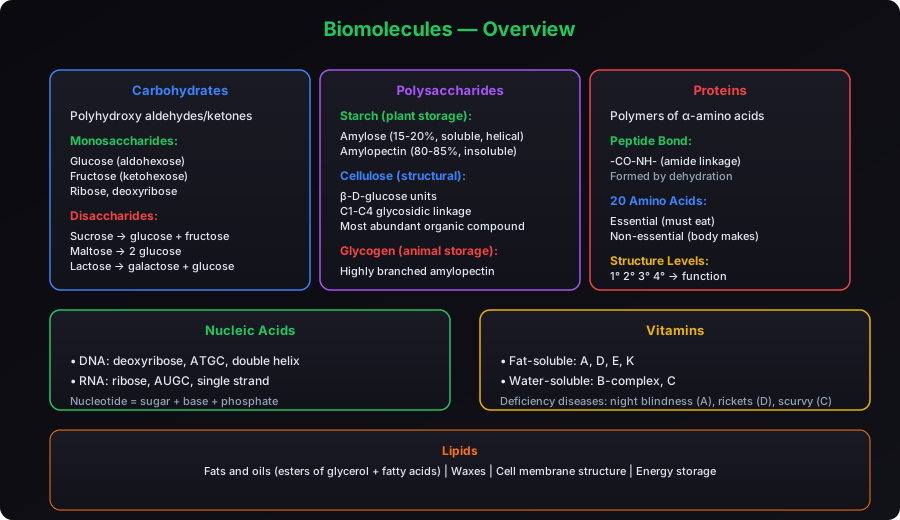
10.1 Biomolecules Overview
10.2 Carbohydrates
Optically active polyhydroxy aldehydes or ketones, or compounds that produce them on hydrolysis. General formula: Cₓ(H₂O)ᵧ.
Classification by Hydrolysis
| Type | Monosaccharides on Hydrolysis | Examples |
|---|---|---|
| Monosaccharides | Cannot be hydrolysed further | Glucose, fructose, ribose |
| Disaccharides | 2 monosaccharides | Sucrose → glucose + fructose |
| Polysaccharides | Many monosaccharides | Starch, cellulose, glycogen |
Glucose Structure
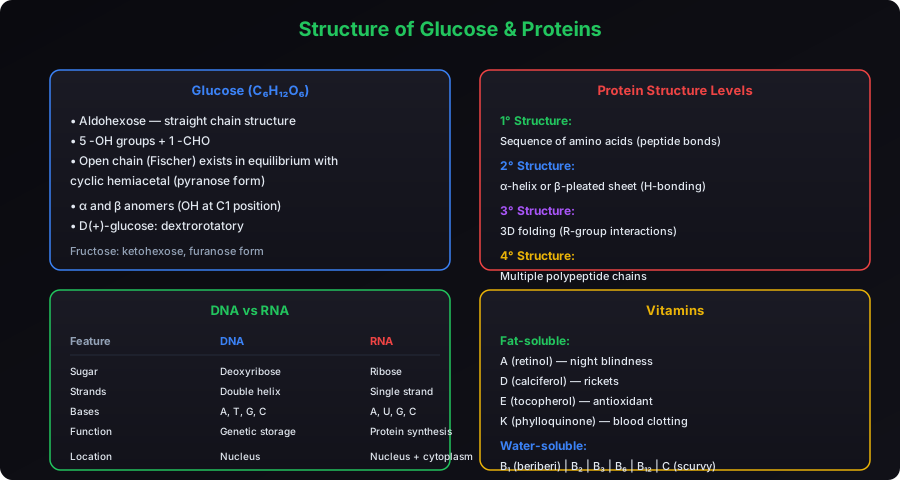
- Open chain: CHO-(CHOH)₄-CH₂OH (D(+)-glucose)
- Cyclic: α-D-glucopyranose and β-D-glucopyranose (hemiacetal)
- Key evidence: Forms oxime and cyanohydrin (C=O), oxidised by Br₂ water (aldehyde), gives saccharic acid on HNO₃ oxidation (CH₂OH)
Important Disaccharides
| Sugar | Monomers | Glycosidic Linkage | Reducing? |
|---|---|---|---|
| Sucrose | Glucose + Fructose | C1(α) - C2(β) | No |
| Maltose | 2 Glucose | C1(α) - C4 | Yes |
| Lactose | Galactose + Glucose | C1(β) - C4 | Yes |
Polysaccharides
- Starch: α-glucose polymer (amylose 15-20% soluble + amylopectin 80-85% insoluble)
- Cellulose: β-D-glucose polymer, most abundant organic compound, plant cell wall
- Glycogen: Highly branched amylopectin, stored in liver/muscles (animal starch)
10.3 Proteins
Polymers of α-amino acids linked by peptide bonds. Chief sources: milk, cheese, pulses, fish, meat.
Peptide Bond
Essential vs Non-Essential Amino Acids
- Essential (10): Valine, Leucine, Isoleucine, Arginine, Lysine, Methionine, Phenylalanine, Tryptophan, Threonine, Histidine — must be obtained from diet
- Non-essential (10): Glycine, Alanine, Serine, Cysteine, Aspartic acid, Glutamic acid, Asparagine, Glutamine, Tyrosine, Proline — body can synthesise
Protein Structure
- Primary (1°): Linear sequence of amino acids
- Secondary (2°): α-helix or β-pleated sheet (H-bonding)
- Tertiary (3°): 3D folding from R-group interactions
- Quaternary (4°): Multiple polypeptide chains
Denaturation
Loss of 3°/4° structure by heat, pH change, or chemicals (e.g., coagulation of egg white). 1° structure (peptide bonds) remains intact.
10.4 Nucleic Acids
Polymers of nucleotides. Each nucleotide = nitrogenous base + pentose sugar + phosphate group.
DNA vs RNA
| Feature | DNA | RNA |
|---|---|---|
| Sugar | Deoxyribose | Ribose |
| Strands | Double helix | Single strand |
| Bases | A, T, G, C | A, U, G, C |
| Function | Genetic information storage | Protein synthesis |
| Location | Nucleus | Nucleus + cytoplasm |
Chargaff's rule: [A] = [T], [G] = [C] in DNA
10.5 Vitamins
Fat-Soluble Vitamins
| Vitamin | Name | Deficiency Disease |
|---|---|---|
| A | Retinol | Night blindness, xerophthalmia |
| D | Calciferol | Rickets in children, osteomalacia in adults |
| E | Tocopherol | Increased fragility of RBCs |
| K | Phylloquinone | Delayed blood clotting |
Water-Soluble Vitamins
| Vitamin | Name | Deficiency Disease |
|---|---|---|
| B₁ | Thiamine | Beriberi, loss of appetite |
| B₂ | Riboflavin | Cheilosis, digestive disorders |
| B₃ | Niacin | Pellagra (dermatitis, diarrhoea, dementia) |
| B₅ | Pantothenic acid | Increased irritability, fatigue |
| B₆ | Pyridoxine | Convulsions, anaemia |
| B₇ | Biotin | Skin disorders |
| B₉ | Folic acid | Megaloblastic anaemia |
| B₁₂ | Cobalamine | Pernicious anaemia |
| C | Ascorbic acid | Scurvy (bleeding gums) |
Summary
Biomolecules are the chemical compounds found in living organisms. Carbohydrates are classified as monosaccharides, disaccharides, and polysaccharides. Glucose exists in open chain and cyclic forms. Proteins are polymers of α-amino acids linked by peptide bonds, with four levels of structural organisation. Nucleic acids (DNA and RNA) carry genetic information. DNA is double-stranded with base pairing (A-T, G-C); RNA is single-stranded with uracil replacing thymine. Vitamins are essential dietary factors classified as fat-soluble (A, D, E, K) and water-soluble (B-complex, C).