Unit 6: Haloalkanes and Haloarenes
Organic compounds containing halogen atoms — intermediates in synthesis and important in industry
6.1 Classification
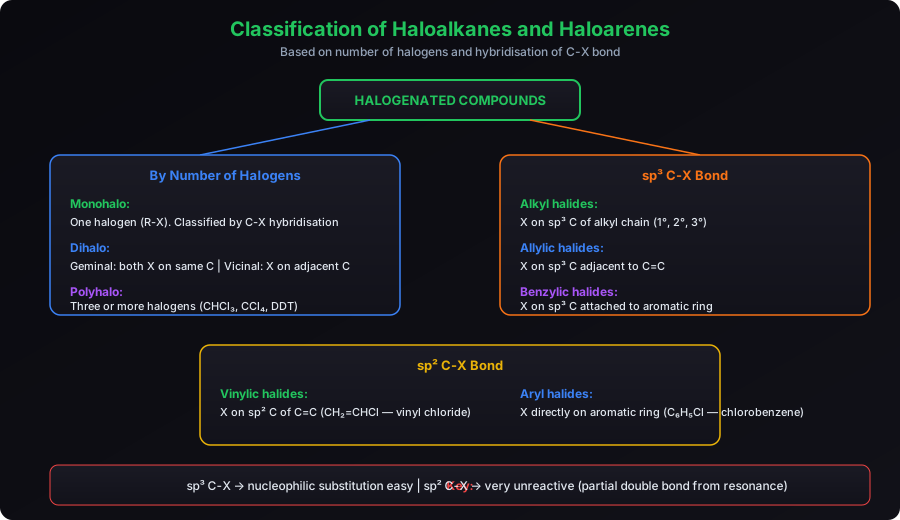
Haloalkanes and haloarenes are classified based on the number of halogen atoms and the type of carbon-halogen (C-X) bond.
sp³ C-X Bond
Haloalkanes: halogen bonded to sp³ carbon. Includes alkyl, allylic, and benzylic halides.
sp² C-X Bond
Vinylic (on C=C) and aryl (on aromatic ring) halides. Less reactive due to partial double bond character.
Geminal & Vicinal Dihalides
Geminal: both halogens on same carbon. Vicinal: halogens on adjacent carbons.
6.2 Preparation
From Alcohols
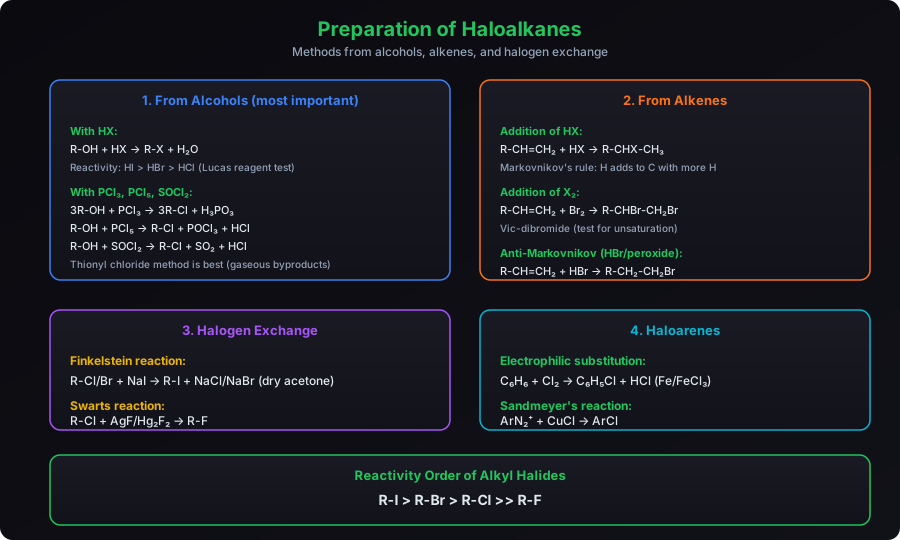
3R-OH + PCl₃ → 3R-Cl + H₃PO₃
R-OH + PCl₅ → R-Cl + POCl₃ + HCl
R-OH + SOCl₂ → R-Cl + SO₂ + HCl
Reactivity of hydrogen halides: HI > HBr > HCl. The thionyl chloride method is preferred because gaseous by-products (SO₂ and HCl) escape, leaving pure product.
From Alkenes
R-CH=CH₂ + HBr → R-CH₂-CH₂Br (Anti-Markovnikov, peroxide effect)
Halogen Exchange
R-Cl + AgF → R-F (Swarts reaction)
Reactivity order of alkyl groups: 3° > 2° > 1°
6.3 Nucleophilic Substitution
Nucleophilic substitution is the most characteristic reaction of alkyl halides, where a nucleophile replaces the halide leaving group.
SN2 Mechanism (Bimolecular)
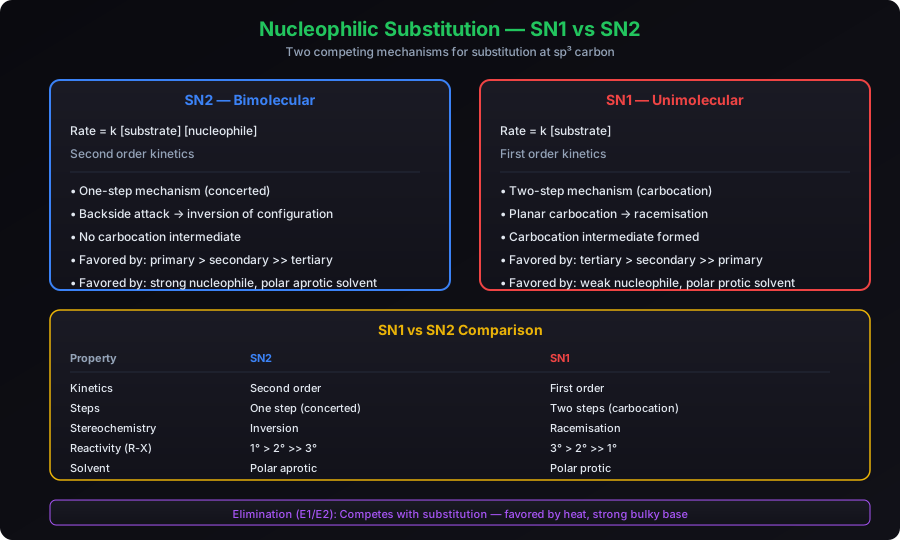
- Single-step concerted mechanism
- Nucleophile attacks from the back side
- Rate = k [substrate] [nucleophile] — second order
- Causes inversion of configuration (Walden inversion)
- Favoured by: primary alkyl halides, strong nucleophile, polar aprotic solvent
SN1 Mechanism (Unimolecular)
- Two-step mechanism via carbocation intermediate
- Rate = k [substrate] — first order
- Causes racemisation (partial inversion in practice)
- Favoured by: tertiary alkyl halides, weak nucleophile, polar protic solvent
6.4 Stereochemistry
Optical Activity
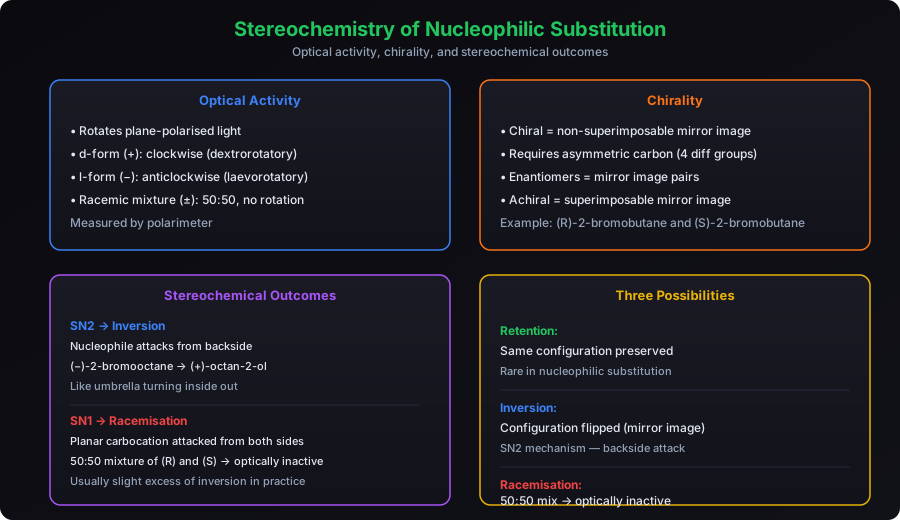
- Chiral molecules rotate the plane of plane-polarised light
- d-form (+): dextrorotatory (clockwise rotation)
- l-form (−): laevorotatory (anticlockwise rotation)
- Racemic mixture: 50:50 mixture of enantiomers — optically inactive
Walden Inversion
In SN2, the nucleophile attacks from the side opposite to the leaving group. This inverts the configuration at the carbon, like an umbrella turning inside out. Example: (−)-2-bromooctane gives (+)-octan-2-ol on hydrolysis with NaOH (SN2).
6.5 Elimination Reactions
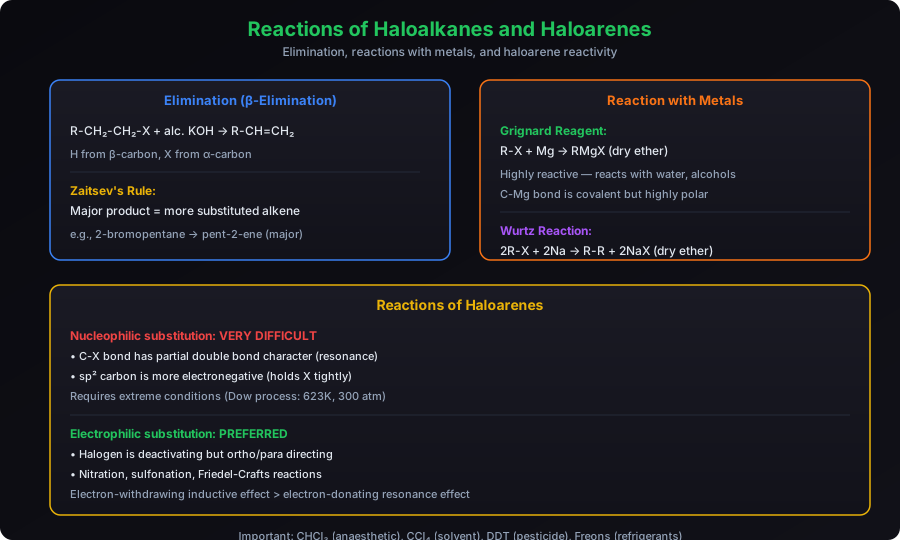
When an alkyl halide is treated with alcoholic KOH, hydrogen is eliminated from the β-carbon and the halide from the α-carbon, forming an alkene.
Example: 2-Bromopentane gives pent-2-ene (major, disubstituted) rather than pent-1-ene (minor, monosubstituted).
6.6 Reactions with Metals
Grignard Reagent
Grignard reagents are extremely reactive organometallic compounds. The C-Mg bond is covalent but highly polar, making the carbon nucleophilic. They react with water, alcohols, and many electrophiles.
Wurtz Reaction
Used to prepare symmetrical alkanes from alkyl halides. Not useful for unsymmetrical alkanes (gives mixture of products).
6.7 Reactions of Haloarenes
Nucleophilic Substitution — Very Difficult
- The C-X bond in haloarenes has partial double bond character due to resonance
- The sp² carbon is more electronegative, holding the halogen more tightly
- Requires extreme conditions: Dow process (623 K, 300 atm) for chlorobenzene
Electrophilic Substitution — Preferred
The halogen is deactivating but ortho/para directing in electrophilic aromatic substitution.
- Halogens withdraw electrons through inductive effect (−I) — deactivating
- Donate electrons through resonance (+R) — ortho/para directing
- Reactions: nitration, sulfonation, Friedel-Crafts reactions
6.8 Important Polyhalogen Compounds
| Compound | Formula | Use |
|---|---|---|
| Chloroform | CHCl₃ | Formerly used as anaesthetic; solvent |
| Carbon tetrachloride | CCl₄ | Fire extinguisher (Pyrene); solvent |
| Freons | CCl₂F₂ (CFC-12) | Refrigerants, aerosol propellants (ozone depleting) |
| DDT | (ClC₆H₄)₂CHCCl₃ | Pesticide — non-biodegradable, banned in many countries |
Summary
Haloalkanes and haloarenes are classified by the number of halogens and C-X bond type. They are prepared from alcohols, alkenes, or by halogen exchange. Nucleophilic substitution proceeds via SN2 (backside attack, inversion) or SN1 (carbocation, racemisation) mechanisms. Elimination gives alkenes following Zaitsev's rule. Grignard reagents are versatile organometallic reagents. Haloarenes resist nucleophilic substitution but undergo electrophilic substitution (ortho/para directing). Important polyhalogen compounds include chloroform, CCl₄, Freons, and DDT.