Unit 5: Coordination Compounds
Complex compounds — vital in biology, industry, and analytical chemistry
5.1 Werner's Theory
Alfred Werner (1893) proposed that metal ions exhibit two types of valences in coordination compounds:
Secondary valence: Non-ionisable, fixed for a metal, equal to coordination number
The secondary valence determines the geometry: octahedral, tetrahedral, or square planar
Werner's theory explained why CoCl₃·6NH₃ (yellow) gives 3 mol AgCl, while CoCl₃·4NH₃ (green) gives only 1 mol AgCl — the chloride ions outside the coordination sphere are ionisable, those inside are not.
5.2 Key Terms
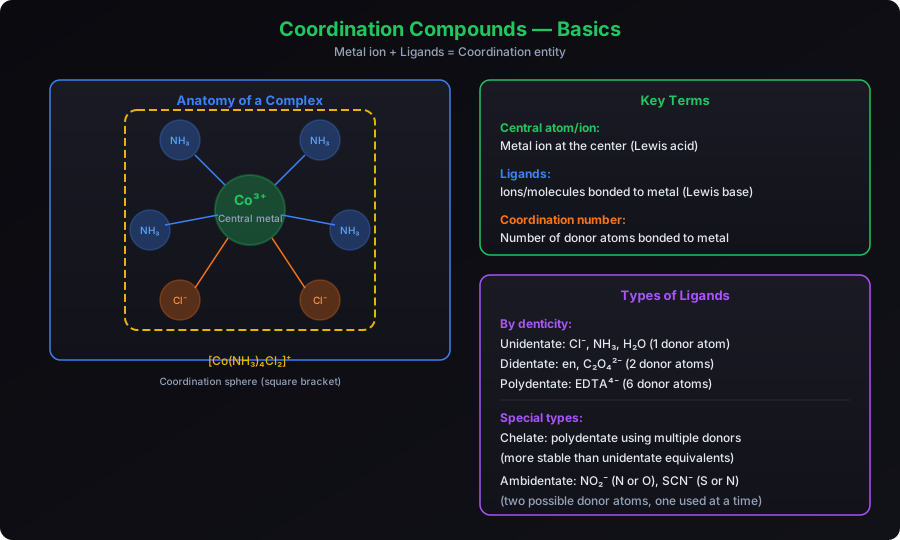
Coordination Entity
Central metal + ligands enclosed in square brackets. E.g., [Co(NH₃)₆]³⁺
Coordination Number
Number of donor atoms directly bonded to metal. Count only σ bonds.
Oxidation Number
Charge on metal if all ligands removed. E.g., Cu in [Cu(CN)₄]³⁻ → Cu(I)
Homoleptic vs Heteroleptic
Homoleptic: one kind of ligand. Heteroleptic: more than one kind.
5.3 IUPAC Nomenclature
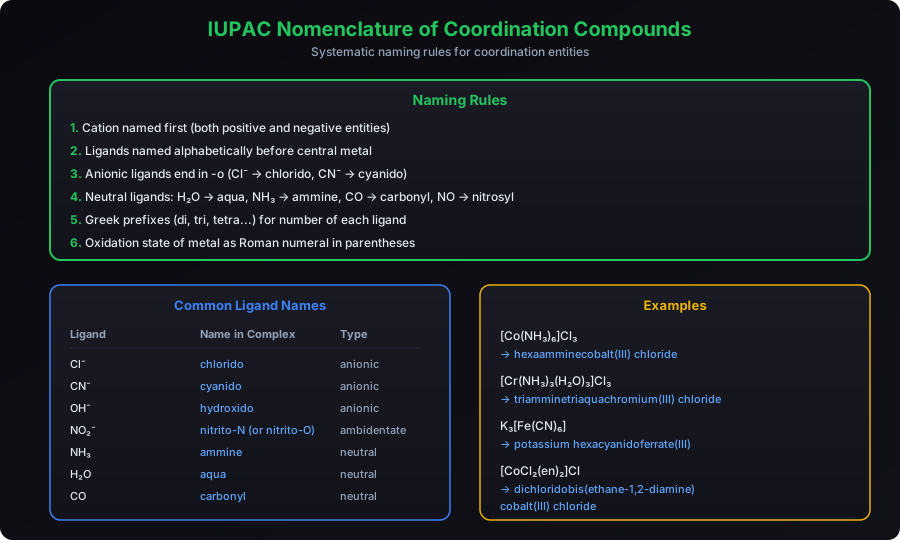
Anionic metal: suffix -ate (ferrate, cobaltate, platinate)
Special ligand names: aqua (H₂O), ammine (NH₃), carbonyl (CO), nitrosyl (NO)
Examples
K₃[Fe(CN)₆] → potassium hexacyanidoferrate(III)
[Cr(NH₃)₃(H₂O)₃]Cl₃ → triamminetriaquachromium(III) chloride
5.4 Isomerism
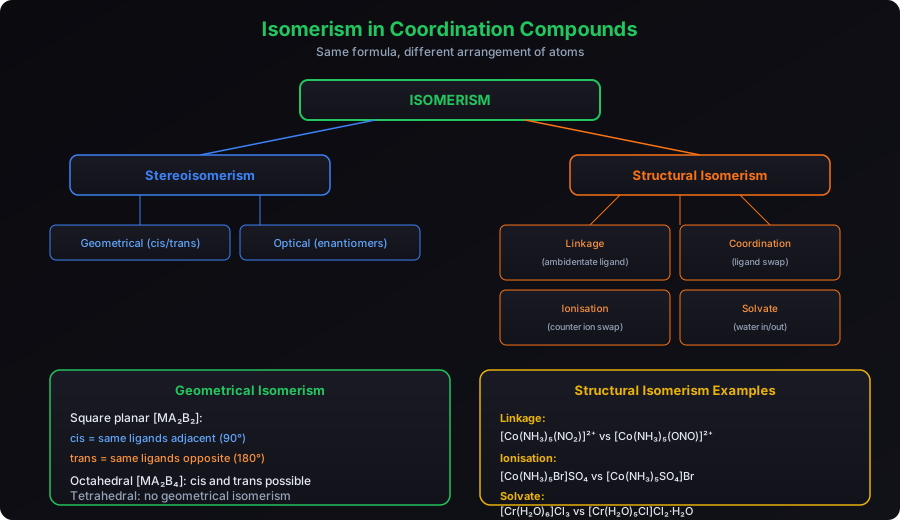
Geometrical Isomerism
- Square planar [MA₂B₂]: cis (adjacent, 90°) and trans (opposite, 180°)
- Octahedral [MA₂B₄]: cis and trans possible
- Tetrahedral: No geometrical isomerism (all positions equivalent)
Structural Isomerism
| Type | Description | Example |
|---|---|---|
| Linkage | Ambidentate ligand bonds through different atoms | [Co(NH₃)₅(NO₂)]²⁺ vs [Co(NH₃)₅(ONO)]²⁺ |
| Coordination | Ligands swap between two metal centres | [Co(NH₃)₆][Cr(CN)₆] vs [Cr(NH₃)₆][Co(CN)₆] |
| Ionisation | Counter ion swaps with ligand | [Co(NH₃)₅Br]SO₄ vs [Co(NH₃)₅SO₄]Br |
| Solvate | Water inside vs outside coordination sphere | [Cr(H₂O)₆]Cl₃ vs [Cr(H₂O)₅Cl]Cl₂·H₂O |
5.5 Valence Bond Theory
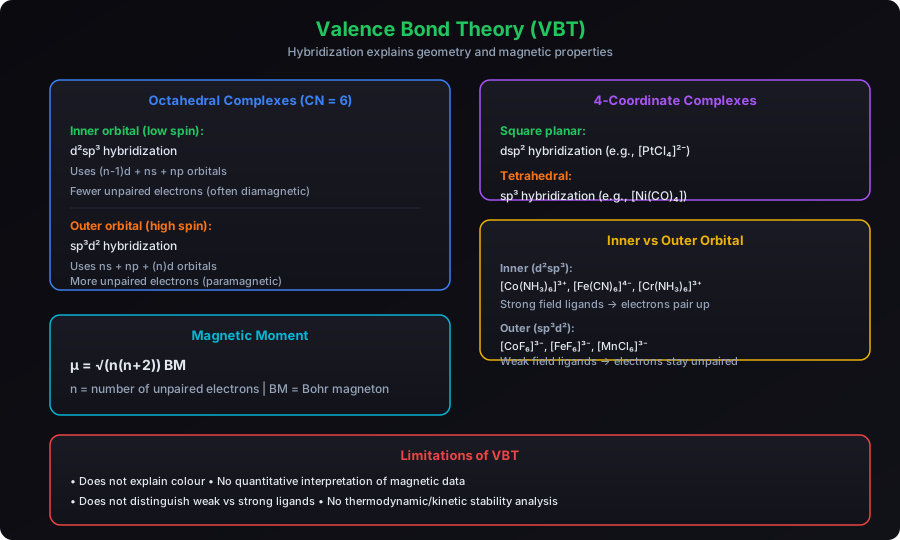
Inner orbital complexes: d²sp³ (uses inner d orbitals, low spin, strong field ligands)
Outer orbital complexes: sp³d² (uses outer d orbitals, high spin, weak field ligands)
Magnetic Moment
Where n = number of unpaired electrons, BM = Bohr magneton. Each unpaired electron contributes ~1.73 BM.
5.6 Crystal Field Theory

Octahedral: Δₒ splitting (t₂g lower, eₓ higher)
Tetrahedral: Δₜ = (4/9)Δₒ (inverted, smaller splitting)
Colour: d-d transitions absorb visible light → complementary colour observed
Spectrochemical Series
Weak field ligands (left) → small Δ → high spin complexes. Strong field ligands (right) → large Δ → low spin complexes.
Colour of Complexes
When a complex absorbs visible light, an electron is excited from t₂g to eₓ. The colour observed is complementary to the absorbed wavelength.
| Complex | Absorbed (nm) | Colour Absorbed | Colour Observed |
|---|---|---|---|
| [Ti(H₂O)₆]³⁺ | 498 | Blue-green | Violet |
| [Cu(H₂O)₄]²⁺ | 600 | Red | Blue |
| [Co(NH₃)₆]³⁺ | 475 | Blue | Yellow-orange |
Summary
Coordination compounds contain a central metal ion bonded to ligands. Werner's theory introduced primary and secondary valences. IUPAC nomenclature provides systematic naming. Isomerism (geometrical and structural) explains different forms with the same formula. VBT explains geometry and magnetism through hybridization. CFT explains colour and magnetic properties through d-orbital splitting. The spectrochemical series ranks ligands by field strength. Coordination compounds are vital in biology (chlorophyll, haemoglobin), metallurgy, catalysis, and medicine.