Unit 4: d and f Block Elements
Transition metals and inner transition metals — the chemistry of partly filled d and f orbitals
4.1 Electronic Configurations
The d-block occupies groups 3–12, where d orbitals are progressively filled. The f-block (lanthanoids and actinoids) fills 4f and 5f orbitals respectively.
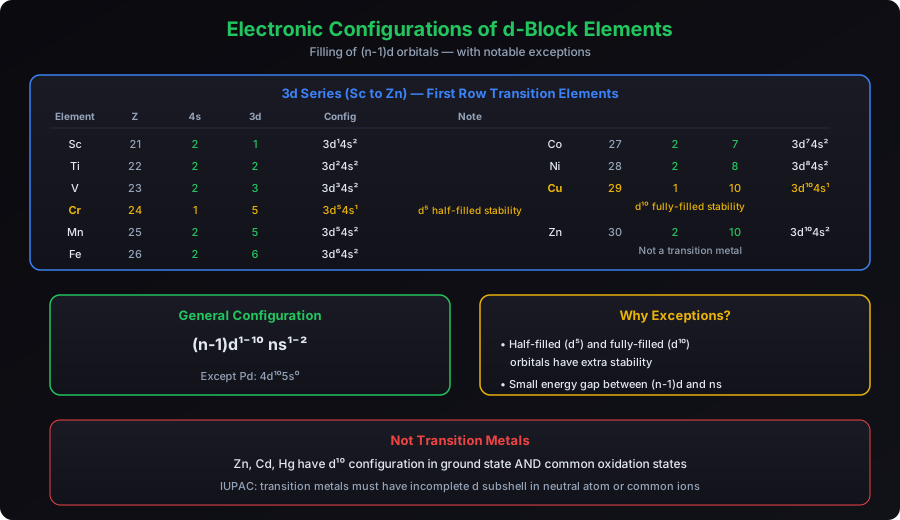
Exceptions: Cr = 3d⁵4s¹ (not 3d⁴4s²), Cu = 3d¹⁰4s¹ (not 3d⁹4s²) — due to extra stability of half-filled and fully-filled d orbitals
4.2 General Properties and Trends
Physical Properties
- Metallic character: High tensile strength, ductility, conductivity
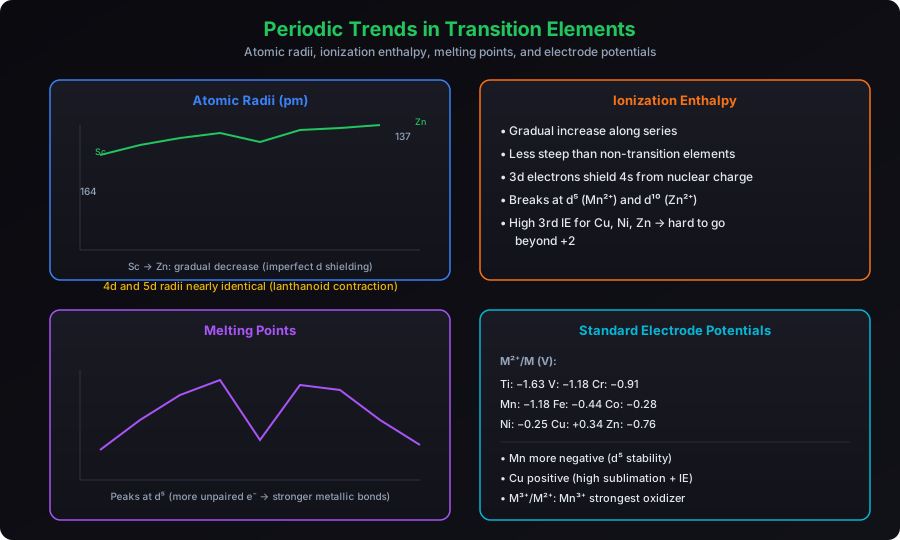
- Melting/boiling points: High, peak at d⁵ (strongest metallic bonding from unpaired d electrons)
- Atomic radii: Decrease across series (imperfect d shielding), then small increase at end
- Density: Increases across series (radius ↓, mass ↑)
Ionization Enthalpies
Gradual increase along series, but less steep than non-transition elements. The 3d electrons shield 4s from increasing nuclear charge. Breaks occur at d⁵ and d¹⁰ configurations.
Electrode Potentials
M²⁺/M values become less negative across the series (general trend). Exceptions: Mn and Zn are more negative than expected (d⁵ and d¹⁰ stability). Cu has positive E° due to high enthalpy of atomization.
4.3 Oxidation States
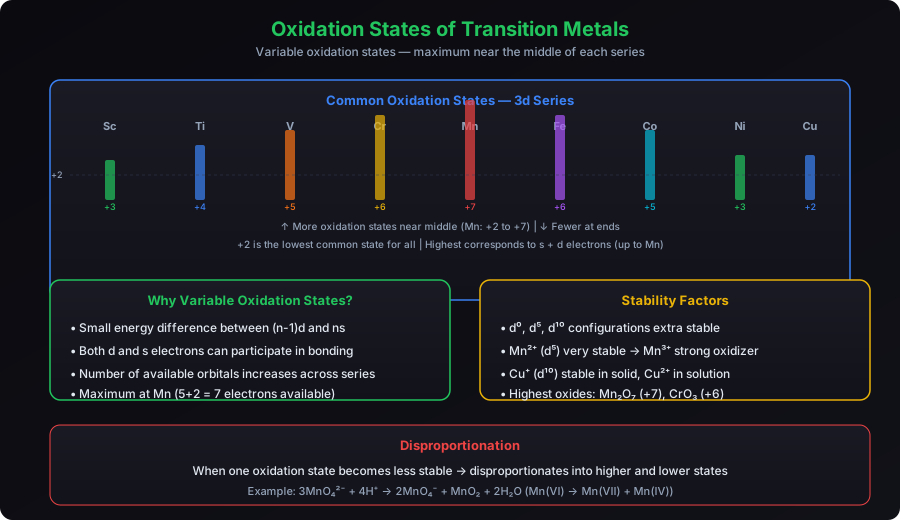
Maximum states near the middle of each series (Mn: +2 to +7). Fewer states at the extremes (Sc, Zn).
Coloured Ions
Transition metal ions are coloured due to d-d transitions. Electrons in lower d orbitals absorb visible light and jump to higher d orbitals. The colour observed is complementary to the absorbed wavelength.
| Ion | Config | Colour |
|---|---|---|
| Ti³⁺ | 3d¹ | Purple |
| V³⁺ | 3d² | Green |
| Cr³⁺ | 3d³ | Violet |
| Mn²⁺ | 3d⁵ | Pink |
| Fe²⁺ | 3d⁶ | Green |
| Fe³⁺ | 3d⁵ | Yellow |
| Cu²⁺ | 3d⁹ | Blue |
Magnetic Properties
Paramagnetism arises from unpaired d electrons. Magnetic moment is calculated using the spin-only formula:
Catalytic Properties
Transition metals and compounds are excellent catalysts due to their ability to adopt multiple oxidation states and form complexes. Examples: V₂O₅ (Contact process), Fe (Haber's process), Ni (hydrogenation).
4.4 Important Compounds
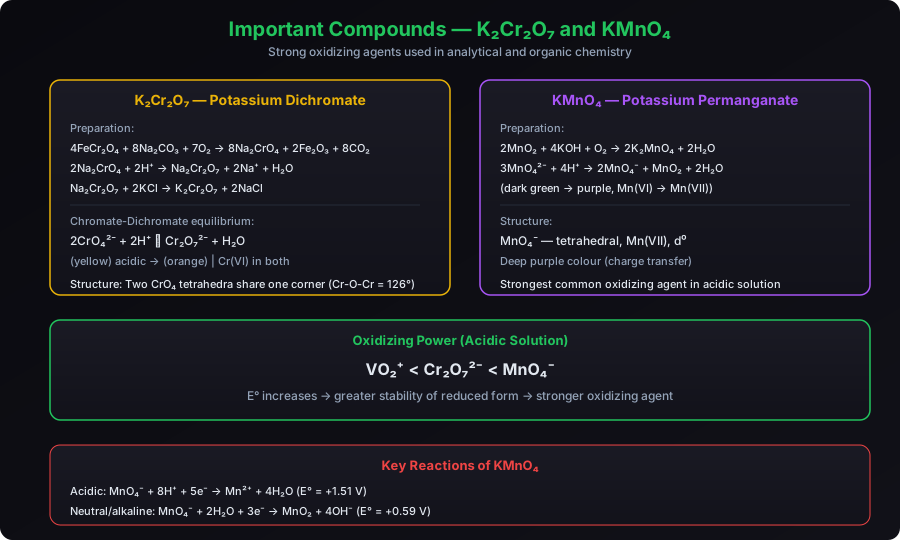
K₂Cr₂O₇ — Potassium Dichromate
Chromate-Dichromate equilibrium:
2CrO₄²⁻ + 2H⁺ ⇌ Cr₂O₇²⁻ + H₂O
(yellow, basic) ⇌ (orange, acidic)
Oxidizing action (acidic): Cr₂O₇²⁻ + 14H⁺ + 6e⁻ → 2Cr³⁺ + 7H₂O (E° = 1.33 V)
KMnO₄ — Potassium Permanganate
Oxidizing action (acidic): MnO₄⁻ + 8H⁺ + 5e⁻ → Mn²⁺ + 4H₂O (E° = +1.51 V)
Oxidizing power order: VO₂⁺ < Cr₂O₇²⁻ < MnO₄⁻
Other Properties
- Interstitial compounds: Small atoms (H, C, N) trapped in metal lattices — very hard, high melting points (e.g., TiC, Fe₃H)
- Alloy formation: Transition metals form alloys easily due to similar radii (e.g., stainless steel, brass, bronze)
4.5 Inner Transition Elements (f-Block)

Lanthanoids
| Property | Lanthanoids | Actinoids |
|---|---|---|
| Series | 4f (Ce to Lu) | 5f (Th to Lr) |
| Common oxidation state | +3 | +3 to +7 (wider range) |
| Chemical similarity | Very similar to each other | More complex, varied |
| Radioactivity | Only Pm is radioactive | All are radioactive |
| 4f/5f shielding | 4f shields poorly → contraction | 5f shields better than 4f |
Lanthanoid Contraction
Consequences:
- 4d and 5d series have nearly identical radii (Zr 160 pm ≈ Hf 159 pm)
- Zr and Hf occur together in nature — very difficult to separate
- 2nd and 3rd transition series elements have very similar properties
Actinoids
Actinoids show more variable oxidation states (+3 to +7). Their chemistry is more complicated due to radioactivity and the wider range of oxidation states. Thorium (Th), Protactinium (Pa), and Uranium (U) are important sources of nuclear energy.
Summary
The d-block elements (transition metals) have partly filled d orbitals and exhibit variable oxidation states, coloured ions, paramagnetism, catalytic activity, and complex formation. Key trends include decreasing atomic radii, increasing ionization energy, and melting points peaking at d⁵. Important compounds include K₂Cr₂O₇ and KMnO₄, both powerful oxidizing agents. The f-block contains lanthanoids (4f) and actinoids (5f). Lanthanoid contraction causes 4d and 5d elements to have nearly identical radii and similar properties.