Unit 3: Chemical Kinetics
The speed of chemical reactions — how fast reactants become products
3.1 Rate of a Chemical Reaction
Chemical kinetics is the study of reaction rates, mechanisms, and the factors that influence them. While thermodynamics tells us if a reaction is feasible, kinetics tells us how fast it proceeds.
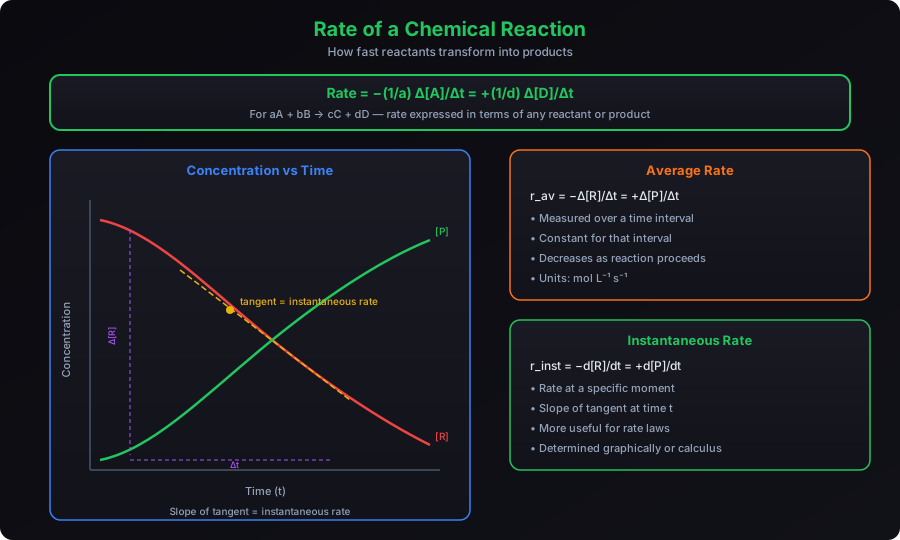
Instantaneous rate: r_inst = −d[R]/dt = +d[P]/dt
Units: mol L⁻¹ s⁻¹ (or atm s⁻¹ for gases)
For a reaction aA + bB → cC + dD, the rate is expressed as:
3.2 Rate Law and Order
The rate law expresses how rate depends on reactant concentrations. It must be determined experimentally — it cannot be predicted from the balanced equation alone.
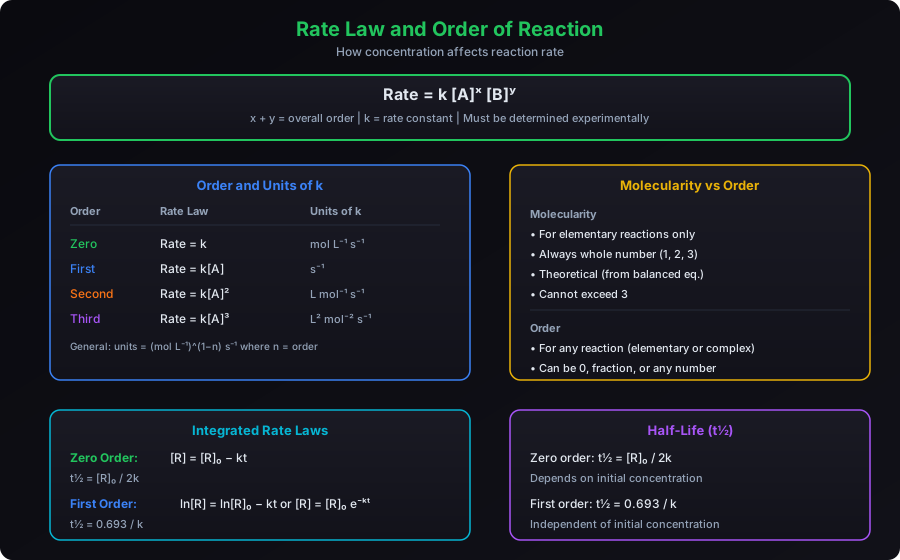
Order: x + y = overall order (experimental quantity, can be 0, fraction, or any number)
k = rate constant (specific to each reaction at a given temperature)
Example: Determining Order from Experimental Data
For 2NO(g) + O₂(g) → 2NO₂(g):
| Exp | [NO] (mol L⁻¹) | [O₂] (mol L⁻¹) | Initial Rate |
|---|---|---|---|
| 1 | 0.30 | 0.30 | 0.096 |
| 2 | 0.60 | 0.30 | 0.384 (×4 when [NO] ×2) |
| 3 | 0.30 | 0.60 | 0.192 (×2 when [O₂] ×2) |
Doubling [NO] quadruples the rate → order = 2 for NO. Doubling [O₂] doubles the rate → order = 1 for O₂.
Molecularity vs Order
| Property | Molecularity | Order |
|---|---|---|
| Applicable to | Elementary reactions only | Any reaction |
| Values | 1, 2, or 3 (never 0 or fraction) | 0, 1, 2, 3, or fraction |
| Determined by | Number of molecules in balanced equation | Experiment |
| Meaning | Simultaneous collisions required | Sum of concentration powers in rate law |
3.3 Integrated Rate Equations
Zero Order Reaction
Differential Rate Law
−d[R]/dt = k
Integrated Rate Law
[R] = [R]₀ − kt
Half-Life
t½ = [R]₀ / 2k
Zero order reactions are uncommon but occur on saturated metal surfaces and in some enzyme-catalyzed reactions. Example: decomposition of NH₃ on hot platinum.
First Order Reaction
Differential Rate Law
−d[R]/dt = k[R]
Integrated Rate Law
ln[R] = ln[R]₀ − kt
or [R] = [R]₀ e⁻ᵏᵗ
Half-Life
t½ = 0.693 / k
Pseudo First Order Reactions
When one reactant is in large excess, its concentration barely changes. The reaction appears first order even though it is technically higher order.
Rate = k [CH₃COOC₂H₅] (water in large excess → [H₂O] ≈ constant)
3.4 Temperature Dependence
Most reactions speed up with increasing temperature. For many reactions, the rate approximately doubles for every 10°C rise.

Linear form: ln k = −(Eₐ/R)(1/T) + ln A
Two temperatures: log(k₂/k₁) = Eₐ/2.303R × (T₂−T₁)/(T₁T₂)
Effect of Catalyst
A catalyst provides an alternative reaction pathway with lower activation energy. It does not change ΔG, the equilibrium constant, or the thermodynamic feasibility — it only helps the system reach equilibrium faster.
3.5 Collision Theory
According to collision theory, reactant molecules must collide with sufficient energy (≥ Eₐ) and proper orientation for a reaction to occur.
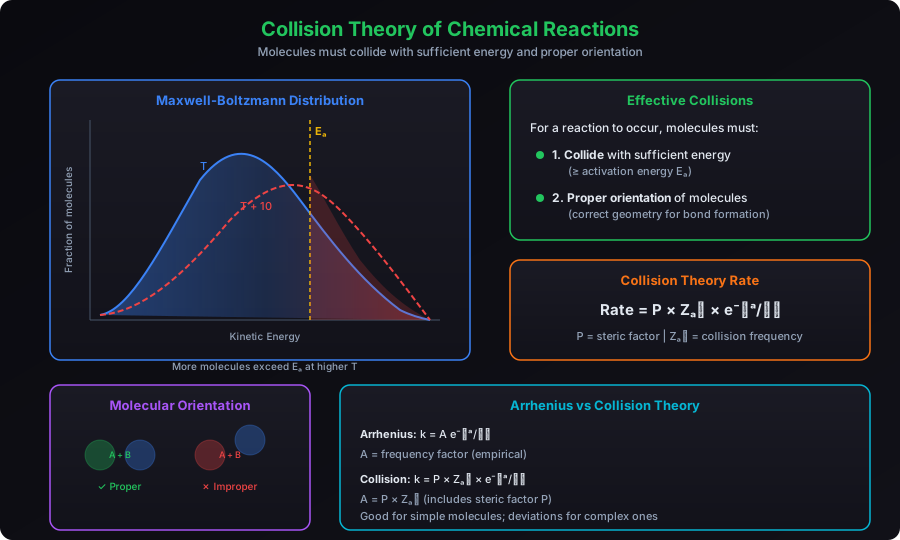
P = steric factor (orientation requirement)
Zₐᵦ = collision frequency
e⁻ᴱᵃ/ᴿᵀ = fraction of molecules with energy ≥ Eₐ
Collision theory works well for simple molecules but shows deviations for complex molecules where orientation effects (steric factor) become significant.
3.6 Factors Affecting Rate — Summary
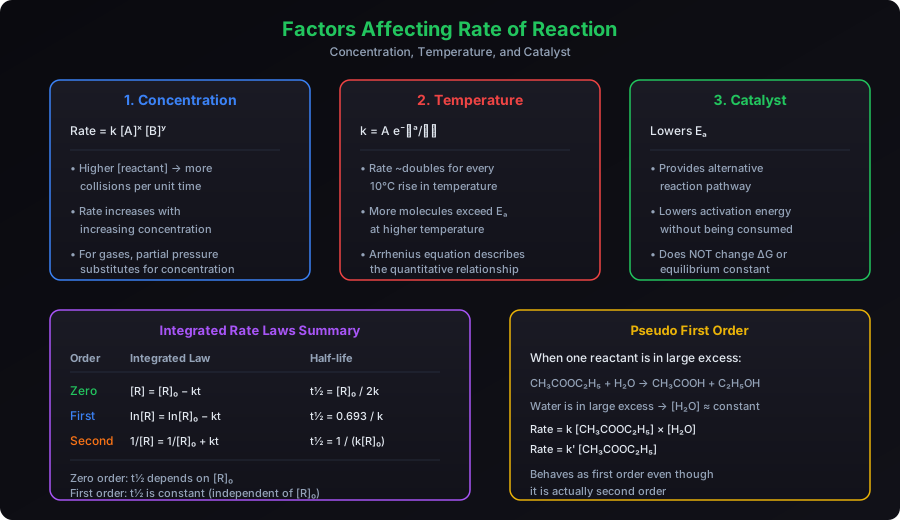
| Factor | Effect on Rate | Explanation |
|---|---|---|
| Concentration | Increases with ↑[reactant] | More collisions per unit time |
| Temperature | Increases with ↑T | More molecules exceed Eₐ |
| Catalyst | Increases rate | Lowers Eₐ via alternative path |
| Surface area | Increases with ↑ area | More exposed particles for collision |
Summary
Chemical kinetics studies reaction rates and their dependence on concentration, temperature, and catalysts. The rate law (Rate = k[A]ˣ[B]ʸ) must be determined experimentally. Order is the sum of concentration powers; molecularity applies only to elementary reactions. Integrated rate equations relate concentration to time for zero and first order reactions. The Arrhenius equation (k = Ae⁻ᴱᵃ/ᴿᵀ) describes temperature dependence. Collision theory explains that effective collisions require sufficient energy and proper orientation. Catalysts lower activation energy without being consumed.