Unit 2: Electrochemistry
The interplay between electrical energy and chemical reactions — from batteries to corrosion
2.1 Electrochemical Cells
An electrochemical cell converts chemical energy into electrical energy (galvanic) or vice versa (electrolytic). A spontaneous redox reaction drives a galvanic cell, producing an electric current.
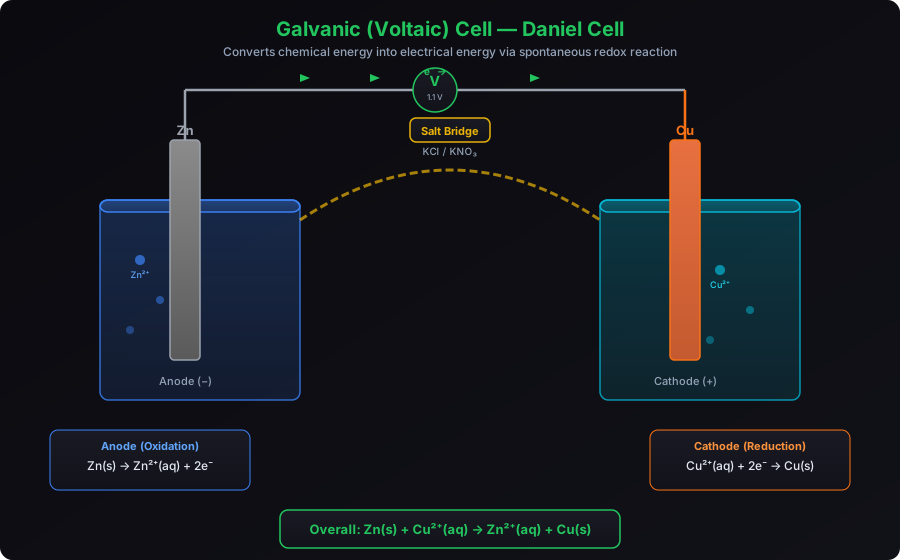
Anode (oxidation): Zn(s) → Zn²⁺(aq) + 2e⁻
Cathode (reduction): Cu²⁺(aq) + 2e⁻ → Cu(s)
Overall: Zn(s) + Cu²⁺(aq) → Zn²⁺(aq) + Cu(s) E°cell = +1.1 V
Electrode Potentials
The tendency of a electrode to lose or gain electrons is measured as electrode potential. By convention, the standard hydrogen electrode (SHE) is assigned E° = 0 V.
| Half-Reaction | E° (V) |
|---|---|
| Li⁺ + e⁻ → Li | −3.04 |
| Zn²⁺ + 2e⁻ → Zn | −0.76 |
| 2H⁺ + 2e⁻ → H₂ | 0.00 (SHE) |
| Cu²⁺ + 2e⁻ → Cu | +0.34 |
| Ag⁺ + e⁻ → Ag | +0.80 |
| F₂ + 2e⁻ → 2F⁻ | +2.87 |
More negative E° → stronger reducing agent (tendency to lose electrons)
More positive E° → stronger oxidizing agent (tendency to gain electrons)
2.2 Nernst Equation
The Nernst equation relates electrode potential to the concentration of reacting species under non-standard conditions.
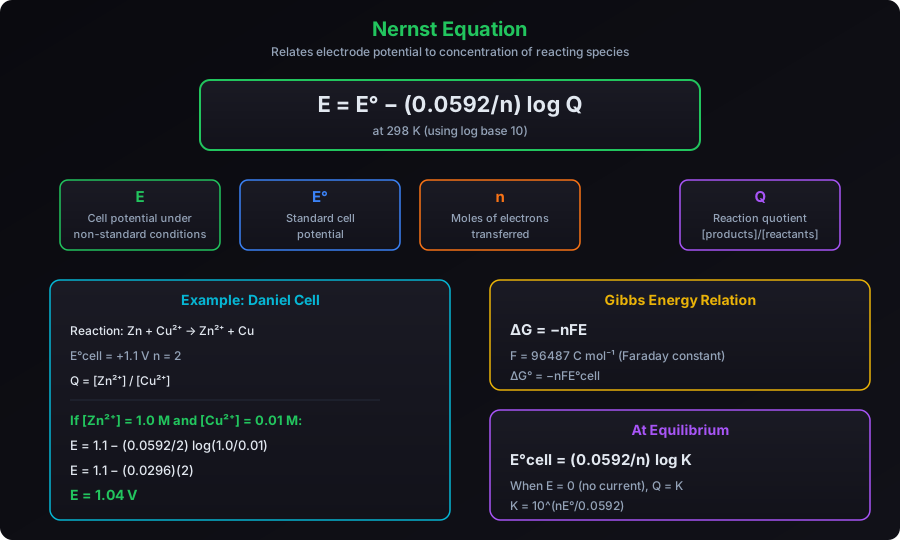
E = E° − (0.0592 / n) log Q
For the Daniel Cell:
E = E° − (0.0592/2) log([Zn²⁺] / [Cu²⁺])
Gibbs Energy and Equilibrium
Gibbs Energy
ΔG = −nFE
ΔG° = −nFE°
where F = 96487 C mol⁻¹
At Equilibrium
E = 0, Q = K
E° = (0.0592/n) log K
K = 10^(nE°/0.0592)
2.3 Conductance of Electrolytic Solutions
Unlike metallic conduction (electrons), electrolytic solutions conduct via movement of ions. The conductance depends on the nature of the electrolyte, ion size, solvent viscosity, concentration, and temperature.

Conductivity (κ)
G = 1/R = κ · A/l
SI unit: S m⁻¹
1 S cm⁻¹ = 100 S m⁻¹
Molar Conductivity (Λm)
Λm = κ / c
Units: S m² mol⁻¹
or S cm² mol⁻¹
Variation with Concentration
κ decreases on dilution
Λm increases on dilution
Λm = Λ°m − A√c (strong electrolytes)
Measurement of Conductivity
Conductivity is measured using a Wheatstone bridge with an AC source (to avoid electrolysis) and a conductivity cell (platinized Pt electrodes).
Conductivity: κ = G* / R
Known G* is determined using KCl solutions of known conductivity.
2.4 Kohlrausch Law
Kohlrausch's law of independent migration of ions states that the limiting molar conductivity of an electrolyte is the sum of the individual contributions of the anion and cation.
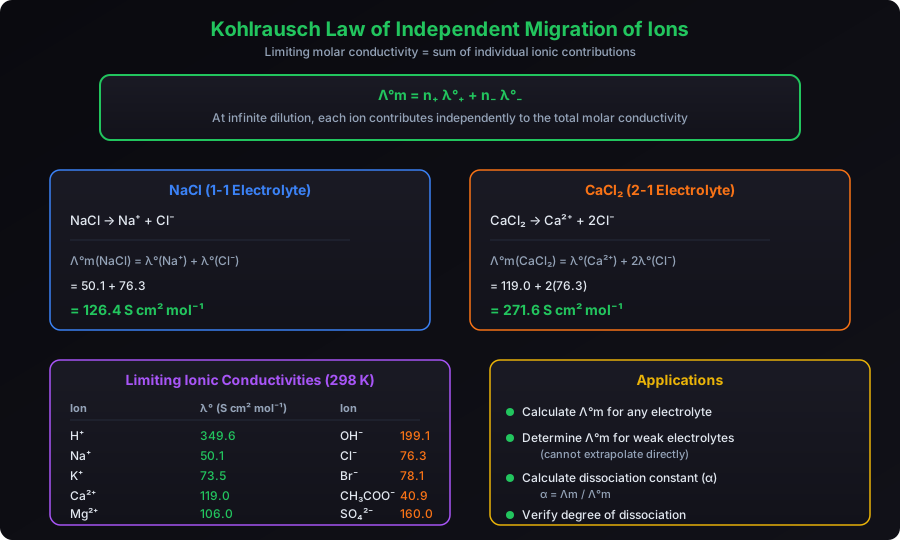
Applications:
- Calculate Λ°m for any electrolyte from ionic values
- Determine Λ°m for weak electrolytes (cannot extrapolate directly)
- Calculate dissociation constant: α = Λm / Λ°m
Dissociation Constant of Weak Electrolytes
For a weak electrolyte like acetic acid:
At infinite dilution, even weak electrolytes dissociate completely (α → 1), but conductivity becomes too low to measure. Kohlrausch law provides the alternative route to Λ°m.
2.5 Applications of Electrochemistry
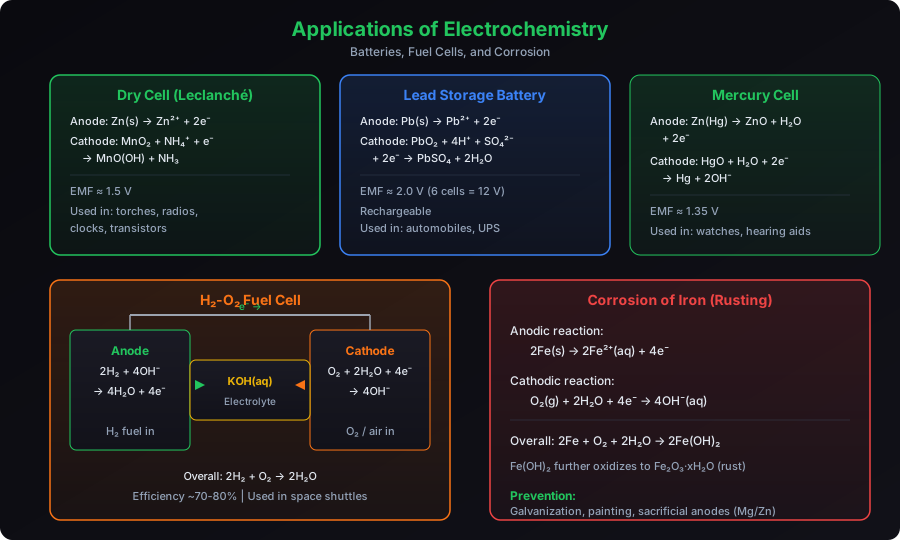
Batteries
| Battery | Anode | Cathode | EMF |
|---|---|---|---|
| Dry cell (Leclanché) | Zn | MnO₂ + NH₄⁺ | ~1.5 V |
| Lead storage | Pb | PbO₂ | ~2.0 V |
| Mercury cell | Zn(Hg) | HgO | ~1.35 V |
Fuel Cells
In a H₂-O₂ fuel cell, hydrogen and oxygen react to produce electricity. The electrolyte is aqueous KOH.
Cathode: O₂ + 2H₂O + 4e⁻ → 4OH⁻
Overall: 2H₂ + O₂ → 2H₂O
Fuel cells are highly efficient (70–80%) and are used in space shuttles and submarines.
Corrosion
Corrosion is an electrochemical process where a metal is oxidized by its environment. Iron rusting involves:
Cathode: O₂ + 2H₂O + 4e⁻ → 4OH⁻
Overall: 2Fe + O₂ + 2H₂O → 2Fe(OH)₂ → Fe₂O₃·xH₂O
- Galvanization: Coating iron with zinc
- Painting: Barrier against moisture and air
- Sacrificial anodes: Attaching more reactive metal (Mg/Zn) which corrodes instead
- Alloying: Stainless steel (Cr + Ni added to Fe)
Summary
Electrochemistry studies the interconversion of chemical and electrical energy. Galvanic cells produce electricity from spontaneous redox reactions; electrolytic cells use electricity to drive non-spontaneous reactions. The Nernst equation relates electrode potential to concentration. Conductivity and molar conductivity measure how well electrolytic solutions carry current. Kohlrausch's law allows calculation of limiting molar conductivity from individual ionic contributions. Applications include batteries, fuel cells, and corrosion prevention.